
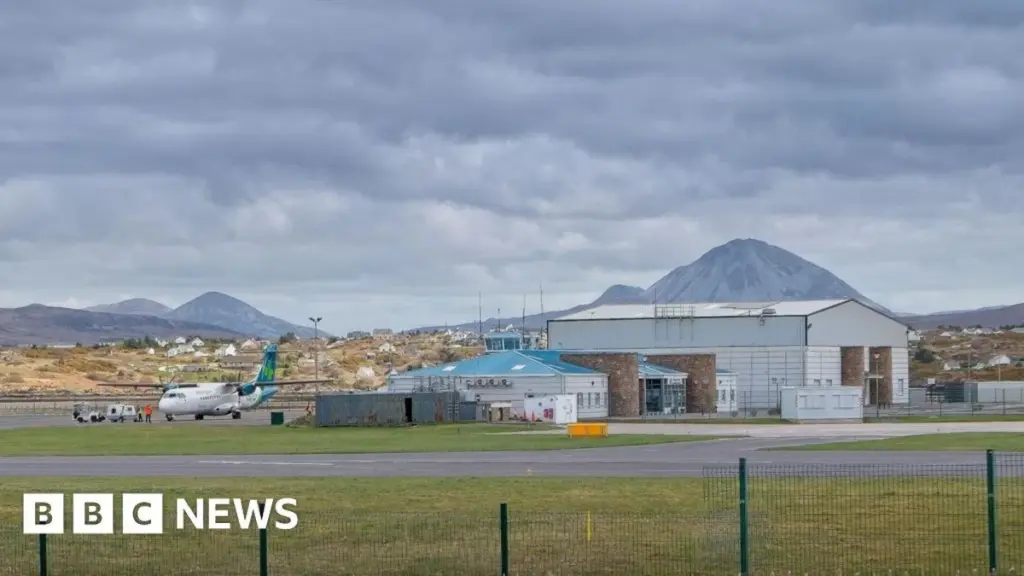
A woman from Donegal, who has been treated for ovarian cancer, has voiced her apprehension regarding proposed alterations to a crucial flight route. This route is vital for her and other cancer patients needing to access medical treatment in Dublin.
The flight service connecting Donegal and Dublin operates twice daily. Its continued operation relies on a public service obligation (PSO) subsidy from the government, a measure implemented for services that would not otherwise be commercially viable.
The current PSO contract is scheduled for renewal on February 25th. This looming deadline is fueling anxieties that proposed changes to the timetable could result in the cancellation of the afternoon return flight.
Kathleen Griffin, a patient, has warned that such modifications could impose significant burdens on cancer patients. Without same-day flights, they might face mandatory overnight stays in Dublin, incurring extra costs, or undertake arduous alternative journeys.
This particular flight route has been operational since 2004. It provides an early morning departure to Dublin and an afternoon service that returns to the airport in west Donegal later on the same day.
Emerald Airlines, a regional carrier operated by Aer Lingus, is slated to operate the PSO route until February 25th. A new procurement process is currently underway to select a new provider for the service.
Impact on Cancer Support Services
Mary Coyle, representing the charity Donegal Cancer Flights & Services, which aids in organizing these flights for cancer patients, highlighted the potential financial strain. She stated that a draft flight schedule lacking an afternoon return flight could compel patients to pay more for accommodation if immediate return travel becomes impossible.
Speaking on BBC Radio Foyle’s Mark Patterson Show, Coyle explained that her charity supports over 500 clients. A substantial number of these individuals depend on the flight service to reach specialized medical treatments unavailable in Donegal or surrounding regions.
“Our services extend beyond cancer patients,” Coyle noted. “We also assist individuals undergoing kidney transplants and children with lifelong or life-limiting conditions.”
The uncertainty surrounding the flight route’s future has prevented the charity from booking any flights beyond February 25th. This lack of clarity significantly complicates their planning and patient support efforts.
Coyle elaborated on the charity’s coordination with hospital oncology departments. This collaboration aims to secure earlier appointment slots for patients from Donegal, allowing them to return home in time for their flights.
She further detailed the strain on existing transport resources. “We utilize a car and a bus for patient transport, but these are already committed to journeys to Galway, Roscommon, Altnagelvin Hospital in Derry, Ballykelly, and Letterkenny,” she explained. “As a voluntary service with limited funding, our capacity is already stretched.”
These flights, she emphasized, are a lifeline for patients already facing considerable health challenges and financial difficulties.
Limited Patient Transport Options
Kathleen Griffin shared her personal experience, having used the Donegal flight service to travel to Dublin by air on six occasions. She was diagnosed with ovarian cancer three years ago.
“I underwent chemotherapy, and now it’s all about follow-ups to ensure the cancer doesn’t return,” Griffin stated. “My treatment is almost complete, but I still have appointments pending, including another one in Dublin.”
She underscored the existing limitations in available transport options.
Griffin recalled her initial challenge in reaching Dublin. “The first time I needed to go to Dublin, I contacted my doctor in Letterkenny and explained I couldn’t manage by car or bus. That’s when I learned about the Donegal cancer flights service.”
The journey from her home to the hospital in Dublin, including the flight, takes approximately an hour and a half to two hours. In contrast, driving would necessitate a journey of at least six hours.
“There’s no way I could have managed that in one go, given the constant pain I was experiencing,” Griffin remarked.
She concluded by saying, “People don’t truly understand the situation until they are in it. When you are unwell, the last thing you want to be concerned about is travel.”
The Department for Transport in the Republic of Ireland has been contacted for comment on this matter.