
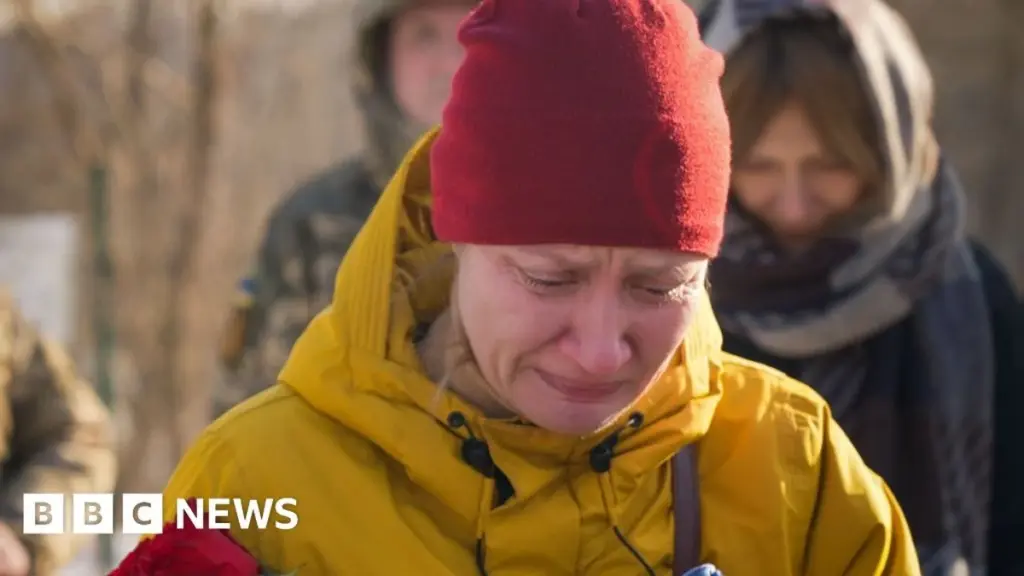
The solemn quiet of a Kyiv cemetery was punctuated by the somber cadence of a trumpet salute, followed closely by the sharp report of rifle fire. Soldiers, with practiced precision, unfurled a Ukrainian flag, draping it over a polished wooden coffin. They then stood in silent honor, their forms stark against the brilliant white snow. Amidst them, a woman’s face contorted with grief, her cries echoing the profound sorrow of the moment.
This was Natalia, laying her husband to rest for a second time. Vitaly had initially fallen three years prior, a casualty of the conflict in the eastern Donbas region. His first grave, situated in their hometown of Slovyansk, now lay perilously close to the advancing Russian forces. The escalating attacks left Natalia with an unbearable choice.
Consequently, Natalia arranged for her husband’s grave to be exhumed. Vitaly’s remains were then transported hundreds of miles across Ukraine to the nation’s capital, Kyiv. “When we buried him in Slovyansk, territory was being liberated, and we genuinely believed the war would conclude swiftly,” Natalia explained after the reburial ceremony, which was conducted with full military honors. “However, the frontline is relentlessly shifting closer, and I harbored a deep fear that Vitaly might fall under occupation.”
A Patriot’s Sacrifice
Before the full-scale Russian invasion in 2022, Vitaly was known as a ceramics artist. He volunteered to defend his country during the initial stages of the conflict. “He didn’t wish to, but he felt compelled to. He was a patriot,” Natalia recounted, her voice thick with emotion. At the time of his death, she was pregnant. Vitaly never had the opportunity to meet their daughter.
The decision to move Vitaly’s body from the land where he was both born and had fought represented an intensely difficult emotional undertaking. “It was exceptionally hard, emotionally. Yet, it was the correct decision,” Natalia stated with unwavering conviction. “It would have been far more agonizing to abandon him, to know that he had remained behind.”
The Spreading Shadow of War
Ukrainians are currently confronted with a series of unimaginable decisions as international efforts seek to broker peace between Moscow and Kyiv. Meanwhile, Russia continues its relentless advance. This includes widespread aerial assaults targeting Ukraine’s energy infrastructure, actions that flagrantly disregard established rules of war.
The most significant pressure for compromise, it appears, rests on Kyiv’s shoulders. Ultimately, US-led negotiations are expected to focus on the most contentious issue: the territorial status of the eastern Donbas region, a place for which so many lives have been sacrificed. Ukraine retains control over approximately one-fifth of this area, including Slovyansk. However, the town now sits precariously close to the active frontline, where Russian forces have been persistently attempting to advance for months.
Kyiv has proposed a cessation of hostilities without any territorial concessions. Moscow, conversely, seeks full control over the remainder of the region, a position that the United States is believed to support. This outcome, while a far cry from Vladimir Putin’s initial ambition to seize all of Ukraine – a stated aim of “denazification” and “demilitarization” – would nonetheless allow him to claim a degree of victory for Russia.
“Drones are present in the streets, striking minibuses, and glide bombs are impacting the city center, leaving behind considerable craters,” Natalia described the current reality in Slovyansk, the town where her husband was once buried. “A few months ago, attacks were a weekly occurrence. Now, they happen every few days.”
A Call for Unity
North of Natalia’s hometown, in the vicinity of the city of Kharkiv, further indications emerge of the spreading danger zone. Workmen are actively driving stakes into the frozen earth, preparing to install nets that will be stretched across roadways. These will form a canopy, intended to provide protection against Russian drones.
Not far from this scene, at an unmarked location, a workshop dedicated to Ukraine’s own Unmanned Aerial Vehicles (UAVs) was visited. Within a basement cluttered with equipment and cables, accessed via a rudimentary wooden staircase, soldiers of the Typhoon unit operate. Their mandate includes repairing drones damaged at the frontline and driving innovation. Ukraine requires every possible advantage against an adversary possessing superior manpower and resources.
The background music filling the workshop is cheerful French pop, yet the soldiers’ sentiments reveal a complex mix of emotions. “We attempt to avoid discussing it here,” stated 29-year-old Roman when questioned about the potential surrender of territory in exchange for peace. “People tend to quarrel, and we do not need that at this juncture. Our priority is unity, and to continue fighting the Russians.”
Roman has experienced significant loss, having seen “a lot of guys” fall during his two years serving in the infantry in the Donbas. It is unsurprising that recruiting volunteers has become considerably more challenging. The previous month, the country’s defense minister disclosed that an astonishing 200,000 soldiers were absent without leave.
However, mirroring the convictions of many Ukrainians, Roman remains steadfast in his belief that ceding the Donbas to Putin would not secure Ukraine’s safety. “The Russians will simply return, seeking more,” he asserted.
Defining Victory in the Face of Adversity
Hunched over a laptop in a back room, another soldier admitted that the definition of “victory” in this ongoing conflict has evolved significantly. “I would contend that our victory lies in preserving our statehood,” argued Maksym, carefully choosing his words. “Under circumstances where we might possess only three square kilometers of land, yet retain our constitution and our institutions, it remains, unequivocally, Ukraine.” He believes that soldiers must press on with the fight, irrespective of the odds. “Russia is ten times our size. Yet, we cannot surrender.”
Back in Kyiv, Natalia steadies herself, clinging to a friend’s arm as grave diggers meticulously place fresh earth onto her husband’s coffin. A wooden cross is then carefully positioned atop. A photograph of Vitaly captures him smiling, standing beside a vibrant yellow sunflower.
Natalia expresses a profound sense of relief at having her husband close once more. This proximity ensures that she and their daughter, Vitalina, can visit his grave without fear. “[She] watches videos of him, looks at photos, and she loves him very much, even though they never met,” Natalia shared, a faint smile gracing her lips. She also harbors the hope of soon informing her husband that she is pregnant, utilizing sperm that the couple had specifically preserved at a clinic just days before Vitaly’s death.
This practice has become increasingly common among soldiers before they depart for the front lines. It stands as a harsh reality, but Natalia mentioned that none of Vitaly’s soldier friends were able to attend his reburial. Tragically, many of them, too, have since perished.
Ukraine has already endured an immense toll from four years of all-out warfare. The prospect of ceding territory that Russia already occupies is a consideration now quietly accepted by many. However, Natalia cannot fathom the idea of Russia seizing additional land, including the town where she and Vitaly built their lives together and shared their love.
She holds “no doubt” that her husband would have advocated for the army to continue fighting, rather than conceding ground at this juncture. “Russia might pause for a year, then another breakthrough will occur, and they will be in Kharkiv,” Natalia stated with firm conviction. “I simply do not believe that Russia will cease its actions.”