
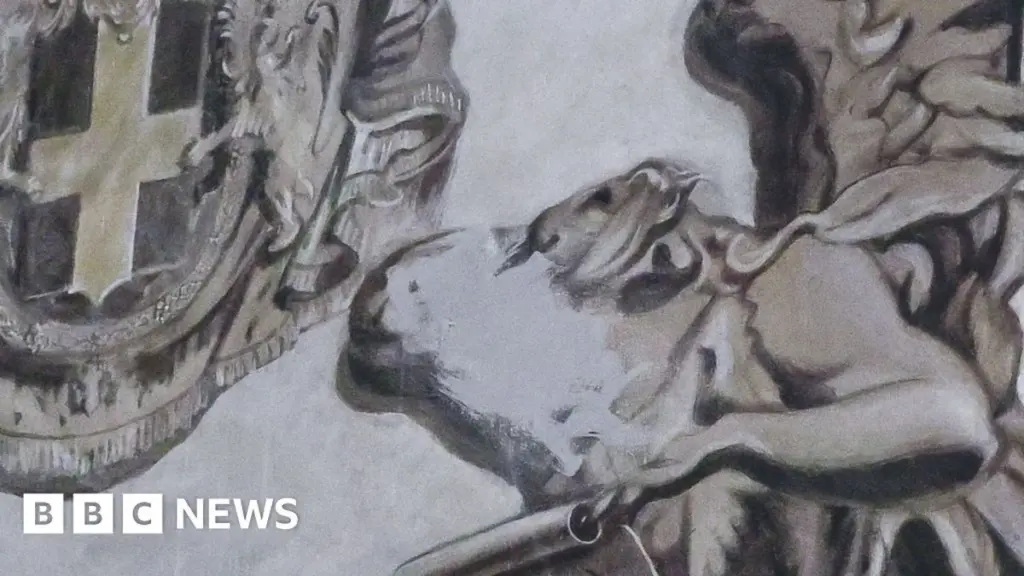
A fresco on display in a Roman church, recently restored, has drawn significant attention and controversy due to a striking resemblance between the face of an angel depicted and Italy’s Prime Minister. Following an investigation, the artist responsible has reportedly altered the fresco, obscuring the contentious facial features.
Controversy Erupts Over Uncanny Likeness
The restored fresco, located in the Basilica of St Lawrence in Lucina, features a cherub whose newly painted face bore an uncanny resemblance to the right-wing leader, Giorgia Meloni. This visual parallel ignited outrage among church and government officials, prompting an immediate inquiry into the matter.
Initially, the artist, Bruno Valentinetti, denied deliberately depicting the prime minister’s likeness. However, he later admitted to the resemblance, asserting that it was similar to the original artistic rendition. Valentinetti, aged 83, stated that he was instructed by the Vatican to cover the painting.
Restoration Efforts and Official Response
The office of the Diocese of Rome announced on Wednesday that the original facial features of the fresco would be reinstated. This decision followed a sternly worded statement from Cardinal Baldassare Reina of Rome, who expressed his “disappointment over what happened.” Cardinal Reina emphasized that “images of sacred art and Christian tradition cannot be misused or exploited.”
The Basilica of St Lawrence, situated a short distance from Prime Minister Meloni’s office in central Rome, experienced a surge in visitors. Many curious individuals arrived, reportedly more interested in viewing the fresco and taking photographs than in prayer.
The basilica’s priest, Reverend Daniele Michelett, shared that he had not initially noticed the resemblance to the prime minister when the restoration was completed. However, he conceded that the depiction did not “conform to the original iconography and sacred context” of the church.
Historical Context and Recent Alterations
The Basilica of San Lorenzo in Lucina stands as one of Rome’s oldest churches, housing artworks by renowned Baroque masters such as Gian Lorenzo Bernini and Guido Reni. The fresco in question, however, was not an ancient piece; it was painted in the year 2000 and was not a protected heritage item.
This particular wall painting is situated in a chapel dedicated to Umberto II, Italy’s last king. The fresco depicts a cherub holding a map of Italy.
Bruno Valentinetti was the original artist commissioned for the work. Reverend Micheletti explained that Valentinetti was later asked to restore the artwork following damage caused by water.
Future Restoration Protocols
The governmental agency responsible for the preservation of Rome’s cultural heritage has formally notified the church. Henceforth, any future restoration projects will necessitate official authorization and the submission of a detailed sketch of the proposed imagery.
The BBC has reached out to the Vatican for an official comment on the situation.