
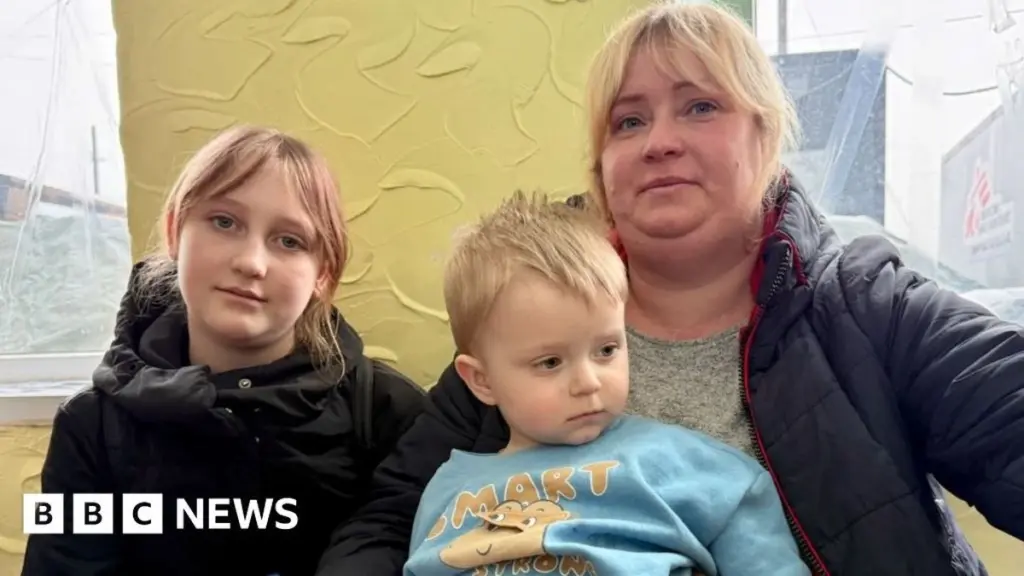
Yulia Hailunas finds the biting cold inside her home more challenging than the sporadic electricity outages following Russian airstrikes. Like many across Ukraine, she has lived without central heating since January, when Russia initiated a series of targeted attacks on the nation’s power infrastructure.
To cope, Yulia now resides in her apartment dressed in a long, quilted coat and hat. She places her feet in a saucepan filled with hot water to ward off freezing. If this proves insufficient, she resorts to lifting weights for ten minutes to generate body heat.
Temperatures slightly above zero are merely bearable. However, forecasts indicate that later this weekend, Dnipro could experience a plunge below -20°C. In Kyiv and other regions, the mercury might drop even lower.
“That’s the genuinely frightening prospect,” Yulia expressed concern. “The heating pipes will inevitably burst, and we won’t be able to repair them. It’s poised to be a catastrophe.”
On Thursday, a statement emerged that Donald Trump had secured an agreement with Vladimir Putin to cease attacks on Ukraine’s major cities during the exceptionally cold weather, purportedly for a single week. The US president described his Russian counterpart’s agreement to an energy truce as a “very nice” gesture. However, details surrounding this understanding remained notably scarce from its inception.
The following day, the Kremlin offered a clarification, stating that Putin’s period of goodwill would conclude on Sunday, coinciding with the onset of the coldest temperatures. Given that significant aerial attacks typically have intervals of a week or more between them, it is uncertain whether Russia has genuinely altered its actions at all.
No major strikes have been recorded since January 24th, an incident that left hundreds of residential buildings in Kyiv without power and heating. “It has been quieter for a brief period, but I’m not sure if that’s connected,” Yulia remarked with noticeable doubt, harboring the suspicion that strikes could resume at any moment.
“I believe Putin aims to turn people against their government, to prompt them to say: ‘Just give Russia anything to make this stop’,” Yulia speculated. “His intention is to break us, but that will not succeed.”
Despite such sentiments, Ukraine’s heating infrastructure is showing signs of deterioration. The Geneva Conventions, governing the laws of war, prohibit attacks on infrastructure that inflict excessive harm on civilian populations. Nevertheless, this marks the fourth consecutive winter where Russia has deliberately targeted the energy grid, leaving it increasingly fragile and more difficult to mend after each subsequent assault.
Engineers have been brought in from Ukraine’s national rail company and other organizations. They are working around the clock, striving to restore electricity, as well as to thaw and patch the vital heating pipes that traverse beneath the large apartment blocks in Dnipro, Kyiv, and surrounding areas.
An extended pause in attacks on this sector would offer a much-needed respite. However, few Ukrainians place their trust in Russia to uphold such a commitment. This skepticism stems from the fact that deadly strikes have continued elsewhere. On Friday, one individual was killed and several others sustained injuries when a bus in Kherson was struck by shelling. Simultaneously, multiple air raid alerts were issued concerning drone activity.
Along the entire eastern front, combat remains as intense as ever, compelling civilians to abandon their homes. In Pavlohrad, located approximately 40 miles from the front lines, families were observed in a state of shock after their evacuation. They had left everything behind, with no certainty of ever returning to their residences. These families were in queues to register at a center for displaced persons, where volunteers provided them with a small allocation of cash, food, and toiletries.
Kateryna tearfully recounted the difficulty of leaving Vasylkivka, the place she had called home her entire life. “It feels like abandoning a part of yourself,” she stated. However, she felt compelled to protect her two young children, who were terrified by the explosions. “Our village was untouched at first, but now it has become a total combat zone. Drones are striking every day,” her mother, Iryna, described the Russian advance. “One day, there were 50 Shahed drones overhead.”
Trump views the energy truce—a cessation of massive aerial assaults on Ukraine’s major cities—as a means to de-escalate tensions while he advocates for progress in peace negotiations. He had long pledged to end the conflict “in a day,” but now acknowledges the considerable difficulty involved in such an undertaking.
Ukraine has reportedly agreed to reciprocate Moscow’s actions by halting its own strikes on oil refineries within Russia, as well as on its clandestine fleet of tankers used to transport Russian oil internationally, thereby circumventing sanctions. This trade route funnels significant revenue into Russia’s war economy. Kyiv’s willingness to make this concession aims to demonstrate its cooperation with Trump’s peace initiatives.
Another round of negotiations is scheduled to take place in the United Arab Emirates on Sunday. However, it appears that no senior US delegates will be in attendance. The US has been publicly highlighting progress in discussions, and Ukraine also claims that only one major point of contention remains—though it is a critical one, concerning territorial control in the east.
Conversely, Russian officials have been tempering expectations regarding a potential agreement. “Of course, we are following the talks; we desire some stability,” Iryna conveyed, emphasizing that people in Ukraine yearn for peace perhaps more than anyone. “But how can we trust Russia not to stab us in the back?”
From the darkness and biting cold of this conflict, it does seem to many Ukrainians as though Moscow is merely playing games with Trump. The coming days and weeks will serve as a crucial test of these dynamics.