
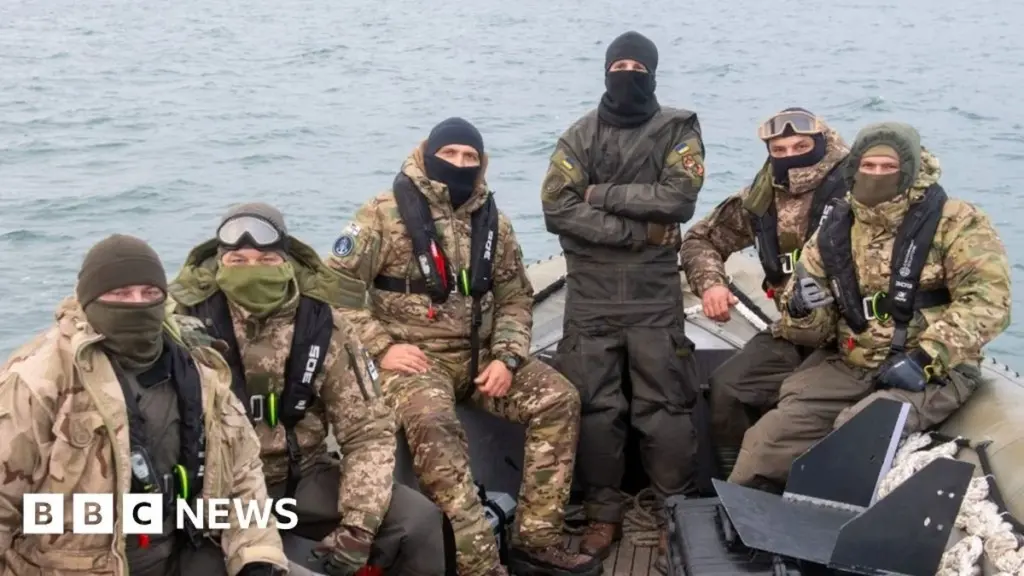
A single misstep can jeopardize everything. This is the stark reality faced by the individuals tasked with neutralizing deadly Russian mines lurking beneath the Black Sea’s surface.
The Black Sea is a vast repository of dangerous weaponry. However, the precise number of these mines and their exact locations remain unknown.
“When we approach it, we should be quiet, we should be slow – and we should be very accurate,” explains Vitalii, a 31-year-old Ukrainian Navy diver. His hand traces a serpentine motion as he describes the delicate procedure of navigating dark waters towards explosive devices submerged on the seabed.
Vitalii is part of a dedicated team of 20 personnel responsible for de-mining the sections of the Black Sea currently under Ukrainian control. This mission is fraught with inherent danger.
Sea mines represent some of the most treacherous and enduring legacies of warfare. They retain their lethal capability for decades. Those deployed at sea introduce additional risks, as they possess the capacity to drift unpredictably with oceanic currents and storms.
The sea mines initially deployed by Moscow at the commencement of the full-scale invasion, particularly when Russian vessels approached Odesa, are no exception to this danger. The threat is not abstract; evidence of its reality emerged last summer when three swimmers tragically lost their lives to mines off the Odesa coast.
The commander of the navy’s mine countermeasures group, known by the callsign Fox, a sharp-eyed and seasoned young officer, estimates that the number of sea mines in the region reaches into the thousands. This figure, however, does not encompass the entirety of the underwater threat.
A Multifaceted Underwater Menace
Beyond mines, the seabed is also strewn with a variety of other explosive hazards. The catastrophic destruction of the Kakhovka dam in 2022 resulted in a deluge of missiles, artillery shells, bombs, and landmines being washed into the sea. These items, too, pose an immediate risk of detonation.
“If we speak about unexploded ordnance in general – missiles, artillery shells, aerial bombs – the total number will be many times higher” than several thousand, Fox clarifies. This indicates a significantly larger scale of contamination than initially suggested by the mine count alone.
The operational scope of Fox’s team is as critical as it is perilous. Despite this extensive contamination threat, maritime traffic within the region has not ceased entirely. A substantial number of merchant vessels continue to operate, utilizing the sole maritime export corridor available to Ukraine.
For Ukraine, the extensive effort to clear the seabed is integral to a broader strategic objective: maintaining the functionality of its Black Sea ports. This is particularly crucial for commercial shipping, which serves as a vital conduit for much-needed revenue.
Shifting Tides in Maritime Warfare
While Russian forces maintain a significant advantage on land, the dynamics at sea present a different picture. Ukraine has managed to establish a degree of parity in the maritime domain.
Dmytro Pletenchuk, a Ukrainian Navy spokesman, observes this shift from a café overlooking the Gulf of Odesa. “There is parity in the maritime domain at the moment,” he states, gesturing towards the sea. “We find new ways to strike them; they look for ways to counter us. What works today will not work tomorrow – on both sides. They adopt our experience; we adopt theirs.”
Ukrainian naval vessels are primarily restricted to the waters surrounding Odesa due to Russia’s substantial control over much of the coastline. Concurrently, Moscow appears to have concluded that repositioning its naval assets from many Black Sea bases carries too great a risk, exposing them to potential Ukrainian aerial strikes.
An example of this strategic adjustment occurred in 2024 when Russia withdrew its final remaining patrol ship from occupied Crimea.
“While Russia may have an advantage on land and in the air, it does not at sea,” Pletenchuk elaborates. “Here, Russia’s main tactic – mass – does not work.” He emphasizes that naval warfare is inherently technological, precluding the effectiveness of overwhelming force in the manner seen with ground troop deployments, a tactic he refers to as utilizing “meat.”
This stalemate at sea has been instrumental in sustaining Ukraine’s sea exports, including the crucial operation of a grain corridor. Maritime exports constitute over two-thirds of Ukraine’s agricultural exports, a sector reportedly generating approximately $9 billion annually. This trade represents a fundamental source of income for the nation.
Despite the persistent threat of aerial attacks, vessels continue to navigate these waters. “Judging by the fact that vessel traffic has not decreased, [commercial companies] are willing to take these risks,” Pletenchuk notes, indicating two large ships moving across the horizon.
The Intricate Process of Underwater Clearance
Ensuring the ongoing viability of these shipping routes now crucially depends on neutralizing the submerged threat of mines and unexploded ordnance. These devices serve as a passive yet potent tool for Russia to disrupt maritime traffic, even without complete control of the Black Sea.
This is precisely the domain of divers like Vitalii. “We move carefully and extremely slowly so that the mine does not detonate,” Vitalii explains, detailing the painstaking nature of his work. “One second you move, then you stay still for some time, and you repeat this until you reach the object. Generally, it’s up to 20 meters before [we reach] the object, so you can try to imagine how long it takes to approach it.”
Before any underwater de-mining operation can commence, Vitalii’s team must first identify the target. The seabed is not solely populated by Russian mines; it also bears remnants of World War Two unexploded bombs and various other ordnance.
Commander Fox categorizes mines into two primary types: contact mines, which detonate upon impact, and influence mines, which are triggered by sensors detecting alterations in sound, pressure, or magnetism. “Usually, the acoustic sensor is on duty,” he states. “If it hears noise, it can activate another sensor.”
Large commercial vessels are particularly susceptible to magnetic mines. These devices are designed to detonate when a ship’s magnetic field is detected. “The mine lies on the bottom and explodes when a big vessel approaches,” Fox explains, simulating the magnetic attraction. “Until that moment, it just waits.”
The de-mining operation itself is conducted by pairs of divers using specialized closed-circuit rebreathers to avoid creating bubbles. Once a mine is identified, its detonation is typically scheduled for the following day. The initial step involves disabling the mine’s sensors, often achieved through a series of controlled explosions initiated from a distance of approximately 10 meters.
Subsequent to sensor neutralization, divers can approach the device. The ultimate determination of whether to relocate the mine or destroy it in situ is made by headquarters. This complex operation demands two days, the deployment of several boats, and the coordinated efforts of 20 individuals. All of this unfolds under the persistent threat of Russian missile and drone attacks, which could inadvertently trigger the very mines being cleared.
During aerial assaults, GPS signals are frequently jammed, compromising the accuracy of sonar readings. While de-mining the sea is technically feasible, undertaking such operations amidst active combat significantly escalates the inherent risks. “Everything can go wrong,” Fox emphasizes.
Unexpected Encounters and Long-Term Prospects
Vitalii recalls a particular instance where, while approaching a mine using sonar, another object appeared on his screen, moving slowly through the darkness. His immediate concern was that it might be a Russian underwater drone, potentially triggering the mine. However, upon closer inspection, he realized it was a pod of four or five dolphins swimming by. “Beautiful, yes,” he muses, his eyes widening slightly, “But not at that moment.”
According to Pletenchuk, the de-mining group successfully neutralized over 50 mines in 2025, representing a fraction of the total estimated number. The British Navy provided Ukraine with two mine-hunting vessels in 2023, a donation intended to expedite the clearance process. However, due to the vulnerability of large ships in the Black Sea to attack, these vessels remain stationed in the UK and are unlikely to be deployed until a ceasefire is agreed upon – a prospect that still appears distant.
Under the current circumstances, Vitalii estimates that clearing the seabed will be a multi-decade undertaking. Despite the substantial risks involved, the revenue generated from maritime exports will only grow in importance for Ukraine as the conflict persists. Consequently, divers like Vitalii will continue to venture into the water, advancing one second at a time, followed by extended periods of cautious waiting.