
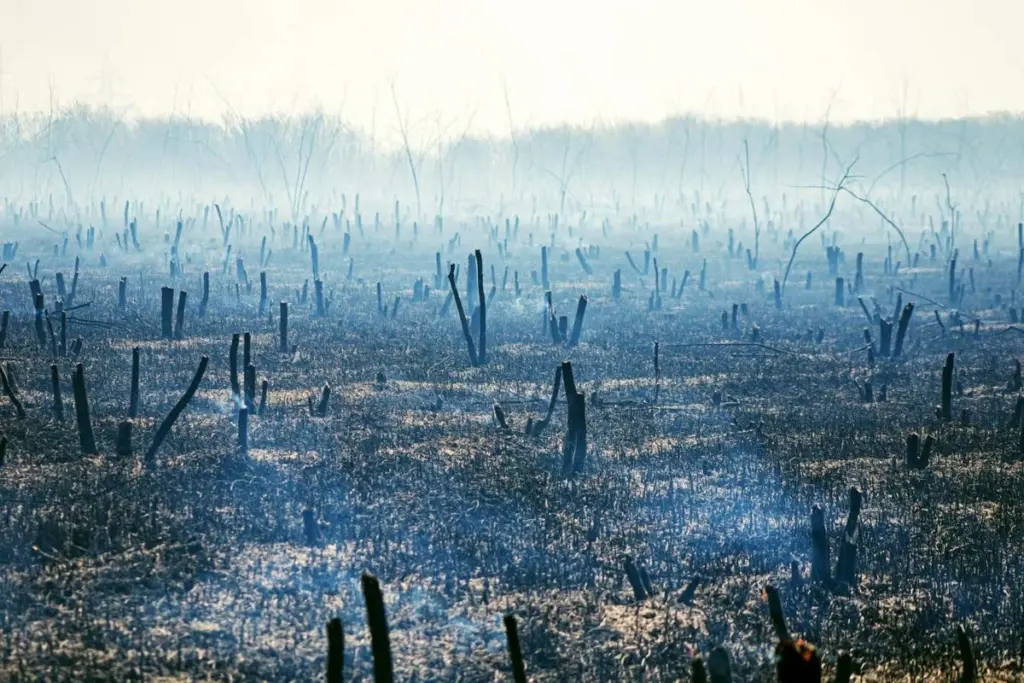
The vehicle continues its journey until the first glimmer of dawn. The drive concludes only when the flat expanse transforms into a desolate black landscape, with nothing but cinders and ash stretching between the present and the distant horizon.
Pulling over, the sidescreen is retracted. The air, blessedly still under the southern sky this morning, offers the sole piece of good fortune encountered in days. The driver is acutely aware of the destructive power of wind over an old fireground; in a gale, ash can overwhelm the lungs within minutes. The memory of comrades who drowned on their feet, amidst windrows of fallen bodies, remains vivid.
A scarf is wrapped over the nose and mouth, and protective glasses are hung around the neck. The door opens cautiously, and the driver steps out, testing the surface with deliberate care. The ground is ankle-deep, at worst reaching the shins. The only sound breaking the silence is the hum of the vehicle’s motors.
The driver calls out, “Stay there.” Although the child, slumped in the corner of the cab, is clearly awake, she does not move. A careful, gingerly walk back leads to a check of the trailer. Everything remains secured as it should be: the generator, water, pods, and implements. The rigors of the journey have, however, left the driver’s green provisions in disarray. While the more leafy edibles show signs of windburn, the overall losses appear manageable.
A tap on the reservoir confirms it is sufficient to fill a flask. With the glasses on, the driver scans the western approaches. There are no plumes of smoke, no signs of movement. The immediate area is clear.
Efforts to wipe the dust from the solar panels and films prove futile. It is understood that within a short time, every generating surface will again be coated in ash. The immediate objective is to allow the turbines to produce just enough power to traverse the remaining distance.
Returning to the cab, the driver thumps their boot heels on the step and climbs back in. The child has not moved. The mingled relief and vexation this causes are beyond immediate explanation.
“We’re okay,” the driver reassures. “We’ll make it.”
The child gazes out over the desolated land. “This place,” the driver begins, “it was all trees once. I flew across it when I was young.”
The child blinks, offering no discernible emotion. The driver continues, “It went on and on. Trees beneath us for hours. The smell – you just wanted to eat the air.”
Silence persists. “Have you flown?” the driver inquires. “I know you’ve been at sea. Just wondered if you’d been up in a stat.”
The child shifts, tilting her head against the sidescreen. “It’s really something,” is the quiet reply.
There is no sign of further interest. The child settles back, leaving a streak of sun-block paste on the glass.
“But just once,” the driver states, “I would’ve liked to fly for the sake of it, not because I was on my way to somewhere horrible.”
The sun appears, molten and slumped at its edges, liquefying before them like a burning blimp. As it ascends, it breaks free of all comparisons, becoming its unmistakable self – something both reassuring and, in its starkness, terrible.
“I talk too much,” the driver declares. “And you? You never say a word. Once upon a time I never said enough. So I was told.”
No response is offered. “I know you hear me. You follow my language.”
The child rubs at the glass, managing to spread more grease than she removes.
“Listen,” the driver says. “Those men back there, we lost them. No one’s coming for us. This morning we need to get across this ash. It won’t be pleasant. But on the other side there’ll be fresh country. We’ll move and camp the way we did before. Okay? Until we find ourselves a situation. There’ll be somewhere. We’ll be alright.”
The child turns her head further away. When the driver takes the scarf and tears a long hank from it, she turns back at the sound. The remainder of the fabric is pulled across the driver’s nose and mouth and bound around the hat’s brim. Despite a flinch, the child offers no resistance when the same is done for her. Dried blood still marks her brow from where she struck herself against the dashboard. Her pale blue eyes appear more luminous above the makeshift mask.
“There,” the driver says. “Cuts the stink a bit anyway. One day we’ll scrub this cab out. And you won’t just be watching, believe me. So. You set? There’s water here. We’ll eat on the other side.”
The sidescreen is lifted, and the vehicle is set into motion. It trundles forward, just fast enough to make progress, yet slow enough to avoid kicking up a blizzard of ash.
The journey continues for hours, over land as black as the night sky, across a fallen ethereal expanse speckled with eruptions of white ash and streaks of milky soot.
The vehicle sways and struggles but carries on until its reserve power is depleted. Then, as the midday sun pierces through the haze, new colors emerge – tan, silver, khaki, bone. The surge of relief that washes over the driver is nearly overwhelming.
Upon reaching the first patch of solid ground, the child is allowed out to relieve herself. She seems invigorated by this newfound freedom. However, once finished, she balks at being hurried back into the vehicle so quickly. The driver refrains from using force but corrals her, speaking sharply. Exhaustion has set in, and the driver admits to still being inept in this role. The urgent need is to create distance between them and the fireground.
Consequently, as they finally move off, the atmosphere within the cab is subdued, a fact the driver regrets. Soon, though, there is cause for relief when, as the batteries finally give out, a strong gust from the south arrives, causing the entire rig to shudder on its axles.
The driver climbs down stiffly. The child also exits. A pointing finger directs attention to the dirty pillars rising into the sky in the distance behind them.
“Look,” the driver says. “We could have been in the middle of that. But we’re out and upwind, see? That’s not just a lucky escape. That’s us being smart.”
The sunshade is cranked out, and the solar array is deployed.
The child watches as the ash clouds twist northward. As the wind intensifies, they churn against one another. Then, she follows the driver to the trailer. She observes as rations of mash are distributed and accepts a dixie and spoon. Kneeling, with her back to the wind, she swathes away the skirts of her hat and eats, her hunger evident.
“We can’t just be lucky,” the driver states. “You and me, we have to stay sharp.”
She is already licking her mess tin clean. The driver takes it from her, offers their own, and while she eats, begins to unlash their swag and roll it out beside the vehicle. Next, the driver unpacks the improvised bedroll for the child, unfurling it near their own. Not so close as to cause anxiety, but close enough to maintain a watchful presence.
“We’re all out of push,” the driver says. “Machine and creatures alike. So let’s sleep.”
She shovels the last of the mash into her mouth, licks the driver’s dixie clean, and the spoon as well. She rises, places both back on the trailer, and returns to sit cross-legged on her swag. Her gaze is fixed eastward, the tail of her hat stirred by the wind.
“Suit yourself,” the driver responds. And then the driver is gone. Out.
Sometime in the afternoon, a faint keening sound awakens the driver. For a fleeting moment, the illusion of being home arises, reminiscent of an ailing hen downstairs, the entire flock threatened by contagion, a catastrophe within the compound. The instinct is to rise, to go directly to the growhouse. Yet, upon opening their eyes, only the awning shimmers in the wind overhead. The driver is here, on the dirt, far south of home. It is the child, her face smeared with tears, weeping. For the woman, the driver imagines, and for countless other lost things.
A reach is extended towards her, but she draws back with a wince. The driver refrains and yields, once more, to sleep.
When wakefulness returns, the shadows cast by the vehicle and its trailer are long, like safety ropes. The waif continues to kip. The driver climbs up, sore and creaky, preparing to set them underway again.