
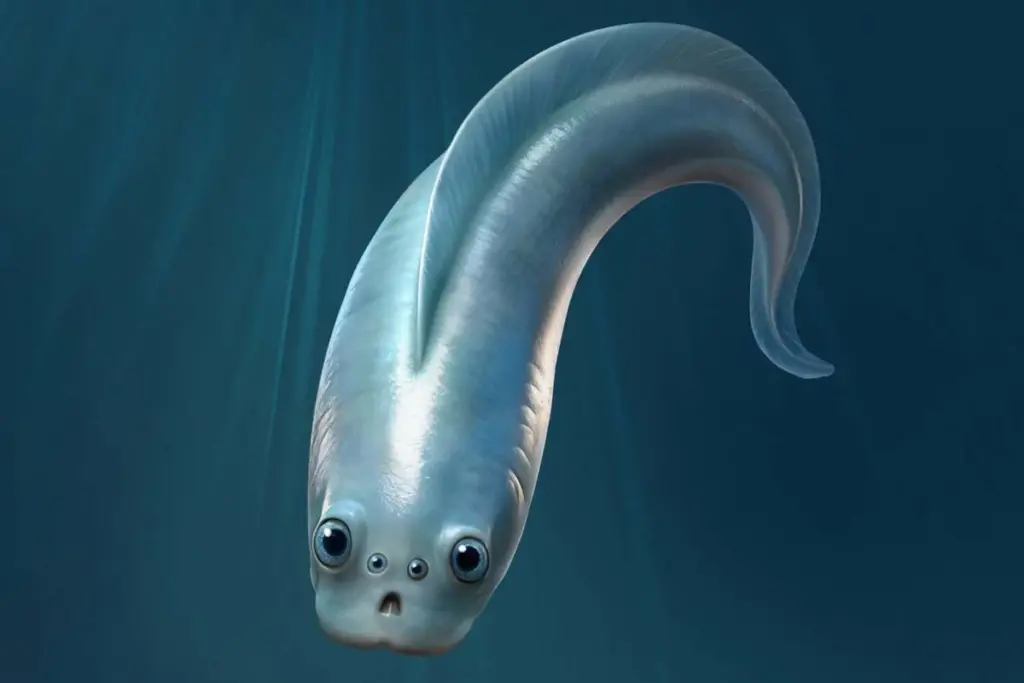
Over 500 million years ago, the Earth’s oldest known vertebrates might have had an additional pair of eyes, a feature that could potentially have left a lasting evolutionary mark on humanity.
Peiyun Cong, along with his colleagues at Yunnan University in China, unearthed remarkable fossils of two jawless fish species, known as myllokunmingids, between 2019 and 2024. These discoveries were made along the shores of Dianchi Lake in southwestern China.
The fossils recovered from this locale, referred to as the Chengjiang biota, are preserved with exceptional clarity. They date back approximately 518 million years, to the Cambrian period. This era witnessed a dramatic surge in life’s diversity, leading to the emergence of most major animal groups that persist today.
Crucially, the vertebrate fossils discovered by Cong’s team included not only soft body parts but also the creatures’ eyes, providing an unprecedented level of detail.
The Diversity of Visual Systems
Complex eyes evolved independently across various animal lineages. For instance, invertebrates like insects possess compound eyes. These are intricate structures composed of hundreds or thousands of individual units, each equipped with its own lens, cone, and light-sensing cells, collectively forming a mosaic image of the environment.
In contrast, vertebrates, including humans and reptiles, have what scientists describe as camera-type eyes. These eyes feature a spherical lens, a retina, an iris, and muscles that control their orientation. They also contain pigmented structures called melanosomes, which contribute to eye color among other functions.
Light entering the eye is focused onto the retina, generating signals that are transmitted to the brain via the optic nerve.
Unveiling the Four-Eyed Fish
Upon examining the fossils under an electron microscope, Cong and his team observed a pair of eyes situated on the side of the head, complete with preserved melanin-containing melanosomes. Additionally, they noted two smaller, dark smudges positioned centrally between these lateral eyes.
“More strikingly, there is also an impression of a lens in each of the lateral eyes and centrally-positioned eyes,” stated team member Jakob Vinther from the University of Bristol in the UK.
Previously, similar dark spots had been identified in myllokunmingid fossils, but they were generally interpreted as nasal sacs or other internal organs. However, Vinther’s team presents compelling evidence suggesting these ancient creatures possessed two pairs of camera-type eyes.
“This would have enabled these 518-million-year-old vertebrates to form an image of their world much like we do,” Vinther explained. “But a key difference is that they used four eyes and not just two.”
An Evolutionary Link to the Pineal Complex
The researchers propose that this ancient, extra pair of eyes may have evolved into what is known as the pineal complex. While some vertebrates, such as reptiles, retain a light-sensitive organ on the top of their head called the parietal eye, mammals possess only the pineal gland. This gland plays a role in regulating the sleep cycle through melatonin secretion.
“We show [the pineal organs] had a more important function as eyes in the early vertebrates and could create somewhat of a decent image before they evolved into organs regulating our sleep cycle,” Vinther commented.
The larger eyes were likely optimized for high-resolution visual perception, while the smaller, central eyes may have assisted the fish in detecting approaching objects. This dual visual system would have provided a broader field of view, a significant advantage in the Cambrian seas where these jawless fish were a potential food source for predators.
“They likely could see objects quite well, telling their shape and some degree of three-dimensionality,” Vinther added. “They likely also had a broad view of their surroundings, sort of IMAX-style, thanks to their four eyes.”
Debate and Future Research
Tetsuto Miyashita of the Canadian Museum of Nature in Ottawa expressed cautious enthusiasm for this novel interpretation. He described the realization that the structures between the lateral eyes might represent a second set of camera eyes as a “light bulb” moment.
However, Miyashita raised a pertinent question: if these are indeed eyes, where is the nose? He noted that the nose is a critical feature in early fish evolution, and its absence in the fossil record could present developmental inconsistencies.
Miyashita anticipates significant scientific discussion until a consensus is reached. He questioned the evolutionary advantage of such prominent, numerous eyes on the head.
John Paterson from the University of New England in Australia concurred that developing such advanced vision would be advantageous for prey species aiming to evade predators. He highlighted the Cambrian period as a time of unusual evolutionary experimentation, where animals displayed diverse ocular arrangements beyond simple forward or side-facing eyes.
Karma Nanglu at the University of California Riverside emphasized the need for comprehensive mapping of the entire fossilized bodies. This would help ascertain if other similar markings exist, which might suggest that the potential second set of eyes could be an artifact of the fossilization process itself.