
Albert Einstein, at the tender age of sixteen, embarked on a thought experiment: what if he could chase a beam of light? This imaginative leap, as history recounts, was instrumental in the formulation of his renowned theory of special relativity.
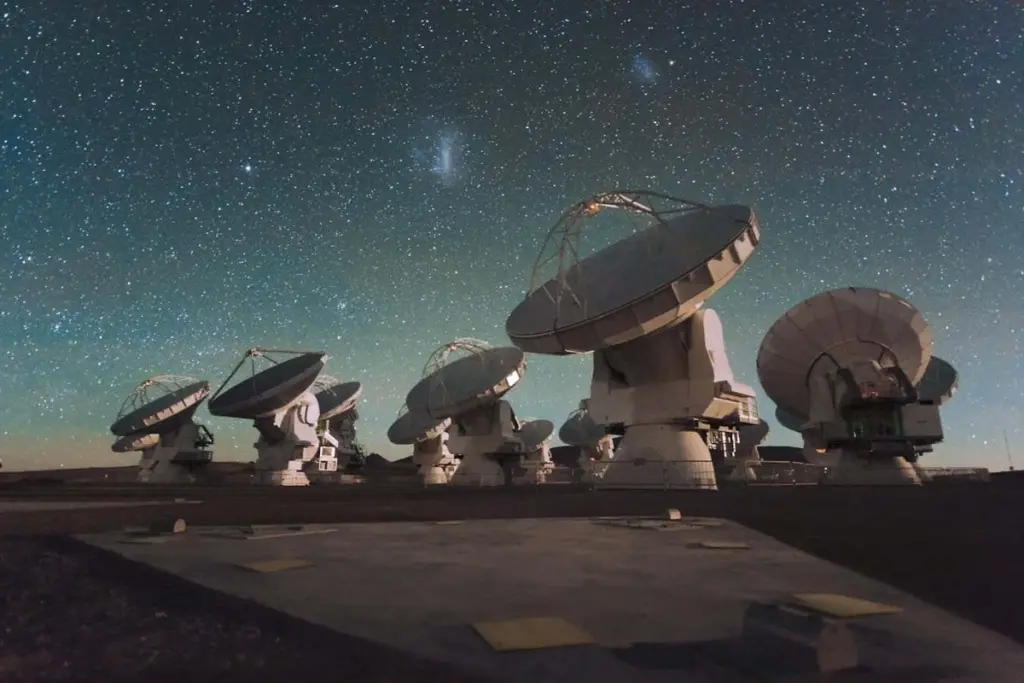
Physicist Emma Chapman, in her recent publication, embarks on a similar quest, albeit with a different objective. Her book, titled “Radio Universe: How to explore space without leaving Earth” (known in the United States as “The Echoing Universe,” released on May 19th), involves tracking a light signal not to experience its speed, but to utilize it as an explorer, a guide, and a messenger. Chapman aptly states, “The universe already speaks the language of light.” Her work provides a compelling exploration of how humanity, through the development and application of radio telescopes, has learned to comprehend and converse in this celestial dialect.
The Electromagnetic Spectrum and Radio Waves
Light, in its essence, is a form of electromagnetic radiation and exists as waves with varying wavelengths. Ultraviolet light, for instance, possesses a short wavelength, characterized by compressed peaks and valleys. In contrast, Chapman, a radio astronomer, focuses on radio waves, which occupy the opposite end of the electromagnetic spectrum. The wavelengths of these radio waves can extend remarkably, with adjacent peaks and valleys potentially separated by several meters.
This extended wavelength allows radio waves to traverse greater distances than other forms of electromagnetic radiation. Consequently, telescopes designed to emit or receive these waves can probe deeper into the universe. A significant advantage of radio telescopes is their capability to operate both day and night, a stark contrast to their visible light counterparts, thereby affording astronomers more observational time. Chapman asserts that these instruments are remarkably versatile, enabling exploration from our moon to the potential abodes of extraterrestrial life.
A Journey Through the Cosmos with Radio Waves
“Radio Universe” is structured into three distinct sections: “Our Solar System,” “Our Galaxy,” and “Our Universe,” charting the path of a radio signal across these cosmic landscapes.
The initial chapter delves into our solar system, revealing that humanity’s first interaction with the Moon was not through a physical landing, but via a radio wave transmission. It also highlights the crucial role contemporary radio studies play in understanding the Moon’s origin and history.
Another chapter shifts focus to Venus. This planet’s extreme environment renders most visible light-based observation techniques ineffective. However, radio waves possess the unique ability, as Chapman notes, to communicate with and glean information from otherwise inaccessible realms.
Later sections explore the foundations of famous black hole imagery, which are derived from radio data. The book also details how radio astronomers captured the first indirect evidence of gravitational waves—ripples in spacetime—and how radio waves were instrumental in the discovery of some of the earliest exoplanets.
The Search for Extraterrestrial Life and Cosmic Mysteries
In the chapter dedicated to radio astronomy’s potential role in the search for alien civilizations, Chapman posits, “Far more likely than any invasion is contact by radio signal.” She further elaborates that regardless of a planet’s atmospheric color, its number of moons, or the physical characteristics of its inhabitants, radio waves are anticipated to be the chosen medium for long-distance communication.
The concluding chapters of “Radio Universe” are devoted to two of modern physics’ most profound enigmas: dark matter and dark energy. These pervasive substances constitute a significant portion of the cosmos, yet their precise nature remains largely unknown, partly due to the challenges in their direct detection. Chapman elucidates the contributions of radio telescopes in this endeavor, citing their ability to detect radiation from interstellar hydrogen gas. This detection, in turn, allows astronomers to infer the distribution of dark matter within specific regions.
Praise and Critique of Chapman’s Approach
Throughout the book, Chapman’s writing style is distinguished by its accessibility, imaginative flair, and engaging nature. A description of Mercury’s swift orbit around the sun, which complicates landing procedures but does not impede radio signal investigations, created a vivid sense of the planet’s motion. Similarly, the discussion on the asteroid belt offered what felt like an expert-level astronomy lesson, delivered in a conversational, friendly tone, akin to the best seatmate on a long journey.
Chapman’s evident passion for her work as a radio astronomer is palpable on every page, and her humor is often a welcome addition. The book even includes an appendix listing radio telescopes accessible to tourists.
Despite this engaging and optimistic presentation, a degree of disappointment arises when Chapman discusses the colonization of Mars and commercial lunar exploration with what appears to be limited critical examination. She notes that “a new generation of tech billionaires has sparked a second space age.” However, her subsequent contemplation of whether researchers aiming to establish telescopes on the moon will be welcomed “amidst those who wish to mine it, settle on it and use it as a springboard to Mars” does not explore the fundamental question of whether such a trajectory for space exploration is inevitable or desirable. The author implicitly questions whether a dedicated astronomer should not be championing a more inclusive and equitable future for space travel and scientific inquiry.
Furthermore, while several prominent American and British radio astronomers are featured extensively, less attention is given to researchers from other regions. This overlooks significant contributions, particularly from locations like Puerto Rico and Chile, where some of the world’s most important radio telescopes have been built and operated.
The Universe’s Constant Hum
Ultimately, Chapman effectively conveys a profound and beautiful insight: the universe is far from silent. “Wherever you are, you are surrounded by radio waves,” she explains. “Some have escaped black holes, some are the echoes from asteroids. Some have even travelled to us from the Era of the First Stars. We just have to close our eyes, and listen.”
The next time one gazes at the night sky, even one obscured by urban lights and ambient noise, this suggestion to simply close one’s eyes and listen is likely to resonate.
Related Astronomical Reading
Further exploration into astronomy can be found in two commendable works:
-
Fear of a Black Universe: An outsider’s guide to the future of physics
By Stephon Alexander. This book offers a complex narrative of the universe’s past and future from an unconventional perspective, blending the insights of a dreamer and musician with the rigor of a cosmologist. Alexander draws inspiration from diverse experiences, including a Zen center visit and the art of Jean-Michel Basquiat, integrating mathematical concepts like Feynman diagrams with personal narratives from his life as a Black man.
-
The Disordered Cosmos: A journey into dark matter, spacetime and dreams deferred
By Chanda Prescod-Weinstein. This work presents a potent fusion of scientific inquiry and personal reflection. As a columnist for New Scientist, Prescod-Weinstein provides meticulous details on phenomena such as dark matter, alongside a thoughtful analysis of sociopolitical factors shaping discussions around modern physics. Notably, the book addresses the inherent tensions and controversies surrounding telescope placement and consent, demonstrating that scientific rigor can extend beyond data collection and analysis.