
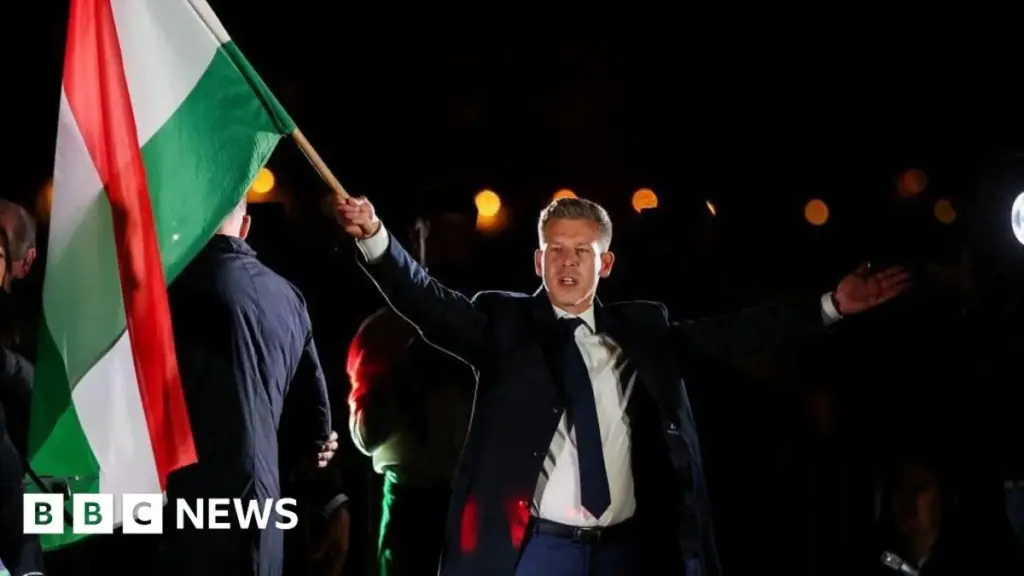
Viktor Orbán’s sixteen-year tenure in power has concluded, and the political system previously characterized as an “electoral autocracy” now stands in disarray. The defeat was delivered by Péter Magyar, a 45-year-old former insider within the political establishment, who successfully persuaded a majority of Hungarian citizens to support a change in leadership.
Addressing a throng of jubilant supporters gathered in a plaza adjacent to the Danube River, with Budapest’s resplendent parliament building visible across the water, Magyar proclaimed, “We did it. Together, we have overthrown the Hungarian regime.”
Preliminary election results, which account for over 98% of all votes cast, indicate that Magyar’s Tisza party is projected to secure an astounding 138 seats. In contrast, Orbán’s Fidesz party is expected to win 55 seats, and the far-right Our Homeland movement is set to gain six.
Over a period of two years, Magyar systematically traveled across villages, town squares, and cities, mobilizing a movement aimed at addressing the pervasive cronyism and corruption that had become deeply ingrained in Hungary over an extended period. He connected with Hungarians who expressed considerable dissatisfaction with the status quo.
Magyar declared on Sunday evening, following a record voter turnout of 79% of the electorate, “Never before in the history of democratic Hungary have so many people voted, and no single party has ever received such a strong mandate.”
Orbán’s governance, built upon four consecutive electoral victories with substantial majorities, was brought to an end in mere minutes. As supporters of Magyar eagerly awaited results on the Buda side of the Danube, the Tisza leader posted a notable message on Facebook: “Viktor Orbán just called me on the phone and congratulated us on our victory.”
The magnitude of the events was still being processed; only 30% of the votes had been tallied at that point. Shortly thereafter, Orbán himself appeared on a stage at a conference center downstream, on the opposite bank of the Danube. He was accompanied by his visibly dejected Fidesz party colleagues.
“The result of the election is clear and painful,” Orbán stated to his supporters, expressing gratitude to the approximately 2.5 million Hungarians who remained loyal. “The days ahead of us are for us to heal our wounds.”
News of Orbán’s concession gradually spread among Magyar’s supporters. At a nearby hotel that served as the makeshift party headquarters, Tisza activists embraced one another in celebration.
Magyar has outlined a platform committed to reversing key Orbán-era reforms in education and healthcare, combating corruption, reinstating judicial independence, and dismantling the widely unpopular patronage system known as NER. This system had been instrumental in enriching party loyalists and facilitating the wasteful expenditure of state resources.
To enact constitutional changes, Magyar’s Tisza party requires a two-thirds majority, which translates to 133 seats. While the final vote tally is pending, current projections indicate Tisza is on track to achieve 138 seats, exceeding this threshold.
Another significant target for Magyar is the state-controlled media, which has been closely aligned with Orbán’s government. The M1 television channel, along with various websites formerly independent but acquired by Fidesz allies, has consistently propagated the party’s narrative.
In an apparent moment of uncertainty regarding immediate actions, M1 replayed a speech delivered by Magyar shortly after voting concluded. At the time of the recording, Magyar had expressed optimism for victory, but by the time of its rebroadcast, the outcome had already been determined with his win.
Hungary had, for some time, appeared to exist as two parallel realities. In one, Orbán consistently conveyed to his supporters and television audiences the certainty of victory and an additional four years in power. This narrative was bolstered by opinion polls conducted by sympathetic pollsters who, as late as Sunday evening, continued to forecast a Fidesz win.
In the other reality, Magyar garnered substantial crowds at every engagement. His campaign benefited from the support of respected pollsters who reported a growing lead over his political rival.
On Sunday night, these two contrasting realities converged, revealing the singular prevailing truth. Should Tisza’s two-thirds majority be officially confirmed, significant changes are anticipated for state television.
Magyar navigated the assembled crowds before ascending the stage, flanked by his party colleagues. He declared to the audience, amidst chants of “Ria-Ria-Hungaria!”, “You performed a miracle today, Hungary made history today.”
He drew parallels between this electoral triumph and Hungary’s 1848 revolution and the 1956 uprising against Soviet occupation. Orbán himself, who once spoke out against Soviet control, has since cultivated a close alliance with Russia’s Vladimir Putin. His rationale for maintaining access to inexpensive Russian oil and gas has made him a figure of considerable unpopularity within the European Union, an entity actively seeking to reduce its dependence on Russian imports. Furthermore, Orbán has withdrawn from an EU agreement to provide Ukraine with a substantial loan of €90 billion.
Magyar supporters chanted “Russians go home” as the incoming Hungarian prime minister pledged to foster improved relations with the European Union.
Poland’s Prime Minister Donald Tusk was among the initial European leaders to extend congratulations for Magyar’s “glorious victory,” adding the Hungarian phrase “Ruszkik Haza,” meaning “Russians go home.”
The Tisza leader announced his intention for his inaugural international visit as prime minister to be to Warsaw, aiming to reinforce Hungary’s century-old friendship with Poland.
Regarding Viktor Orbán, now 62 years old, he has not formally resigned. The future of Fidesz without his leadership remains a subject of considerable speculation.
For the immediate period, Orbán will continue to lead Hungary in a caretaker capacity while he and his party address the aftermath of the election.