
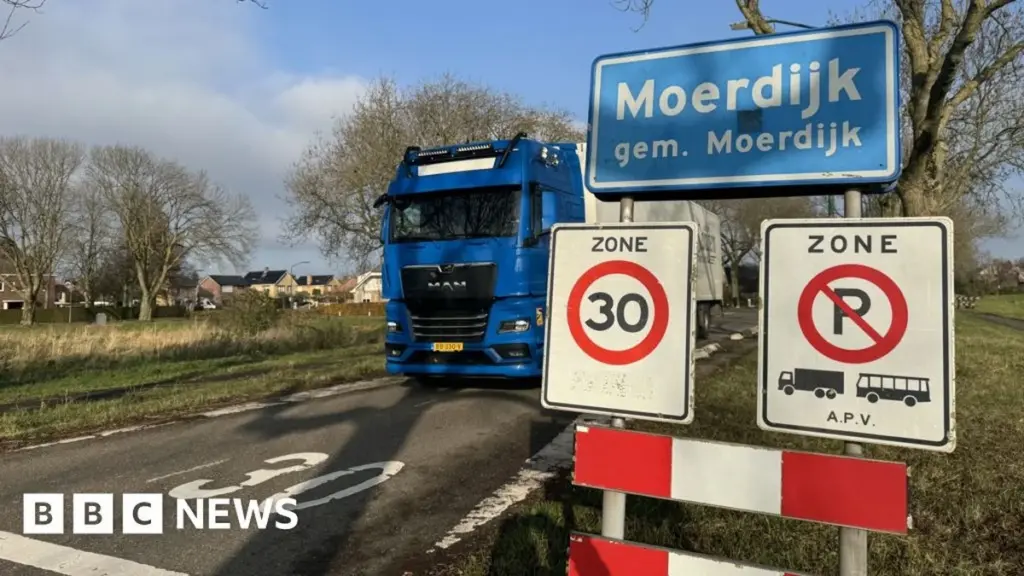
In the southern Netherlands, adjacent to a broad estuary, a village inhabited by approximately 1,100 people stands on the brink of disappearing from the map. Moerdijk, a modest fishing community situated 34 kilometers south of Rotterdam, finds itself positioned on the critical fault line of the nation’s transition toward green energy.
The Dutch government has identified the country’s pressing need for extensive new sites to construct high-voltage substations. These facilities are essential for connecting cables that will carry electricity generated by increasingly numerous offshore wind farms to the national grid. However, the Netherlands faces a significant land shortage.
Officials contend that Moerdijk, located on the southern bank of the Hollands Diep estuary, is strategically positioned. Its proximity to ports, motorways, and existing overhead power lines makes it an exceptionally suitable location for such an energy infrastructure project. Consequently, residents are confronted with the tangible threat of their homes being demolished within the next decade, potentially leading to the village’s erasure.
“We are being brought to the slaughterhouse,” expressed fishmonger Jaco Koman, gesturing towards the horizon from his office overlooking the shimmering waterway.
Koman’s family has been engaged in fishing for their livelihood in this area since 1918. His company continues to maintain live eels for smoking, a traditional Dutch delicacy, and supplies them to high-end restaurants nationwide. Inside a warehouse filled with vast, bubbling water tanks, he displayed a catch of slender, black eels. “Be careful, they can jump,” he remarked with a smile, acknowledging a guest’s apprehension.
Koman explained that his industry, much like his recent catch, is thriving. Yet, the very deep water and open land that support his business are precisely what make Moerdijk so appealing to urban planners. He described the constant threat of his village being cleared for new energy infrastructure as something he “goes to bed with and wakes up with.” He questioned the notion that residents must depart with their entire village.
Recalling the initial announcement, Koman stated that “everybody was shocked.” His voice trembled as he described the news as “really, really terrible.” The current outlook suggests that not only his business but also his home, situated on the other side of the dyke protecting the village from the water, could be lost.
While Koman acknowledges the Netherlands’ need for increased clean energy, he questions the equity of placing the burden on his community. He and many other villagers propose that offshore wind farms could be connected further out at sea, with converter stations established away from existing communities rather than directly within them.
An palpable sense of unease and uncertainty pervades the streets of Moerdijk. “For Sale” signs are dotted among gravel driveways, yet few potential buyers are willing to invest in a location facing potential complete displacement. Flags hang limply at half-mast, a symbolic gesture by residents mourning the impending demise of a village that still officially exists.
Andrea, the owner of the local grocery shop, elaborated on the deeply personal nature of the threat. Her husband constructed their home with his own hands, and all three of their children were born there. “I’m scared I’ll lose my house,” she admitted. “There’s so much life here. But in 10 year’s time, it may be nothing.” The village cemetery, where Andrea’s grandparents and in-laws are interred, presents another significant concern. She pondered what would happen to the graves if the area undergoes redevelopment.
The discussions unfolding in Moerdijk mirror broader challenges confronting the Netherlands. As a densely populated nation, it has long grappled with balancing competing demands for its limited land resources, including housing, agriculture, nature conservation, transportation, industry, and now, the critical infrastructure for large-scale renewable energy projects.
In certain parts of the country, the electricity grid is already so saturated that companies and new housing developments face potential delays of several years for connection. Simultaneously, the Dutch government has ambitious plans to expand offshore wind energy generation in the North Sea. The potential capacity from these projects could meet a significant portion of the national electricity demand, provided the generated power can be efficiently transmitted ashore and distributed across the country.
Geerten Boogaard, a professor of local government at Leiden University, suggests that Moerdijk exemplifies the distribution of political power within the Dutch system. He described the Netherlands as, “in the end, a centralist state.” Boogaard explained that when the national government declares something as “vital national interest,” it possesses instruments to implement such decisions effectively. While local councils can register objections and residents can challenge decisions, the central government ultimately holds legal authority to assume control. However, wielding this power incurs political and financial consequences.
According to Boogaard, the conflict in Moerdijk transcends mere considerations of pylons and planning procedures. It represents a collision between two distinct ways of life: that of a close-knit local community and a nation striving to transform its energy system in response to climate change, security imperatives, and the pressure to phase out fossil fuels.
Jacques, a 71-year-old retired engineer, stood outside his environmentally friendly home on the outskirts of Moerdijk, built in the mid-1990s on former farmland. When he moved in, he recounted, there were no wind turbines on the horizon, no distribution warehouses, and no forests of pylons. Today, the view encompasses one of Europe’s largest logistics hubs and vital transport routes connecting Rotterdam and Belgium, with the constant rumble of passing trucks often drowning out the birdsong. “This village will be demolished. That I know for sure,” he stated with certainty.
The Dutch government has temporarily postponed a decision regarding Moerdijk’s future, but an announcement is anticipated later this year. Ministers involved declined to be interviewed for this article.
Aart Jan Moerkerke, the mayor of the Moerdijk municipality, highlighted the immense pressure involved. He noted that the central government requires approximately 450 hectares of land, equivalent to about 700 football pitches. Beyond the construction of the large power facility, there are plans for several hydrogen production factories. Additionally, substantial pipelines for transporting ammonia and hydrogen from the port of Rotterdam to the southeastern Netherlands are slated to pass through Moerdijk.
Moerkerke explained that the council had, in principle, decided that Moerdijk must relocate to accommodate these development plans. This decision was framed as sacrificing one local village to avert greater disruption and a significant decline in the quality of life for four other communities, including Moerdijk. Nevertheless, the government could ultimately choose to preserve Moerdijk by pursuing an alternative that involves integrating the substations and their associated cabling among the four villages.
The municipality is actively seeking guarantees regarding timelines, compensation, and specific conditions before agreeing to any resolution. Moerkerke described informing residents in Moerdijk that their homes, streets, and cemeteries might not survive the decade as “the hardest decision of my career,” an experience he stated he will “never forget.”
The decision being made here extends beyond the fate of a few streets bordering an estuary. It serves as a critical test of what a government deems can or must be sacrificed for energy security, sustainability, and industrial advancement. In Moerdijk, this dilemma is no longer an abstract issue; it is immediate and poised to fundamentally alter the lives of Jaco, Andrea, Jacques, and all who reside on the precipice of the green transition.
For the present moment, they are living with the profound uncertainty of knowing that the village they inhabit today may eventually exist only on historical maps and within their memories.