
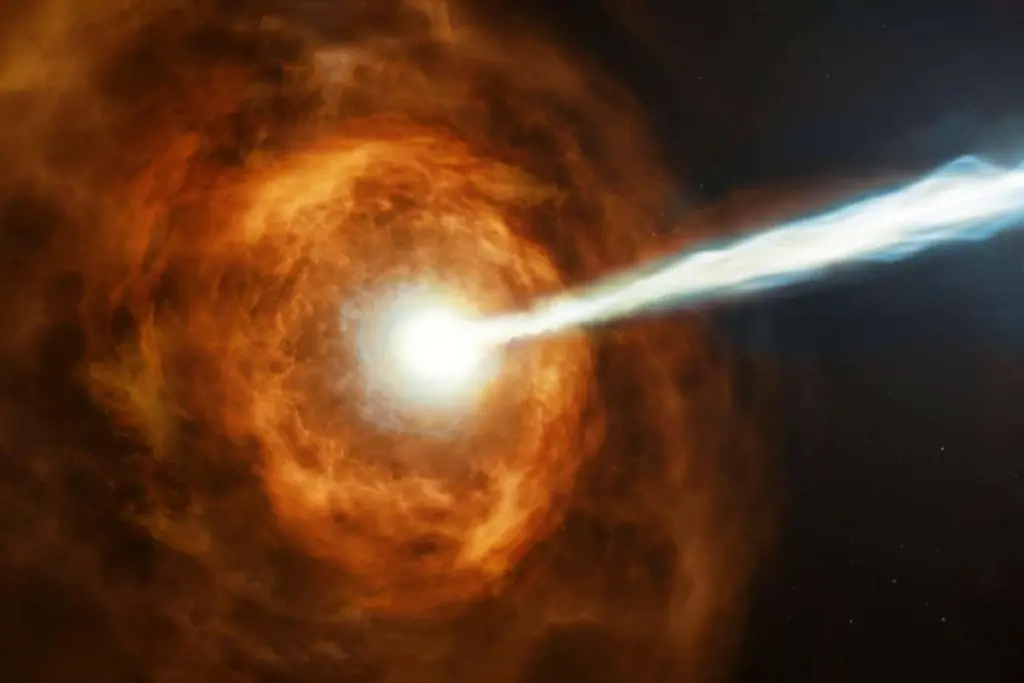
Scientists believe they may have witnessed a phenomenon theorized to occur when massive stars die, a “dirty fireball” explosion. This observation could offer new insights into the final moments of these colossal celestial bodies.
When a large star exhausts its nuclear fuel, it can undergo a gravitational collapse, leading to various explosive outcomes. In instances where this collapse results in the formation of a black hole, an incredibly potent beam of radiation, known as a gamma-ray burst (GRB), can erupt through the star.
These GRBs represent some of the most energetic events in the cosmos. They have the capacity to release an amount of energy equivalent to the entire lifespan output of Sun-like stars, concentrated into a single, directed beam. Nevertheless, the precise mechanisms behind this process and how variations in massive stars influence the jet’s behavior remain subjects of ongoing inquiry for astronomers.
Physicists have posited that a different kind of emission might be observed if the energetic jet becomes mixed with heavier stellar material, such as protons and neutrons. Such contamination could act like a filter, decelerating the jet and causing it to emit X-rays instead of gamma rays. This scenario, termed a “dirty fireball,” has, until recently, lacked direct observational evidence.
A team led by Xiang-Yu Wang at Nanjing University in China, leveraging the capabilities of the new Einstein Probe space telescope, has now identified an X-ray flash designated EP241113a. This event closely matches the expected characteristics of a dirty fireball.
Key Observations and Implications
Wang’s group detected the luminous event originating from a galaxy approximately 9 billion light-years distant. The detected energy was comparable to that of a gamma-ray burst, but crucially, registered in the X-ray spectrum. Following the initial intense burst, the emission transitioned into a luminous glow that persisted for several hours before gradually fading, a pattern reminiscent of typical GRBs.
“It’s a very exciting prospect,” stated Rhaana Starling from the University of Leicester in the UK. She noted that “Dirty fireballs have been theorized to exist since the 90s, but there hasn’t really been any compelling evidence for them.”
While thousands of gamma-ray bursts are cataloged, Starling suggests that the event responsible for this particular blast likely differs from many others. It might involve a black hole or a neutron star engaging with the jet in a unique physical interaction. “If it’s a black hole, then we are able to then get a more complete picture of black hole formation across the universe,” she explained.
The observation also implies that the gamma-ray bursts currently detected might represent a biased sample, and that numerous similar or weaker events could exist. Gavin Lamb of Liverpool John Moores University in the UK commented, “There could well be a continuum that goes right the way down to no jets.”
Further Verification Required
Despite the promising nature of the findings, some caution is warranted. Om Sharan Salafia at Brera Astronomical Observatory in Italy emphasizes the need for further confirmation. “First, we have to establish whether the explosion really did come from a galaxy as distant as Wang and his team claim,” he said. “If all of this holds, then indeed, this transient is a bit puzzling.”
The scientific community awaits further data to definitively confirm the nature of this event and its implications for our understanding of stellar death and high-energy astrophysical phenomena.
Reference: arXiv DOI: arXiv.2603.26213