
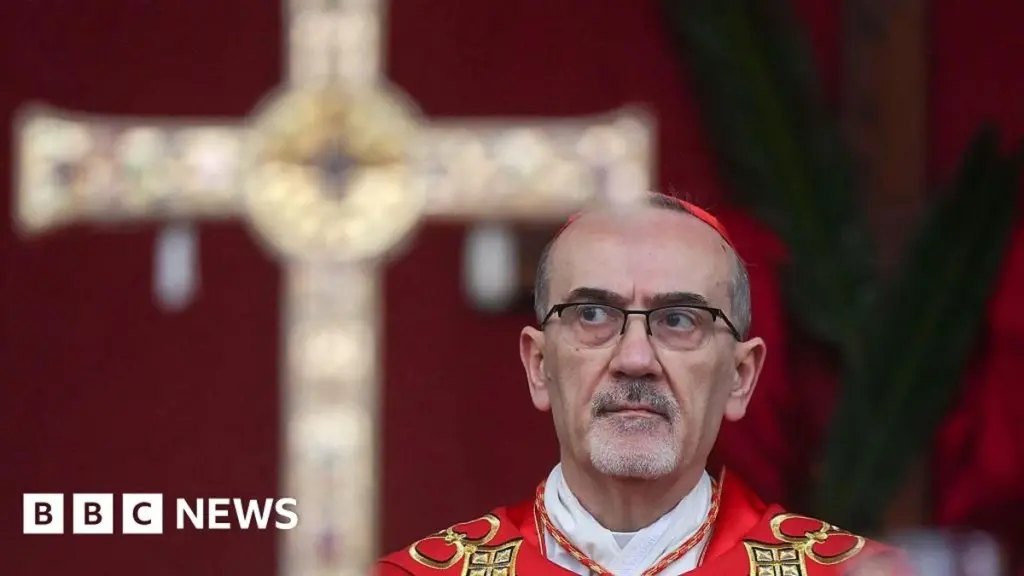
Israeli Prime Minister Benjamin Netanyahu has stated that the Latin Patriarch of Jerusalem will now be granted “full and immediate access” to the Church of the Holy Sepulchre. This assurance follows an earlier incident where police prevented the Patriarch from celebrating Palm Sunday Mass at the revered site.
Netanyahu explained that Cardinal Pierbattista Pizzaballa, the head of the Catholic Church in the Holy Land, had been initially advised against entering the church due to safety concerns. He cited repeated targeting of Jerusalem’s holy sites by ballistic missiles originating from Iran.
The decision to deny the Cardinal entry to one of Christianity’s holiest locations drew criticism from several Western nations. The United States Ambassador to Israel, Mike Huckabee, described the action as an “unfortunate overreach” that was “difficult to understand or justify.”
Details of the Incident
Cardinal Pizzaballa, accompanied by Reverend Francesco Ielpo, was stopped outside the church – believed to be the site of Jesus Christ’s crucifixion – as they prepared to hold a Mass marking the commencement of Holy Week. Church authorities confirmed the incident.
Cardinal Pizzaballa’s office noted this was reportedly “the first time in centuries” a Latin Patriarch had been denied entry to the holy site on Palm Sunday, a day commemorating Christ’s entry into Jerusalem.
The statement from the patriarchate indicated that both the Cardinal and Rev Ielpo were “compelled” to retreat from the church, a site also believed to be where Christ was buried and subsequently resurrected.
“This incident is a grave precedent and disregards the sensibilities of billions of people around the world, who during this week, look to Jerusalem,” a statement from the patriarchate stated earlier. “This hasty and fundamentally flawed decision, tainted by improper considerations, represents an extreme departure from basic principles of reasonableness, freedom of worship, and respect for the status quo.”
The patriarchate asserted that it had adhered to all “imposed restrictions” and acted responsibly since the commencement of the war. They further characterized Sunday’s decision as “a manifestly unreasonable and grossly disproportionate measure.”
Clarification and Safety Concerns
Cardinal Pizzaballa later commented that while he did “not want to force the issue,” the original intention was for a “brief and small private ceremony,” not a public event.
He added, “We want to use this situation to try to clarify better in the coming days what to do, in respect for everyone’s safety but also in respect for the right to prayer.”
Netanyahu reiterated that worshippers of “all faiths” had been advised against visiting sites within Jerusalem’s Old City due to strikes from Iran. He maintained that police actions were driven by “special” safety considerations in this specific instance.
The annual Palm Sunday procession into the city had already been canceled earlier due to restrictions on public gatherings.
Official Statements and International Reactions
Israeli police reported that all holy sites in the Old City had been closed to worshippers since February 28th, citing security reasons related to the conflict involving Iran, and confirmed they had rejected the patriarchate’s request for a Palm Sunday exemption.
Netanyahu stated that Christian, Jewish, and Muslim holy sites had been “repeatedly targeted” by Iranian missile strikes in recent days. He shared on X that “In one strike, missile fragments crashed meters from the Church of the Holy Sepulchre,” and emphasized that Sunday’s decision was made “with no malicious intent whatsoever.”
He also indicated that a plan was being developed to allow church leaders to worship at the site in the ensuing days. Late on Sunday night, Netanyahu announced his directive to relevant authorities to grant the Latin Patriarch “full and immediate access” to the Church of the Holy Sepulchre for services.
Huckabee pointed out that the two clergymen had sought private entry without a procession, and that existing rules primarily concerned religious gatherings exceeding 50 people. He welcomed the Israeli government’s efforts to resolve the situation and facilitate other Holy Week activities.
A spokesperson for the US State Department informed BBC News, “We encourage the Government of Israel to facilitate the safe observance of Holy Week.” The spokesperson also acknowledged “the difficult security conditions in Jerusalem that have arisen from Iran’s ongoing, indiscriminate missile attacks.”
Italian Prime Minister Giorgia Meloni described the prohibition as “an offense not only against believers but against every community that recognises religious freedom.” Foreign Minister Antonio Tajani stated he had summoned Israel’s ambassador to Italy for an explanation.
French President Emmanuel Macron also condemned the action, linking it to “the worrying increase in violations of the status of the Holy Places in Jerusalem.” He declared on X, “Freedom to hold religious rites in Jerusalem must be ensured for all religions.”
Pope Leo XIV, speaking in Rome, offered solidarity to “the Christians of the Middle East, who suffer the consequences of a terrible conflict and in many cases cannot fully live the rites of these holy days.”
Israeli President Isaac Herzog contacted Cardinal Pizzaballa to express his “great sorrow” over the “unfortunate incident.” He reaffirmed “Israel’s unwavering commitment to freedom of religion for all faiths and to upholding the status quo at the holy sites of Jerusalem.”