
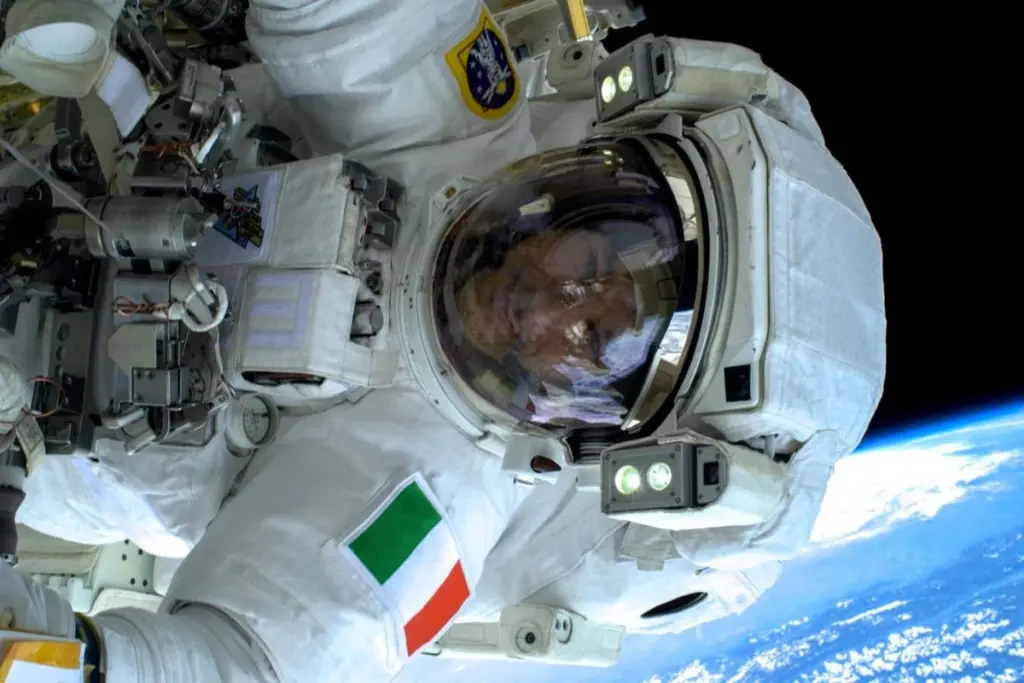
The water, cold and all-encompassing, surged. It met my face, then swiftly covered my nose, infiltrating my nostrils in mere moments. Nearly blinded, the sounds around me faded into a dull roar. Breathing through my nose became an impossibility. My immediate, overriding thought was to reach the airlock, to return to the secure confines of the International Space Station. The critical question in my mind was stark: how much time did I have before the water reached my mouth, cutting off my last avenue for air?
Embarking on a spacewalk thrusts one into an entirely new dimension. The perspective gained is an unparalleled privilege. From within the ISS, gazing through the cupola’s windows, one remains anchored to the station’s familiar safety. It’s akin to observing a vast, extraordinarily beautiful aquarium. Yet, the instant I step outside the ISS for an EVA (Extravehicular Activity), I am plunged into the absolute void. This is an environment that holds no inherent need for me. Stripped of my spacesuit’s protection, survival would be measured in minutes.
The endless expanse of stars against the profound blackness presents an almost tangible spectacle. During one of my spacewalks, I was being repositioned across the station’s exterior by a robotic arm, my feet securely attached. Without any familiar reference points – the station itself was behind me, as was Earth – I experienced a profound realization of space’s three-dimensionality for the first time. Perhaps drawing upon my background in astrophysics, I felt as though I could perceive a porous, spongy structure of interconnected voids, illuminated by immense sources of light. Though I have attempted to recapture that sensation since, it has remained elusive.
A Calculated Risk Amidst an Unforeseen Hazard
I have completed six spacewalks to date. The water intrusion occurred during my second excursion, on July 16, 2013. The initial sensation of the cold fluid at the back of my head was undeniably uncomfortable. Nevertheless, I adhered to the standard operational procedures. I contacted ground control, reporting, “Hey, I feel water in the back of my helmet, FYI – for your information.” The inclusion of “FYI” was my way of signaling that I remained functional and capable of continuing the mission.
I was instructed to await further directions. Subsequently, they inquired about the source of the water. I did not know. However, by that point, I could clearly feel it accumulating. Water behaves in unconventional ways when deprived of gravity’s influence. Capillarity becomes a potent force, facilitating its movement across surfaces.
Many individuals likely envision spacesuits through the lens of cinematic portrayals like “Gravity” or “The Martian.” The helmets depicted in such films are often notably large. This is a deliberate choice, driven by the significant investment in specific actors and the need to capture their facial expressions. Our helmets, however, are relatively compact because the focus is not on displaying an actor’s face but on functionality. The space between the helmet and my head is minimal. The water flowed into this confined area, filling it with an unsettling speed. Once my ears became submerged, my hearing diminished significantly, and I began to suspect that communication with the ground crew was also compromised.
The setting sun introduced another layer of complexity. As we orbit Earth, we experience a sunrise and sunset approximately every 45 minutes. A typical spacewalk spans six to seven hours, meaning a substantial portion occurs during darkness. The sunset was a complicating factor. While the illumination from my helmet lights allowed me to see directly ahead, even with the water present, any attempt to look further into the distance rendered objects indistinguishable. The water impaired my ability to focus on distant targets.
The origin of the water remained unknown. However, at that critical juncture, its source was secondary in importance. The primary concern was the looming threat, the unspoken countdown urging immediate action. I might have had ten minutes, perhaps five, or even a single minute remaining. While I could not control the duration, I could certainly control my response.
Adherence to Training in the Face of Danger
Prior to my astronaut career, I served as a pilot, then a fighter pilot, and subsequently a test pilot. From the very first day of flight school, I learned a fundamental principle for handling emergencies: maintain control, analyze the situation, and execute the appropriate action.
The necessary action was to navigate back to the airlock. The next challenge was to determine how to achieve this. The exterior of the space station is equipped with handrails, aiding in external movement. I recognized that I could utilize these to reach the airlock. My internal query became: could I see the next handrail? The answer was no; it was too distant. Could I locate it by touch? Yes, I could. By following my tether, which was secured to the airlock, I could commence my movement in the correct direction.
Navigating in a spacesuit presents a formidable challenge, likely far greater than commonly perceived. The suit’s internal pressure exerts a continuous force that actively opposes the wearer’s movements. To move, one must exert effort to overcome this resistance. The hands and fingers, lacking significant musculature, are particularly vulnerable. Consequently, each time a grip is required, such as on a handrail, the pressure feels akin to forcefully squeezing a tennis ball.
That final segment of the spacewalk seemed to stretch into an immeasurable duration, an eternity. My perception of time distorted; my mind slowed everything down. In reality, only seven minutes elapsed before I safely re-entered the airlock. During those seven minutes, ground control could not hear me, nor were they aware of my condition. I later learned, however, that they did not perceive the severity of my situation because my heart rate remained remarkably steady. I had effectively managed my physiological response to the crisis.
The memory of that spacewalk remains vivid, though it does not occupy my thoughts constantly. It was not an event that fundamentally altered me, though it did lead to significant operational adjustments for all of us. We identified a blocked filter as the cause of the malfunction. Consequently, our pre-spacewalk procedures were modified to include a thorough inspection of this component. Furthermore, a snorkel was integrated into the spacesuits, providing an emergency breathing apparatus from the suit’s internal air supply should the helmet become inundated with water. This specific incident, therefore, is unlikely to be repeated. That consequence represents a positive outcome.
I would not dispute anyone’s assertion that the work performed by astronauts is extraordinary. The capabilities we demonstrate are indeed remarkable. However, this does not elevate us to the status of extraordinary individuals. Rather, it signifies that ordinary people, equipped with extensive training, can undertake extraordinary tasks.