
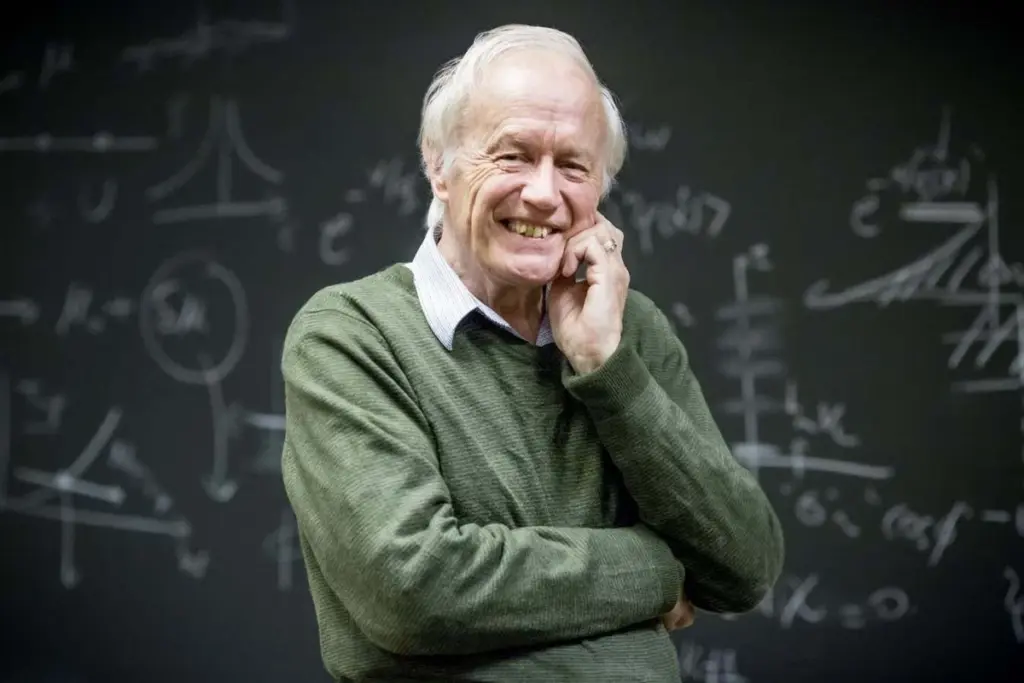
During my first year of graduate studies, I shared an office with a reserved, senior graduate student. In our casual conversations, I learned he was “working on the theory of glasses with Tony.” This revealed two things: the inherent difficulty in understanding the physics of glasses, and my surprising lack of awareness regarding Tony’s identity. I would soon meet him. He was a courteous British gentleman in his seventies, possessing the measured cadence of a lifelong educator and an undeniable spark in his eyes. His full name was Anthony James Leggett. He was a Nobel laureate, a Knight of the British Empire, a recipient of numerous awards, and an authority on the ultracold phenomena of the quantum realm. As a theorist, he co-developed an important test to probe the limits of this quantum world, a question that occupied him for decades. He passed away on March 8th, leaving behind not only his family but also a legion of inspired researchers who knew him, in his characteristic humility, simply as Tony.
Early Pursuits and a Shift to Physics
Born in South London in 1938, Leggett attended a Jesuit school where his father taught physics and chemistry. He initially pursued a degree in classical literature, philosophy, and ancient history at the University of Oxford. However, the compelling allure of physics eventually outweighed the draw of ancient texts and forgotten languages. He earned a second degree, this time in physics, and then relocated to the University of Illinois Urbana-Champaign (UIUC) for his postdoctoral work.
Encountering the Ultracold and Helium-3
At the time, UIUC was a hub for physicists investigating novel quantum matter and materials, many of whose unusual properties only manifested at extremely low temperatures. Leggett was already familiar with the physics of the ultracold from his prior research. However, his time at UIUC brought the intriguing problem of a rare form of helium, known as helium-3, to his attention. During his Nobel Prize lecture, he recounted an instance where physicists John Bardeen and Leo Kadanoff informed him of an ultracold helium experiment underway in the building’s basement. Leggett set out to mathematically describe aspects of this experiment but found himself diverted. He abandoned the calculation, yet his engagement with ultracold helium-3 would continue in an intermittent fashion for the next ten years.
A Pivotal Vacation and a Challenge to Quantum Physics
Serendipity played a role in his return to studying this peculiar substance. In 1972, a planned hiking trip was disrupted by rainy weather. Instead, he met with an experimentalist friend, Robert Richardson. According to Leggett, the discussions that day irrevocably altered his research trajectory and ultimately led to his Nobel Prize. Richardson described the findings from a study of ultracold helium-3, where his team employed a magnetic resonance imaging technique called NMR. These results were so perplexing to Leggett that, immediately after Richardson’s departure, he stated he “sat down to try to construct a formal proof that given the generally accepted laws of quantum and statistical mechanics, the shift observed in the experiments simply could not occur.” Essentially, he was concerned that in their investigation of ultracold helium, Richardson and his colleagues might have inadvertently uncovered a flaw in the very fabric of quantum physics.
Understanding Superfluidity and Symmetry Breaking
Within a few years, Leggett concluded that quantum physics was indeed sound, but that ultracold helium-3 indeed behaved unlike any previously studied ultracold system. The ultracold realm was already presenting physicists with significant challenges. When gases or certain solid materials are cooled to sufficiently low temperatures, they sometimes exhibit remarkably strange behavior. For instance, in superconductors, at very low temperatures, electrons cease to repel each other. Instead, they form pairs and conduct electricity with absolute efficiency. In other scenarios, numerous atoms subjected to extreme cold can collectively enter the same quantum state, behaving as a single quantum entity rather than individual particles. This phenomenon is the basis of superfluidity, resulting in zero viscosity and the ability to perform unexpected actions, such as flowing upwards along the walls of a container. Leggett sought to determine if helium-3 also possessed such “super” properties, and he approached this question with considerable rigor.
He developed a comprehensive theory of ultracold helium-3. This complex mathematical undertaking revealed that it was not merely a single superfluid but could exist in several distinct superfluid forms. In detailing these forms, he also identified a novel mechanism of symmetry breaking—a mathematical characteristic within the new ultracold theory that could account for previously enigmatic laboratory measurements.
Richardson had received the Nobel Prize for his helium-3 experiment in 1966, while Leggett’s Nobel, recognizing his theoretical contributions, was awarded in 2003.
Mentorship and Broader Quantum Inquiries
“I still remember the collective euphoria in 2003 on the day the Nobel prize was announced in the early hours of the morning,” recalls Smitha Vishveshwara, who served as my graduate advisor at UIUC. Tony joined UIUC in 1983, and she began working with him as a postdoctoral researcher in 2002. “He was such a caring, gentle, wise mentor, friend, colleague and inspiration for so many of us.” I can easily picture him at one of the round tables in the institute for condensed matter physics theory at UIUC, which now bears his name, deeply absorbed in thought yet always accessible to answer a question.
Tony’s curiosity extended far beyond the mysteries of superfluid helium-3. There was the study of glasses that the older graduate student had mentioned to me. However, Leggett was particularly captivated by the idea that quantum theory might not universally apply, especially to large-scale objects. Could the perplexing aspects of quantum physics—such as a particle existing as mere probability clouds when unobserved—be confined solely to microscopic entities?
The Leggett-Garg Inequality and Macroscopic Quantumness
Leggett elaborated on these thoughts in a 2003 interview following his Nobel Prize ceremony. He stated: “If we really do still believe [quantum physics] in the year 3000, then I think in some sense our attitude towards the physical world at the everyday level will be radically different from what it is today, because we will really have had to face up to this weirdness, which by that time I’m confident will have been amplified to the everyday level. I think it’s at least equally probable and perhaps more so, that…we will find that somewhere along the line quantum mechanics breaks down and some new theory, of which we can have at present no conception, will take over.” He expressed a personal hope that precisely this scenario would unfold.
Exploring the Boundaries of Quantum Physics
In pursuit of this elusive demarcation of quantum breakdown, he and Anupam Garg formulated a theoretical test in 1985. This test, now known as the “Leggett-Garg inequality,” can be employed to ascertain the quantum nature of macroscopic objects. By observing an object’s behavior over time and inputting these observations into the inequality, one can determine whether quantum physics still governs its actions. In recent years, experiments based on the Leggett-Garg inequality have been conducted on various systems, ranging from photons to minute crystals, with researchers continuously striving to extend their application to larger scales.
Leggett’s inquiries into the relationship between the macroscopic world and quantum physics also provided the impetus for experiments that received the Nobel Prize in the preceding year. “I heard him talk about this in the early ’80s, and others did too. We took his proposal and turned it into a very good experiment,” says John Martinis, of the quantum computing firm QoLab. Martinis was awarded the Nobel for demonstrating that quantum effects can manifest at scales as large as circuits constructed from layered superconductors and insulators. He notes that Leggett possessed a profound understanding of how such circuits could test the existence of macroscopic quantumness, which significantly motivated Martinis and his team in their meticulous laboratory construction efforts.
A Legacy of Curiosity and Insight
“I think it is fair to say that Tony could look at what everyone else dismissed as a minor glitch on a graph and recognise it as signalling something completely new,” wrote his former student David Waxman, now at Fudan University in China. “Tony was extraordinarily sensitive to what nature was trying to say.”
Leggett’s personal counsel to young physicists emphasized a similar approach. “If there’s something in the conventional wisdom that you don’t understand, worry away at it for as long as it takes and don’t be deterred by the assurances of your fellow physicists that these questions are well understood,” he once advised. He further added that “no piece of honestly conducted research is ever wasted,” even if it remains undisclosed for decades before sparking a new idea.
I departed UIUC in the spring of 2020, and even then, it was possible to catch a glimpse of Tony in his office, still working deep into his eighties. I firmly believe he never ceased listening to nature with that renowned curiosity and attentiveness. I often wonder about the studies that might still have been waiting for their moment among the papers on his desk drawers.