
The seemingly empty void of outer space, the most desolate realm known to humanity, has paradoxically fueled an extraordinary level of human imagination and obsession. Dallas Campbell, a presenter and author, delves into this phenomenon in his forthcoming book, “Space Journal: Art, Science and Cosmic Exploration.” The publication brings together seminal images that symbolize our connection to space, alongside its more intriguing, lesser-known details.
A significant portion of the most compelling visuals featured in “Space Journal” originates from periods when our understanding of space and its potential inhabitants was notably limited. During these times, speculative imaginings often filled these knowledge gaps. An example of this is a Belgian cover art for H. G. Wells’s “War of the Worlds,” dating back to 1906, which prominently depicts menacing tripods, illustrating the era’s creative interpretations.
However, the field of astronomy soon began to systematically enhance this understanding. Around 1897, advancements were driven by instruments such as the telescope funded by businessman Percival Lowell. Though basic by modern standards, this instrument was revolutionary for its time, as shown in accompanying historical documentation.
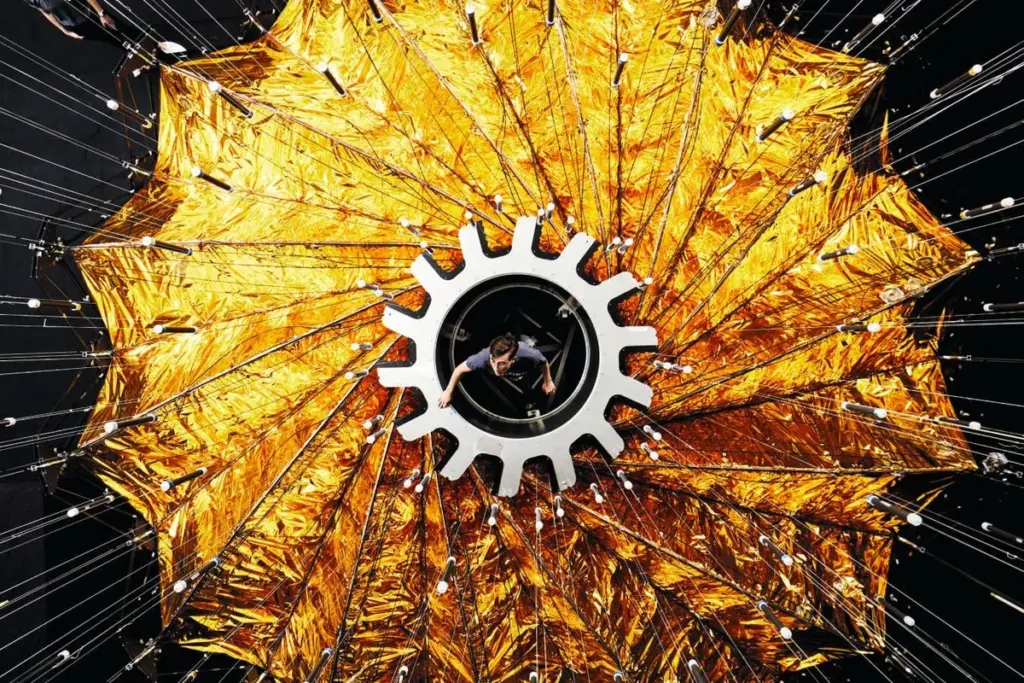
More recently, the sophisticated James Webb Space Telescope has become a pivotal tool in our exploration. The telescope’s complex star shade, crucial for its operation, necessitated an ingenious origami-like folding mechanism for its deployment during launch. A prototype of this remarkable engineering feat is captured in the feature image.
Dallas Campbell was born in the period immediately following NASA’s Apollo missions, an era that fundamentally altered humanity’s perception of the Moon and space. The impact of these missions is evident in his work, much like the distinct imprints left by astronauts on the lunar surface, a visual testament to human presence.
Campbell reflects on the permanence of these lunar footprints. “On Earth, footprints can fossilize in rock or wash away in hours,” he writes. “Here they will last for aeons, despite being formed in the finest of materials. The Sea of Tranquility has no tide to erase them. These are imprints that mark a moment when we migrated from our home planet to another.” This observation underscores the profound significance of these moments in human history.
Astronomy’s Journey Through Uzbekistan and the Silk Road
Uzbekistan offers a compelling narrative of astronomical contributions, interwoven with a rich scientific heritage and breathtaking natural landscapes. The region’s historical engagement with astronomy is particularly notable as a component of the extensive cultural exchange facilitated by the ancient Silk Road.
This network of routes connected diverse regions across Eurasia and beyond, fostering the transmission of knowledge and ideas. Within this framework, astronomy played a significant role. The interplay between celestial observation and cultural development along the Silk Road, particularly in key cities, highlights a dynamic period of scientific and societal interaction.