
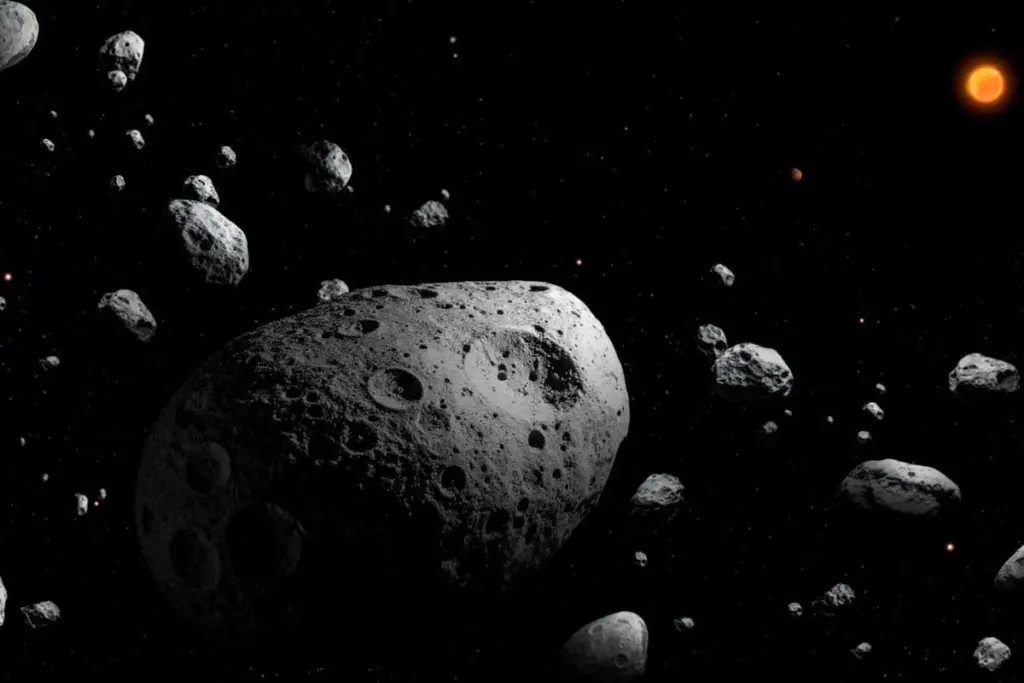
The Vera C. Rubin Observatory, situated in Chile, has detected the most rapidly rotating large asteroid ever observed. This celestial object, measuring over half a kilometer in diameter, completes a full rotation approximately every 1.9 minutes, a rotational speed previously believed to be unattainable.
Dmitrii Vavilov of the University of Washington in Seattle, leading a team of colleagues, identified this particularly fast-spinning asteroid. Their discovery, along with several other surprisingly swift rotators, emerged from data gathered during the Rubin Observatory’s initial nine nights of operations in late April and early May of 2025. Vavilov shared these findings at the Lunar and Planetary Science Conference held in Texas on March 17th.
Identifying Super-Fast Rotators
During this initial observation period, the research team successfully determined the rotational periods of 76 asteroids. Among these, 19 were categorized as “super-fast rotators,” characterized by their completion of a rotation in 2.2 hours or less. This threshold represents the theoretical maximum speed at which an asteroid composed of a “rubble pile” – a loosely aggregated collection of smaller rocks held together by gravity – can spin before disintegrating.
Given that the majority of asteroids are believed to be of the rubble pile composition, researchers did not anticipate finding many rotating faster than once every 2.2 hours. The fastest asteroid among the super-fast rotators identified in their initial analysis spins approximately once every 13 minutes. Vavilov mentioned during his presentation that their first set of analyses did not even search for objects with spin periods under five minutes.
“We thought that was crazy that they could rotate any faster,” he stated, reflecting on their initial assumptions.
Discovery of Ultra-Fast Rotators and a Record Holder
Upon re-examining the data with a focus on even faster rotators, the team identified three asteroids exhibiting such extreme speeds that they have been classified as “ultra-fast rotators.” These objects have rotational periods of roughly 3.8 minutes, 1.92 minutes, and 1.88 minutes. The most exceptionally fast of these, designated 2025 MN45, boasts a diameter of approximately 710 meters. Its rotation rate exceeds that of any asteroid larger than 500 meters across ever documented.
Implications for Asteroid Composition
The remarkable rotational velocity of 2025 MN45 strongly indicates that it cannot be a typical rubble pile asteroid. Its composition must be significantly more robust than that of most rocky bodies in space. “2.2 hours is supposed to be the limit for this asteroid, and yet it’s rotating in less than 2 minutes,” Vavilov observed. He further elaborated that the tensile strength required to hold such a rapidly spinning body together would exceed that of even clay, suggesting it is likely composed of a single large rock or possibly solid metal.
Future Discoveries with the Rubin Observatory
Over the next decade, the Vera C. Rubin Observatory is projected to detect numerous additional rotating asteroids during its comprehensive survey of the southern celestial hemisphere. These ongoing observations will provide astronomers with valuable opportunities to investigate the surprising diversity found among these space-bound rocks.
Journal Reference: The Astrophysical Journal Letters DOI: 10.3847/2041-8213/ae2a30