
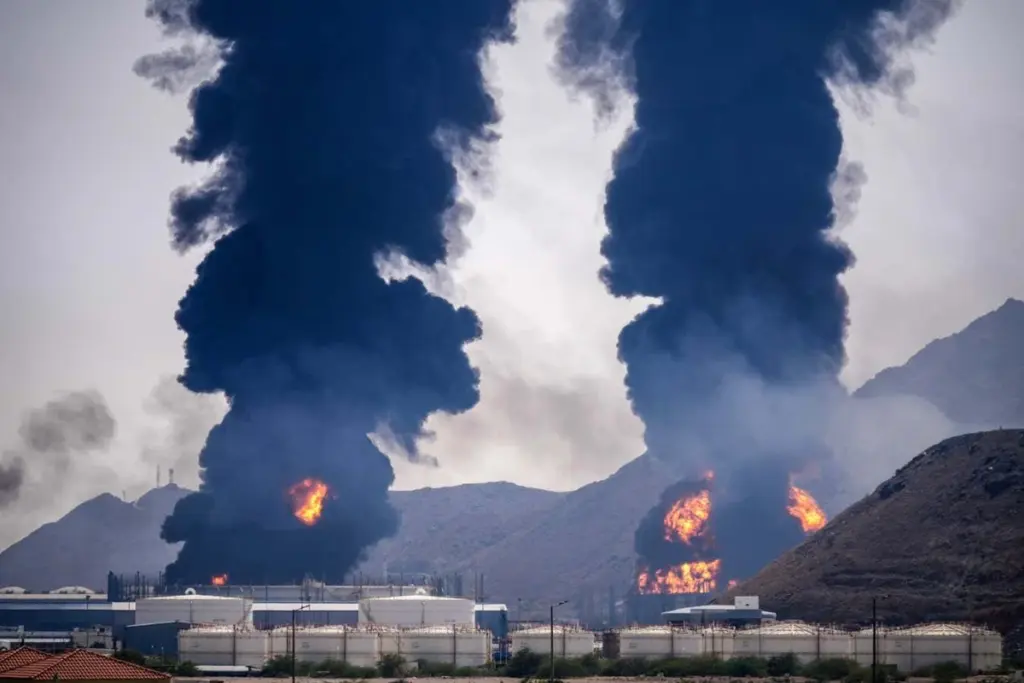
Donald Trump’s strong stance against climate action, often summarized by the slogan “drill, baby, drill,” has ironically propelled the green revolution forward due to recent events involving Iran. The Islamic Republic’s response to perceived provocations has effectively halted nearly all maritime traffic through the Strait of Hormuz. This vital waterway is critical, carrying one-fifth of global oil and a similar proportion of seaborne natural gas supplies. In parallel, Iran has employed drones and missiles to strike oil and gas fields, escalating regional tensions.
The immediate consequence has been a significant surge in oil prices, climbing from approximately $70 to over $100 per barrel. Natural gas prices have also seen sharp increases across most regions. Although Arab nations have managed to reroute a substantial portion of their fuel supplies via pipelines, the expectation is that prices will remain elevated. Even if oil prices stabilize at an average of $85 for the entire year, this scenario would impose an additional $240 billion cost on countries reliant on fossil fuel imports, according to the think tank Ember.
However, the report highlights that fully embracing renewable energy sources, electric vehicles, and heat pumps could offset this increased expenditure by as much as 70 percent. Sam Butler-Sloss from Ember observed that the conflict in Iran is almost certainly acting as an accelerant for the energy transition. He noted that rising prices and a heightened awareness of the fossil fuel system’s fragility make it increasingly apparent that nations require more secure energy alternatives. Furthermore, he pointed out that virtually every location globally benefits from abundant solar and wind resources.
Asia Faces a Vulnerable “Ukraine Moment”
The ramifications of this current energy crunch are poised to be more extensive than those experienced in 2022, following Russia’s invasion of Ukraine, which disrupted Russian oil and gas flows to Europe. In the aftermath of that conflict, the European Union’s annual solar capacity expansion more than doubled, and the UK’s increased by approximately two-thirds. Wind power generation has also continued its upward trajectory. Collectively, renewable energy sources now account for about 45 percent of the world’s total energy capacity.
Currently, Asia stands as the most vulnerable region, receiving four-fifths of the oil and liquefied natural gas (LNG) that transit the Strait of Hormuz. Japan and South Korea, for instance, depend on the strait for 70 percent of their oil supply, while a third of Taiwan’s natural gas originates from this route. India imports up to half of its oil and natural gas through the strait, with some restaurants reportedly compelled to limit menu options due to cooking gas shortages. Butler-Sloss aptly described this situation as “Asia’s Ukraine moment.”
Temporary Setbacks and Long-Term Shifts
In the short term, greenhouse gas emissions might actually increase. Countries like Japan and South Korea have begun to rely more heavily on coal for power generation, a fuel source twice as polluting as natural gas. Both nations are also stepping up output from their existing nuclear power plants. Conversely, Seoul has committed to expediting the financing, permitting, and grid access for wind and solar projects. India’s Prime Minister Narendra Modi announced on March 11 that solar power and electric vehicles would play a crucial role in reducing the nation’s dependence on foreign fuel imports.
Pavel Molchanov of investment firm Raymond James & Associates remarked that Asian economies are receiving a wake-up call, similar to Europe’s experience four years ago. He believes this will drive greater adoption of renewables within the electricity mix, as fossil fuels remain susceptible to disruptions. Analysts anticipate that China, already a global leader in solar and wind installations, will further accelerate its deployment in this sector. This is particularly relevant given that nearly half of its crude oil imports pass through the Strait of Hormuz. Simultaneously, as the world’s largest coal producer, China is also likely to increase its reliance on coal for its energy needs.
Li Shuo from the Asia Society Policy Institute stated that China will likely maintain its long-standing “all-of-the-above” energy strategy, a lesson he suggests many other countries will also draw. In nations with less developed electricity grids, the escalating costs of natural gas and diesel will make solar energy increasingly attractive for utility providers, villages, and individual households. Following Pakistan’s near exclusion from the LNG market after the Ukraine invasion, solar power’s contribution to its electricity production surged from 4 percent to 25 percent, largely credited to homes and businesses installing affordable Chinese solar panels.
Electric Vehicles and the Shifting Energy Landscape
Looking further ahead, electric vehicles (EVs) may emerge as the most significant global beneficiary. The majority of natural gas transportation occurs via pipelines, suggesting its prices could stabilize sooner. Oil, however, operates as a global commodity with a unified price. Consumers, even in major oil-producing nations like the United States, are facing substantial increases in fuel costs at the pump.
Consequently, more individuals are likely to consider purchasing EVs, and governments are encouraged to support this trend. Ember suggests that widespread EV adoption could reduce the energy bills of fossil-fuel importing countries by one-third. Nonetheless, Michael Liebreich, an energy consultant at Liebreich Associates, cautions that due to the average vehicle lifespan of nearly two decades, a significant increase in EVs on the road will take considerable time. He anticipates that the replacement of natural gas power with renewables will be more immediately visible and will continue even if gas prices decline.
Liebreich concluded that the narrative of continuously growing gas demand, in a world now equipped with inexpensive wind, solar, and battery technology, and increasingly wary of global commodity market dependencies, is fundamentally flawed and has ended. The focus has irrevocably shifted.