
Researchers have analyzed air bubbles trapped in a 3-million-year-old ice core, providing the first direct measurements of atmospheric gases from the late Pliocene epoch. This period is notable for its warmer global temperatures, estimated to be around 1°C higher than today, and significantly elevated sea levels, approximately 25 meters above current levels. The Pliocene is often referenced as a historical parallel for contemporary climate concerns. However, the concentrations of carbon dioxide and methane found within these ancient bubbles are considerably lower than current atmospheric levels. This finding could imply that Earth’s climate system is more susceptible to minor atmospheric shifts than previously understood.
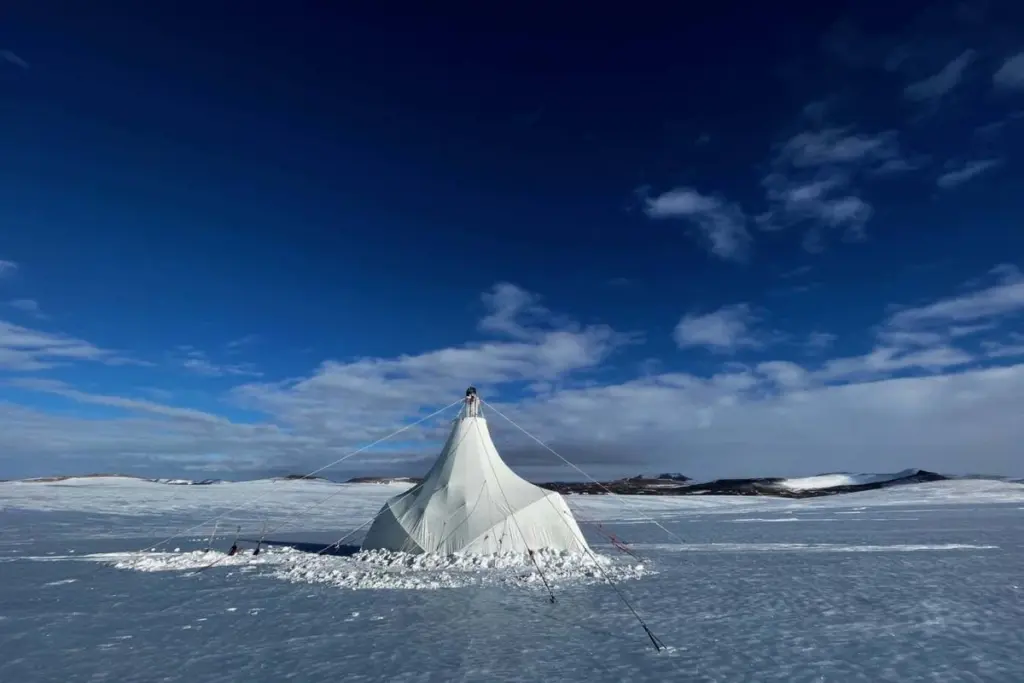
In certain regions of Antarctica, annual snowfall accumulates and compresses over time, forming layers of ice that encapsulate pockets of air. These air bubbles serve as a continuous record of Earth’s past atmosphere. The Beyond EPICA project successfully extracted the longest continuous ice record to date last year, extending back over a million years. Scientists have also identified even older ice formations in locations where prevailing winds have eroded younger ice layers, exposing older, dense “blue” ice closer to the surface.
A team led by Julia Marks-Peterson from Oregon State University utilized such ancient ice from the Allan Hills region. Their work offers the first direct quantification of carbon dioxide and methane concentrations in the Pliocene atmosphere approximately three million years ago. The findings revealed surprisingly low levels of both gases: 250 parts per million for carbon dioxide and 507 parts per billion for methane. During a subsequent cooling phase within the same epoch, the researchers observed a slight reduction in carbon dioxide, with no discernible impact on methane levels.
These direct measurements stand in contrast to prior estimations, which were based on indirect methods. Those indirect analyses had suggested carbon dioxide levels closer to the present-day 400 parts per million. Methane, for which no indirect measurement methods exist for past concentrations, currently hovers just below 2000 parts per billion.
“We were certainly surprised by the results,” stated Marks-Peterson. If these findings are accurate, they may indicate that even minor fluctuations in greenhouse gas concentrations could precipitate significant climatic changes. “It’s possible the Earth’s system is even more sensitive to CO2 variations than we’ve grasped,” she commented. “That’s a somewhat concerning prospect, and it’s something our current record cannot definitively confirm yet.”
Cristian Proistosescu of the University of Illinois Urbana-Champaign, who was not part of the research team, noted that any new data suggesting lower Pliocene CO2 levels than previously assumed could imply that future climate change might prove more severe than anticipated. However, he cautioned that further investigation is necessary before these findings can be reliably integrated into climate models.
Tim Naish from Victoria University of Wellington in New Zealand advised against drawing premature conclusions. “It is far too early to dismiss our existing understanding,” he remarked. Naish highlighted his interest in seeing the ice core record extended further back in time, particularly into periods when the Pliocene was even warmer.
Thomas Chalk, affiliated with the European Center for Research and Education in Environmental Geosciences, expressed confidence in the study’s low CO2 values. Nonetheless, he pointed out that distortions within ancient ice samples make it challenging to ascertain whether these low concentrations correspond to a cool period, a warm period, or simply an average measurement from the era. “The data represents something specific. We need to clarify what that something is,” Chalk explained. “The ice core does not inherently provide its own temperature estimate, let alone a global one.”
The research team intends to enhance the confidence in their analysis by cross-referencing their results with data from the continuous ice core obtained by the Beyond EPICA group. “This will enable us to achieve a better understanding of our own findings,” Marks-Peterson said. “We are all eagerly awaiting their discoveries.”