
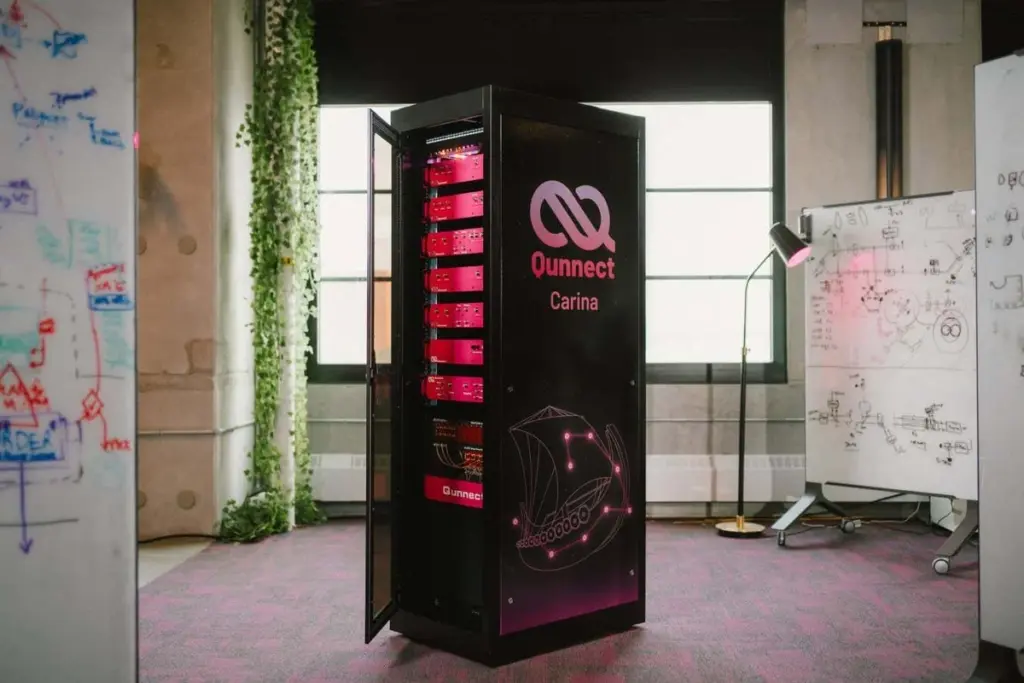
Medhi Namazi is offering quantum entanglement for sale. For nearly a decade, he and his team at Qunnect have been developing devices that make the sharing of quantum-entangled light particles, or photons, a practical reality for secure communication. At their Brooklyn, New York, headquarters, laboratories bustle with lasers, lenses, specialized crystals, and intricate components designed for manipulating light. These meticulously crafted elements are destined for enclosure within distinctive bright magenta boxes, ready to be dispatched to pioneers of future communication technologies.
Amidst the striking New York City skyline, Namazi unpacked a box for me. At first glance, the electronics within seemed unremarkable. However, when several of these units are assembled, they form what the company terms a Carina rack. It is these racks that enable remarkable quantum phenomena.
In February, Qunnect’s researchers successfully executed “entanglement swapping” over 17.6 kilometers of fiber-optic cable. This experiment linked Brooklyn and Manhattan, utilizing a commercial data center as an intermediary point.
Entanglement swapping involves the transfer of quantum entanglement’s unique properties from one pair of photons to another. Entangled photons exhibit extreme sensitivity to any interference, rendering the surreptitious theft of information virtually impossible. The entanglement swapping technique allows this inherent security to be extended across significant distances, paving the way for a long-distance quantum internet. Qunnect demonstrated consistent performance, swapping quantum entanglement between 5,400 photon pairs every hour. The system operated autonomously for days, a significant advancement over previous experiments that achieved rates at or below half this level.
Before a Carina rack can perform its function, entangled photons must first be generated by a separate apparatus. Examining the core of this “entanglement source,” I observed a compact glass and metal enclosure containing a vapor of rubidium atoms. When subjected to laser light, this vapor produces pairs of photons. Precision in the smallest details is crucial here. Namazi explained how his team enhanced the yield of entangled photons by precisely adjusting the angle at which laser beams entered the containment box.
Following their creation, the entangled photon pairs are directed by a Carina rack through a network of fiber-optic lines spanning New York City, reaching research facilities such as those at New York University and Columbia University. Namazi outlined the process of establishing a personal entanglement-sharing system for purposes like sending highly secure messages. “With two of these [Carina] racks, you can achieve entanglement distribution within a matter of hours,” he stated.
Qunnect maintains one such rack within a commercial data center in Manhattan, operated by the telecommunications firm QTD Systems. When I inquired with QTD’s Peter Feldman, his response mirrored Namazi’s viewpoint. “I don’t need any knowledge of quantum physics,” he commented. The devices responsible for sustaining the flow of entangled photons through Qunnect’s network are remotely controllable, and the process can continue autonomously for extended periods, often spanning weeks.
Efforts to construct an unhackable quantum internet are not confined to New York City. Several other metropolitan quantum networks are operational globally, including sites in Hefei, China, and Chicago, Illinois. In each instance, further development is necessary to fully realize their potential. A persistent challenge involves overcoming the loss of photons over long transmission distances.
Nonetheless, Namazi highlighted that access to quantum entanglement already offers tangible benefits. Entangled photons can be integrated into streams of conventional light-carrying information. They function as a form of quantum tripwire, capable of detecting any illicit attempts at interception. Alexander Gaeta of Columbia University, a collaborator with Qunnect, noted another near-term application: verifying user identity when exchanging sensitive data, based on precise location confirmation. This capability, too, stems from the quantum characteristics of entangled photons. Javad Shabani at New York University pointed out that numerous financial institutions, even within a single New York City neighborhood, stand to gain from these advancements. “Once the infrastructure is in place, end-users will follow, likely from just across the street,” he observed.
While the quantum internet remains a distant prospect for widespread adoption, the extent of its current operational status became apparent during a car journey from Qunnect’s headquarters to QTD’s data center. Crossing a New York bridge, I reflected on the journey of countless entangled photons that had traversed the same routes. Busy quantum denizens of New York, each with its own destination.