
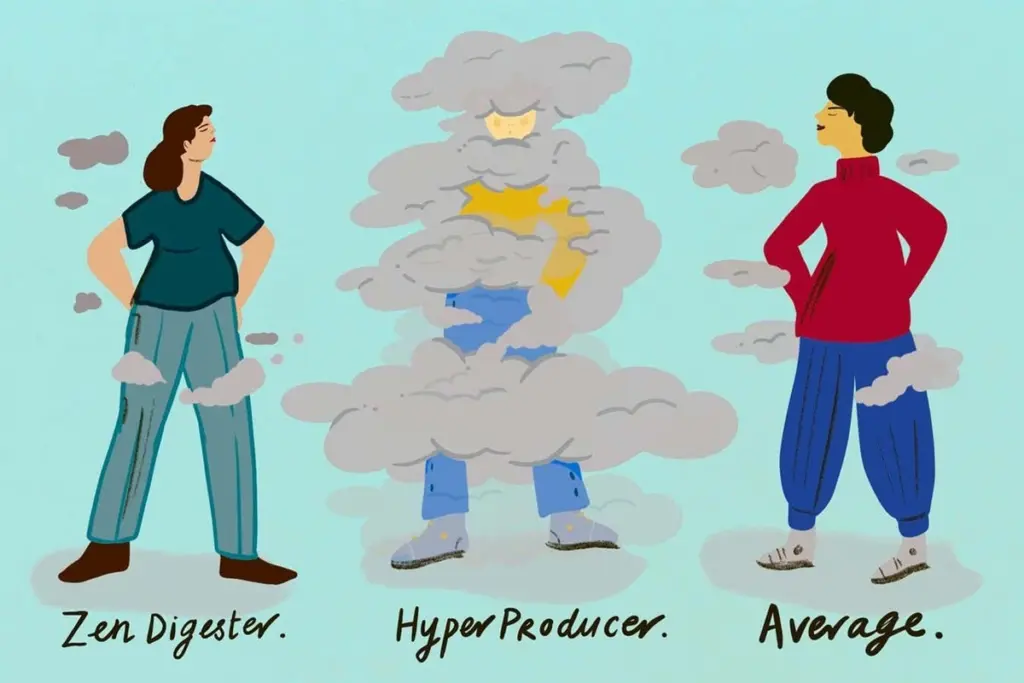
Feedback, a fixture in New Scientist for its often amusing observations on science and technology, thrives on reader contributions via [email protected]. This particular installment delves into two distinct realms: innovative, if unconventional, scientific measurement, and the evolving ways we attempt to comprehend artificial intelligence.
Measuring the Unmeasurable: Smart Underwear and Flatulence
The Feedback column boldly predicts a future Ig Nobel award for a research endeavor focused on the objective quantification of human flatulence. The project, described as utilizing biosensors embedded in “Smart Underwear,” appears tailor-made for the satirical science prize. A press release from the University of Maryland, forwarded by physics reporter Karmela Padavic-Callaghan, introduced the concept.
The core challenge addressed by the research is the lack of established normal ranges for flatulence, a stark contrast to well-defined biomarkers like blood glucose. Prior studies heavily relied on self-reporting, a method inherently flawed due to incomplete recall and imprecise judgment of gas volume. Moreover, the impossibility of logging nocturnal emissions poses a significant limitation, a fact readily apparent to anyone who has shared a sleeping space with another individual.
Enter the Smart Underwear developed by Brantley Hall and his colleagues. The press release characterizes it as “a tiny wearable device that snaps discreetly onto any underwear and uses electrochemical sensors to track intestinal gas production around the clock.” Upon investigating the term “tiny,” Feedback discovered the sensor itself measures 26 × 29 × 9 millimeters. While acknowledged as relatively small, the implications for participant attire, particularly skinny jeans, were noted.
Initial study findings indicate that “healthy adults produced flatus an average of 32 times per day,” a figure approximately double previous estimates. However, significant individual variation was observed, with daily totals ranging from as few as four to as many as 59 instances.
As the Smart Underwear technology becomes more widely distributed, the collected data is intended to populate the Human Flatus Atlas, a project with a dedicated website (flatus.info). The site allows individuals to sign up for flatus tracking and offers the enticement of categorizing users as “Hydrogen Hyperproducers” or “Zen Digesters” (those who emit minimal gas, even on diets conducive to it). The column humorously questions the sensors’ resilience against exceptionally substantial emissions, referencing a sensationalized report of a historical unexploded shell incident, suggesting such extreme cases might exceed the device’s capabilities.
The lead researchers have since established VentosCity to commercialize this technology. Their website is deliberately minimalist, featuring a gas animation, the slogan “Measure. Master. Thrive.,” and a promise of “The future of gut health is coming soon.” Feedback speculates this heralds the imminent arrival of a subscription-based mobile application.
Navigating the AI Landscape: Analogies and Concerns
As artificial intelligence infiltrates daily life, a need arises for accessible explanations. Given that a deep understanding of AI often requires advanced mathematical knowledge, metaphors and analogies have become essential tools for comprehension.
Feedback highlights several linguistic devices proposed to aid understanding of the AI phenomenon. One suggestion, originating from user “hikikomorphism” on Bluesky, is the concept of a “hungry ghost trapped in a jar.” This analogy serves as a litmus test for sensible AI usage: if substituting “AI” with “hungry ghost trapped in a jar” in a given context still yields a comprehensible statement, the AI application is likely reasonable. For instance, “I have a bunch of hungry ghosts in jars; they mainly write SQL queries for me” is deemed plausible, whereas “My girlfriend is a hungry ghost I trapped in a jar” is considered nonsensical.
The proliferation of unsolicited AI-generated content—including fake romance novels and AI summaries of various communications—necessitates a framework for expressing reactions. Building upon the internet acronym “tl;dr” (too long, didn’t read), the new phrase “ai;dr” is introduced, its meaning inferable from the context of unwanted AI output.
Anecdotes abound regarding AI’s spectacular failures in critical tasks. These include a venture capitalist’s AI tool accidentally deleting years of photos when tasked with organizing a desktop, and AI systems producing fabricated analytical data, often termed “hallucinations.”
In light of these observations, writer Nick Pettigrew’s comparison of AI to radium is cited. Pettigrew posits on Bluesky that AI, much like radium, possesses genuinely useful applications within specific, controlled environments. However, he warns that its widespread, indiscriminate integration into everyday items—from children’s toys to toothpaste—mirrors historical mistakes with radium, potentially leading to unforeseen harm that future generations will question. The irony is not lost on Feedback, noting a presumed AI deletion of their own commentary, a scenario ripe for becoming a modern equivalent of “the dog ate my homework.”
A New Name in Quantum Information Theory
It appears that over the years, the existence of quantum information theorist Toby Cubitt has somehow escaped Feedback’s notice until recently.