
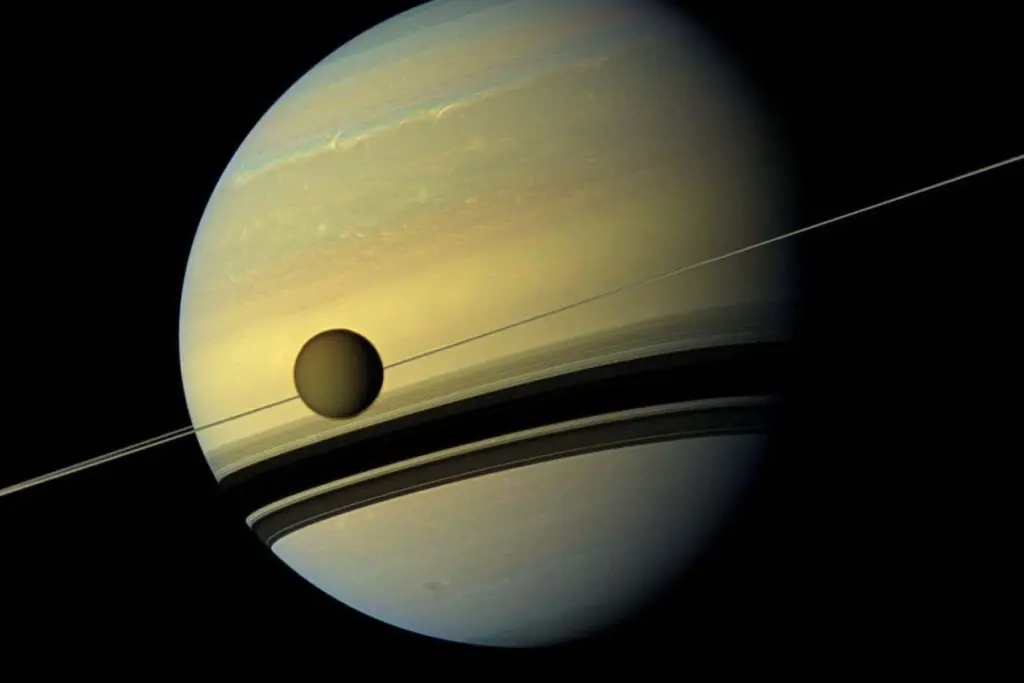
The intricate history of Saturn, encompassing its famous rings and numerous moons, may have its genesis in an event involving its largest satellite, Titan. An impact between an early proto-Titan and a smaller celestial body, occurring approximately 400 million years ago, could have initiated a cascade of events leading to the formation of Saturn’s distinctive rings and significantly altered the planet’s axial tilt and the orbital paths of its moons.
The Saturnian system remains a domain rich with unanswered questions. Observations reveal that its rings appear to be younger than conventional models suggest. Furthermore, the planet’s noticeable wobble is not synchronized with the orbital motion of Neptune, a discrepancy that existing simulations fail to fully explain. The orbit of Iapetus, a comparatively small moon, exhibits a peculiar inclination. Titan itself presents fewer impact craters than expected, and its orbit is notably eccentric, meaning it is more oval-shaped than circular.
A singular, substantial collision that ultimately shaped Titan into its current form offers a potential explanation for all these observed anomalies. Matija Ćuk of the SETI Institute in California, who spearheaded this research, describes the hypothesis as a “grand unified theory that covers all of the major problems.” He elaborates that while individual enigmas were understood to some extent, this new model proposes a cohesive narrative connecting them, which can then be subjected to empirical testing.
The framework begins with the postulation of an additional moon, named Chrysalis, residing in the outer regions of the Saturnian system. This concept was first introduced in 2022 as a means to account for the decoupling of Saturn’s wobble from Neptune’s orbital cadence. The prevailing idea was that Chrysalis was ejected towards Saturn, subsequently fragmenting to form the rings, thereby disrupting Saturn’s wobble and Iapetus’s orbital stability. However, Ćuk and his team’s simulations indicated that Chrysalis was most likely to collide with Titan.
This outcome posed a significant challenge. “If there was a collision with Titan, it could not have become the rings,” Ćuk explains. Consequently, he and his research group focused on calculating the consequences of such an impact. Their findings suggest that a collision between Chrysalis and Titan around 400 million years ago would have effectively erased pre-existing craters on Titan, shifted its then-circular orbit to an elliptical one, and generated a substantial debris field. The moon Hyperion might be a remnant of this debris, explaining its significantly younger age compared to Saturn’s other moons.
Subsequently, over an extended period, Titan’s altered orbital path would have disrupted the orbits of the smaller inner moons. This gravitational disturbance could have led to collisions among these inner satellites, gradually grinding them down into the fine particles that now constitute Saturn’s rings. Ćuk describes this as a process where “it all starts from Titan and then trickles down to a second catastrophe in the inner system.”
Sarah Hörst from Johns Hopkins University in Maryland notes the potential significance of this theory, stating, “If a collision with Titan 1.0 can explain many other things about the Saturn system, then I think that would really centre Titan as being pivotal to how we see the system today.” She further appreciates “the elegance of how many Saturn system problems it would solve at once.”
Crucial data that could either validate or refute this scenario is anticipated relatively soon. NASA’s Dragonfly mission, scheduled for launch in 2028 and expected to reach Titan by 2034, will conduct a detailed examination of Titan’s surface. Analysis of this surface composition should provide evidence to determine whether it did indeed merge with Chrysalis, potentially unlocking the secrets behind many of Saturn’s peculiar characteristics.