
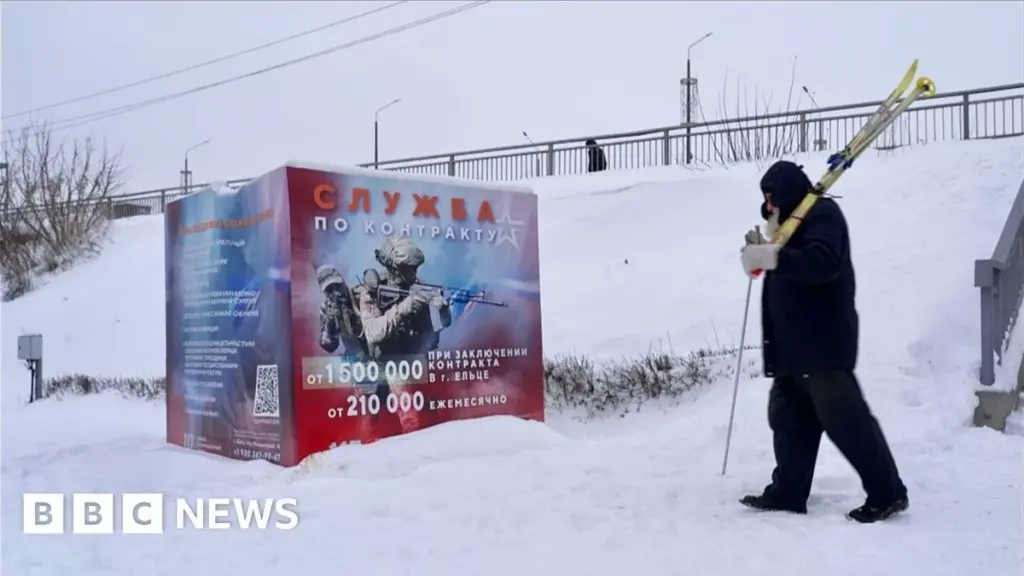
Yelets, a town nestled 350 kilometers south of Moscow, usually evokes images of a Russian fairy tale in its winter guise. Golden church domes gleam, and ice fishermen dot the frozen riverbank.
However, this picturesque scene is a fleeting illusion. Near the river, an army recruitment billboard offers a substantial lump sum, equivalent to £15,000, for those willing to enlist and fight in Ukraine. A nearby poster features a Russian soldier aiming a Kalashnikov, accompanied by the assertive slogan, “We’re there where we need to be.”
The War’s Unforeseen Trajectory
The Kremlin initiated its full-scale invasion of Ukraine on February 24, 2022. Internationally, this move was widely interpreted as an effort to reassert Moscow’s influence over Kyiv and fundamentally alter the post-Cold War European security order. The initial expectation from the Russian leadership was a swift and decisive military victory.
This strategic miscalculation proved significant. Four years on, the conflict in Ukraine continues unabated. Intriguingly, this prolonged war has now outlasted Nazi Germany’s ferocious campaign against the Soviet Union, an event commemorated in Russia as the Great Patriotic War.
In towns like Yelets, the tangible consequences of this protracted war are becoming increasingly evident.
The Faces of Loss and Persistent Hardship
One side of a nine-story apartment block in Yelets is dominated by a mural depicting the faces of five local men who perished fighting in Ukraine. At the mural’s apex, the inscription reads, “Glory to the heroes of Russia!”
While Russian authorities have refrained from releasing official casualty figures for the ongoing “special military operation,” Russia is known to have sustained considerable losses on the battlefield. Over the past two years, numerous towns and villages visited have established museums and monuments honoring soldiers killed in Ukraine, often dedicating specific sections at local cemeteries to these recent war dead.
“My friend’s husband was killed fighting there. My cousin’s son, too. And grandson,” shared Irina, a ticket collector at the bus station, when pausing to speak near the mural. “So many people have died. I feel for these young men.”
Irina’s personal financial struggles are stark. “Utility bills are suffocating us. Prices are crushing us. It’s very hard to get by,” she admitted, highlighting the economic pressures faced by many.
Despite her own financial constraints, Irina contributes by assembling aid packages for Russian soldiers on the front lines. She offered no direct criticism of the war but expressed clear confusion. “In the Great Patriotic War, we understood what we were fighting for,” Irina stated. “I’m not sure what we’re fighting for now.”
The War’s Shadow on Domestic Life
Although the Ukrainian border lies 250 kilometers away, the front line often feels much closer. The Lipetsk region, where Yelets is located, has experienced targeted attacks by Ukrainian drones. Emergency shelters have been erected throughout the area, including at a bus stop and within a local park, stark reminders of the conflict’s reach.
These concrete structures stand as silent testaments to President Vladimir Putin’s “special military operation,” a necessity born from the drone attacks that did not exist prior to the invasion.
Apartment buildings in Yelets also feature designated shelters in their basements. “The sirens go off almost every night,” Irina explained. “But I don’t leave my building. We just go into the corridor where there are no windows.”
Even seemingly innocuous details bear the war’s imprint. A local pancake cafe’s signage incorporates the Latin letters V and Z, symbols associated with the “special military operation.” Its accompanying slogan declares, “Grab a pancake, then the whole world.”
This slogan resonated with statements made by Vladimir Putin. “Where the foot of a Russian soldier steps, that’s ours,” he declared in St. Petersburg the previous year. Earlier, in Moscow, an electronic billboard displayed another of his pronouncements: “Russia’s borders do not end anywhere.”
Economic Strain and Public Discourse
Wars impose significant financial burdens. Russia’s growing budget deficit and stagnating economy have prompted the government to increase the Value Added Tax (VAT) from 20% to 22%. The Finance Ministry has indicated that these additional revenues will be allocated to “defence and security.”
State television channels have encouraged public acceptance of the situation. Dmitry Kiselev, a prominent TV anchor, told viewers, “We live in a time of war: a war forced on us by the West. We have to win it, and we can’t get by without a war budget.”
Small businesses are particularly affected. In a Yelets bakery, despite the inviting aroma of freshly baked goods, the owner, Anastasiya Bykova, cited economic downturns and tax increases as major challenges. “We’ve had to raise prices,” she stated, “because our utility bills, rent, and tax bills have all gone up. And the VAT increase means our ingredients are more expensive.”
“Imagine we all have to shut down: our bakery, and the restaurant opposite,” Bykova lamented. “We try to make our town look good. But if we close, what’s left? Just a dark grey patch.”
Deeper Roots of Concern
An hour’s drive from Yelets, in the regional capital Lipetsk, further reminders of the war are visible – more military posters and additional shelters. However, within his apartment building’s stairwell, pensioner Ivan Pavlovich’s immediate concerns are more mundane: a leaking pipe and a non-functional lift.
He expressed frustration over the lack of repairs and voiced complaints about high prices and escalating utility bills. When asked if he attributed these issues to the war, Ivan responded, “If I was younger, I’d go and fight there. The special military operation is excellent. It’s just that prices keep rising. Pensions go up, but then prices go up even more. So, what do I gain? Nothing.”
“Of course, we’d live more comfortably if there was no special operation,” he conceded. “They spend a lot of money on it. People also give what they can. We need to help. I’m not complaining.”
Many Russians perceive a worsening quality of life and feel a lack of agency to enact change. As the war enters its fifth year, optimism appears scarce. A prevailing sentiment among many residents is one of enduring hardship and hoping for better times ahead.