
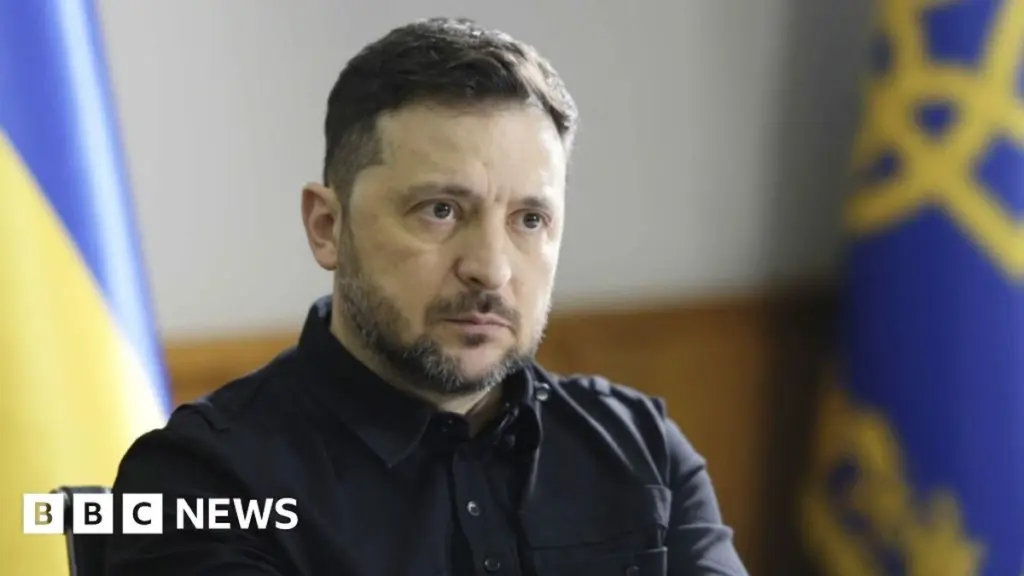
Volodymyr Zelensky, the President of Ukraine, continues to project an unwavering stance of defiance. During a recent meeting at the government headquarters in Kyiv, he articulated a conviction that Ukraine would emerge victorious from the ongoing conflict, emphatically rejecting any ceasefire terms that demanded territorial concessions to Russia. These concessions, he noted, represented strategic areas Russia had failed to capture despite significant human cost.
Zelensky asserted that President Vladimir Putin had already initiated a global conflict, and that the sole effective response involved applying robust military and economic pressure to compel Russia’s withdrawal. He explained, “I believe that Putin has already started it. The question is how much territory he will be able to seize and how to stop him… Russia wants to impose on the world a different way of life and change the lives people have chosen for themselves.”
Territorial Demands and Societal Impact
When questioned about Russia’s demand for Ukraine to cede approximately 20% of the eastern Donetsk region, including strategically important “fortress cities,” along with additional territories in the southern Kherson and Zaporizhzhia regions, and whether this constituted a reasonable price for peace, Zelensky offered a different perspective. He characterized such a proposal not merely as a land transfer but as an act of abandonment. This, he argued, would weaken Ukraine’s position and abandon hundreds of thousands of its citizens residing in those areas. The act of “withdrawal,” he was certain, would ultimately divide Ukrainian society.
He further elaborated on the potential consequences of agreeing to these terms. While acknowledging that it might temporarily satisfy President Putin and provide him with a much-needed pause, Zelensky anticipated that Putin would likely resume hostilities once he had recovered. Our European partners estimate this recovery period could range from three to five years, but in my assessment, he could regain strength in no more than a couple of years. His future intentions remain uncertain, but his desire to continue the conflict is a certainty.
The Setting and the Resilience of Leadership
The interview took place in a conference room within the heavily secured government complex situated in a prosperous district of central Kyiv. Throughout the discussion, President Zelensky primarily spoke in Ukrainian. The profound weight of his leadership was palpable, underscored by the meticulous diligence of his security detail. Rigorous security checks are standard when meeting any head of state, but accessing the presidential buildings in Kyiv involved a level of scrutiny rarely encountered.
This heightened security is understandable for a nation at war, particularly given that its president has reportedly been a target. Despite these pressures, Zelensky, who began his career as an entertainer, achieving a victory on Ukraine’s version of “Strictly Come Dancing” in 2006 and later portraying an unlikely president in a popular television comedy before assuming the real-life role, demonstrates remarkable resilience.
International Pressure and Ukraine’s Stance
Statements from influential figures, such as U.S. President Donald Trump, who urged Ukraine to negotiate swiftly prior to recent ceasefire talks, have suggested a tendency to place greater pressure on Ukraine than on Russia. Western diplomatic sources have indicated since last summer that Trump aligns with Putin’s view, believing that territorial concessions from Ukraine are crucial for achieving the ceasefire Trump desires, ideally before the upcoming summer.
A significant number of analysts outside the White House share the assessment that Ukraine might be unable to win the war without making concessions to Moscow, leading to a potential loss. When asked if Trump and his supporters had a valid point, Zelensky responded by asking where the interviewer stood at that moment. “Today you are in Kyiv, you are in the capital of our homeland, you are in Ukraine. I am very grateful for this. Will we lose? Of course not, because we are fighting for Ukraine’s independence.”
Defining Victory and Global Implications
Zelensky has consistently expressed Ukraine’s capacity for victory. When asked to define what victory would entail, he stated that it inherently meant restoring normal life for Ukrainians and ceasing the bloodshed. However, his broader conception of victory extended to addressing what he perceives as a global threat originating from Putin. “I believe that stopping Putin today and preventing him from occupying Ukraine is a victory for the whole world. Because Putin will not stop at Ukraine.”
Clarifying whether victory meant reclaiming all lost territory, Zelensky affirmed that this would happen, emphasizing it was a matter of time. He explained that achieving this immediately would result in immense human loss, given the size of the Russian army and the known costs of such actions. He posed a rhetorical question: “And what is land without people? Honestly, nothing.”
Furthermore, he noted the insufficient supply of necessary weaponry, contingent not only on Ukraine’s efforts but also on its partners. For these reasons, immediate territorial reclamation was not feasible. However, he concluded, “returning to the just borders of 1991 [the year Ukraine declared its independence, precipitating the final collapse of the Soviet Union] without a doubt, is not only a victory, it’s justice. Ukraine’s victory is the preservation of our independence, and a victory of justice for the whole world is the return of all our lands.”
Shifting Diplomatic Landscape and U.S. Relations
A year prior, Zelensky’s visit to the White House was described by a senior Western diplomat as a pre-arranged public “diplomatic mugging” orchestrated by Donald Trump and his Vice President, JD Vance. The interactions, broadcast globally, signaled a definitive shift away from the support Ukraine had received under President Joe Biden. NATO members were reportedly put on notice by the new administration, with Vance having recently addressed European allies regarding the robustness of the transatlantic alliance.
Since then, reportedly with guidance from figures like Britain’s National Security Adviser Jonathan Powell, Zelensky has strategically avoided public confrontations with Trump. The former U.S. President has significantly curtailed shipments of military aid to Ukraine. Nevertheless, the United States continues to provide critical intelligence, while European nations invest billions in acquiring American weaponry for Ukraine.
Addressing Trump’s often contradictory statements, including the accusation that Zelensky is a dictator who initiated the war—a claim mirroring those made by Vladimir Putin—President Zelensky responded with laughter. “I am not a dictator, and I didn’t start the war, that’s it.”
Trust, Guarantees, and Institutional Stability
When questioned about the trustworthiness of President Trump and the reliability of any security guarantees he might offer, given his tendency for changing positions, Zelensky shifted the focus. “It is not only President Trump, we’re talking about America. We are all presidents for the appropriate terms. We want guarantees for 30 years for example. Political elites will change, leaders will change.” His point was that U.S. security guarantees required congressional approval to ensure their long-term validity. “They will be voted on in Congress for a reason. It’s not just presidents. Congress is needed. Because the presidents change, but institutions stay.”
This implies that while Donald Trump’s personal commitment might be volatile, the institutional framework represented by Congress offers a more enduring assurance. Zelensky indicated that such congressional-backed security guarantees would need to be established before he could entertain another American request: the scheduling of a general election in Ukraine by summer. This demand echoes Russian talking points that question Zelensky’s legitimacy as president.
Zelensky stated that he had not yet decided whether he would seek re-election, whenever an election might take place. “I might run and might not.” Elections were originally scheduled for 2024 but could not proceed under martial law, which was enacted following Russia’s full-scale invasion. While acknowledging the technical possibility of holding postponed elections through legislative changes, he stressed the prerequisite of security guarantees for Ukraine.
He raised numerous practical challenges associated with conducting elections, given the millions of Ukrainian refugees abroad and substantial portions of the country under Russian occupation, leading to a suggestion that he was hesitant about the idea. “If this is a condition for ending the war, let’s do it. I said, ‘honestly, you constantly raise the issue of elections’. I told the partners, ‘you need to decide one thing: you want to get rid of me or you want to hold elections? If you want to hold elections, (even if you are not ready to tell me honestly even now), then hold these elections honestly. Hold them in a way that the Ukrainian people will recognise, first of all. And you yourself must recognise that these are legitimate elections'”.
Domestic Standing and International Demands
Volodymyr Zelensky faces opposition and intense criticism within Ukraine. His administration experienced a significant corruption scandal last autumn, resulting in the departure of his closest advisor. Despite this, leading a new team, Zelensky maintains approval ratings that most European leaders would aspire to. He has, at times, strained relations with allies through persistent requests for more and advanced military equipment. One criticism leveled against him by Trump and Vance in the Oval Office a year earlier was a perceived lack of sufficient gratitude.
The latest item on his agenda is securing licenses to manufacture American weaponry domestically, including Patriot air defense missile systems. “Today the issue is air defence. This is the most difficult problem. Unfortunately, our partners still do not grant licenses for us to produce systems ourselves, for example, Patriot systems, or even missiles for the systems we already have. So far, we have not achieved success in this.” When asked why such licenses were not being granted, he responded, “I don’t know. I have no answer.”
Concluding Remarks on Conflict and Future Strategy
At the conclusion of the interview, switching to English, Zelensky was asked if the world needed to prepare for an extended conflict in Ukraine. “No, no, no, it’s two parallel tracks… you are playing chess with a lot of leaders, not with Russia. There is not one right way. You have to choose a lot of parallel steps, parallel directions. And one of these parallel ways will, I think, bring success. For us, success is to stop Putin.”
Pressed further on whether Vladimir Putin would end the war without immense pressure, which he does not currently seem to be under, Zelensky offered a nuanced response. “Yes and no. We will see. Yes and no. He doesn’t want, but doesn’t want doesn’t mean he will not. God bless. God bless, we will be successful. Thank you.” Following these remarks, he posed for photographs, shook hands with the BBC team, and departed.