
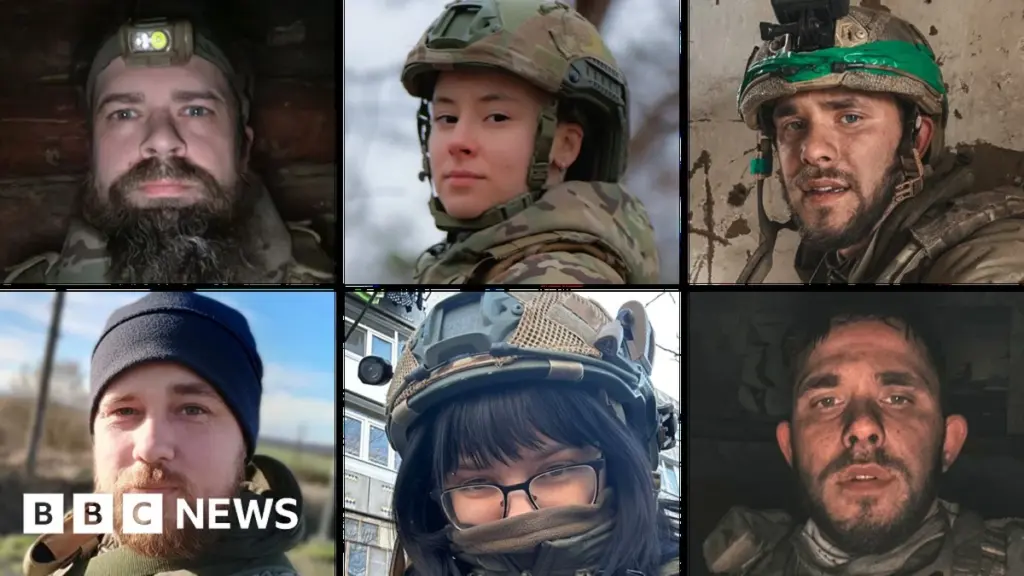
The commencement of Russian airstrikes on Ukrainian territory on February 24, 2022, unexpectedly transformed tens of thousands of ordinary citizens into soldiers. Many who had never handled a firearm before immediately enlisted. Over the ensuing four years, as the conflict persisted and the initial wave of patriotic fervor subsided, thousands more individuals have been conscripted. For men, military service is currently open-ended, applying to citizens between the ages of 25 and 65. Women have the option to serve on a contractual basis.
Nine Ukrainian soldiers, speaking from various frontline locations and support facilities, shared with the BBC their experiences transitioning from civilian life to military service. They reflected on the profound impact the war has had on their identities and well-being.
Olena, 26: “My place is here as long as the enemy is in my house.”
Recently, Olena was employed as a nightclub administrator in Prague. She recalls a perception of having ample time and a future brimming with possibilities. However, she soon recognized that inaction would mean remaining confined by her past. In December 2024, she returned to Ukraine, enlisted in the army, and commenced training as a pilot.
“Looking at my ‘before’ photograph, I see a calmer, more naive version of myself,” Olena states. “Everything has changed. I have changed.” Her former life, she explains, was characterized by a relentless pursuit of achievement and validation. “Now, the focus is simpler: ensuring my comrades-in-arms survive enemy assaults is paramount.”
For Olena, the most challenging aspects of war are not the moments of direct conflict or danger. “Sometimes the silence that follows news of casualties is the hardest part,” she admits. She finds solace in thoughts of her family, who, despite enduring weeks without light and heating away from the front lines, maintain hope for a better future. As long as the conflict continues, she cannot envision an alternative existence: “My place is here as long as the enemy is in my house.”
Oleh, 37: “I am not a military man; I have never envisioned myself that way.”
Like most Ukrainians, Oleh experienced confusion and fear upon the invasion’s commencement on February 24, 2022. While some fled towards the borders, others headed for recruitment centers. “I felt paralyzed, trying to overcome my apprehension,” Oleh recalls. A graduate in publishing and formerly an NGO worker, he never saw himself as suited for military life and struggled to comprehend how ordinary citizens could confront such a formidable adversary.
Despite his reservations, Oleh, who previously enjoyed role-playing board games and creative writing, joined the army the following month. He describes military life as a constant mental confinement: “You are perpetually within a confined mental space that shrinks with each passing moment. Outside, life continues unabated, but there is no exit from your own perceived limitations.”
The war has profoundly impacted his perspective. “Previously, I prioritized assisting others in finding their path to strength and self-confidence,” he shares. “Now, I understand that positive affirmations are ineffective against armed aggression.” Oleh views the act of confronting and neutralizing these threats as a tangible contribution, distinct from mere words. “You cannot save everyone,” he concedes, “but even your unsuccessful attempts carry significance.”
Anastasiia, 19: “Before, I lacked a clear understanding of life’s values.”
Upon completing school, Anastasiia was unsure of her future path, leading her to work as a barista. Her interest later shifted to drones, the agile and potent aircraft that have become central to the conflict in Ukraine. In March 2025, she enlisted in the army.
“Initially, I served as an unmanned systems duty officer before transitioning to an FPV (first-person view) operator role,” she explains. She has found that being a woman in the armed forces presented and continues to present significant challenges. “You are constantly compelled to demonstrate your worthiness for the role, on par with everyone else.”
In the eleven months since enlisting, Anastasiia believes she has gained a new appreciation for happiness. She lists “time with loved ones, love, delicious food,” and, crucially, “proximity to family, without the constant fear of not waking up tomorrow.” She reflects, “Due to my age, I previously lacked a clear grasp of life’s values. Now, my perspective is entirely different.”
Roman, 42: “I try not to dwell on the future.”
Before the full-scale invasion, Roman was a leading bio-engineer in Ukraine, specializing in creating 3D models for reconstructive facial surgery. Following the 2022 escalation, he volunteered as a medic and was subsequently mobilized. He notes that in the absence of war, he might have relocated to Copenhagen, where he frequently collaborated with prominent surgeons.
Instead, he has spent recent years in defensive positions across Ukraine. From his current post in the north, he focuses on the present: “I attempt not to contemplate the future; I live in the here and now.” His responsibilities include operating drones and applying his medical expertise whenever required. In many respects, he observes, his life remains intertwined with his work, much like it was before his military service.
The immediate prospects for an end to the conflict remain unclear. “I will rest after the war,” he says, then pauses. “No, there will be extensive reconstructive surgery required then. Perhaps, after that.”
Viktor, 28: “Looking at these photos, it’s like a different person.”
A photograph taken in early 2022, shortly before Viktor made what he describes as the most crucial decision of his life, captures him in a significantly different state. After completing four years of military service and relocating to Poland, he returned to Ukraine on the afternoon the Russian invasion began. “It wasn’t because I wasn’t afraid,” he asserts, “but because I had no other choice.”
“In these images, I appear young, like a boy,” he reflects now. “I can barely recall that version of myself. However, I remember vividly who I have become, and whom the war has shaped me into.” When he shared these photographs online, thousands of Ukrainian soldiers followed suit. “Our eyes convey a great deal; there’s no need to articulate the experiences we’ve endured.” Tragically, nearly all the friends with whom he enlisted have perished.
“Looking at these photographs, it feels like observing a different individual, yet it is still me – simply someone unaware of what lay ahead. It is likely fortunate that I remained uninformed.”
Serhii, 42: Two years as a prisoner of war
On the day of the Russian invasion, Serhii, then a civilian employed in a government role, joined the army. By springtime, he was among the thousands of Ukrainian soldiers captured by Russian forces during the protracted siege of the Azovstal steelworks in Mariupol. He endured over two years of captivity, an experience he describes as the most harrowing of his life. “That sensation of impending doom… Of all my experiences in the army and in life, that was the worst. Having no certainty about the future or what awaited me.”
During the lengthy siege, he speaks of “a profound reevaluation of my values – it felt as though one suddenly began to rush through life.” He contemplated his pre-war existence and set objectives for how he would live should he survive. He is currently undergoing rehabilitation and resides with his wife and two children. “If I look at a photograph of myself from before the full-scale invasion, I can only say one thing: ‘Oh, kid, you have no idea what still awaits you.'”
Kyrylo, 35: “I had plans – the war took them all away.”
Prior to 2022, Kyrylo’s life was fulfilling. He states, “I had a wife, two children, a house – everything I needed. I had plans.” He attributes the loss of these aspirations directly to the war.
Kyrylo was held captive in Russia for several weeks in 2022, witnessing the mistreatment of his fellow soldiers. “It was difficult,” he recounts, “when you cannot even stand up to defend them.” His return to freedom in Ukraine proved equally challenging. “Very often, you encounter situations where you are perceived as nobody. This is common for soldiers: while you are fighting, you possess significance, identity. Once you cease, then that’s it – you are nobody.”