
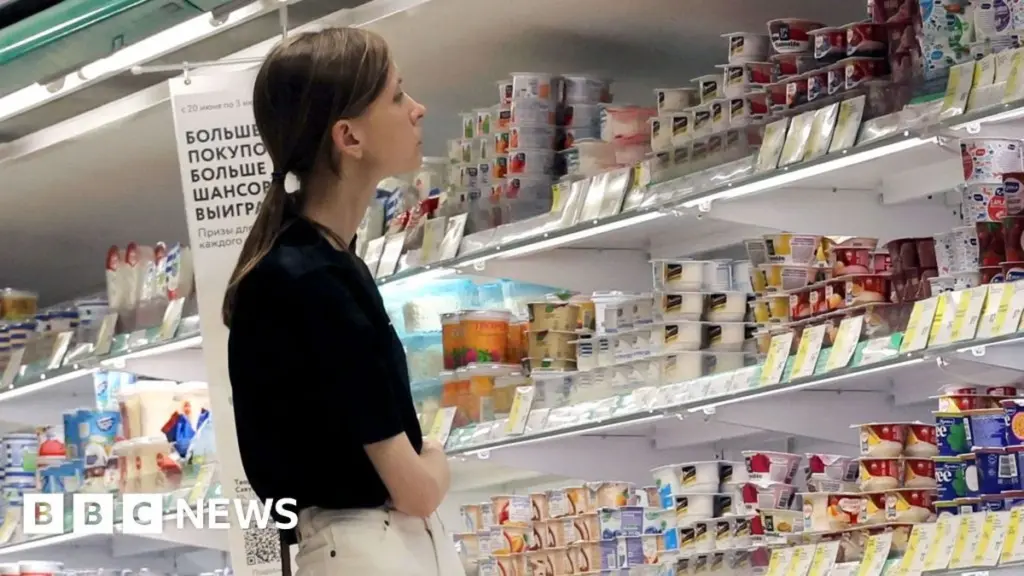
The rising cost of food is becoming a prominent concern for many in Russia, prompting questions about the direct impact of the ongoing conflict on ordinary citizens’ finances. Alexander, a Moscow-based advertising specialist, illustrates this growing pressure. In a single month, his food expenses escalated by over 22%, jumping from 35,000 to 43,000 rubles. This personal experience reflects a broader economic trend affecting Russians as the conflict in Ukraine enters its fourth year.
Across local supermarkets, consumers are observing price hikes on a wide range of essential items, including eggs, chicken, and seasonal vegetables. Even modest daily expenditures, such as Alexander’s morning Americano coffee, saw a significant increase, rising 26% from 230 to 290 rubles.
Economic Pressures and Shifting Consumption
These price increases have been a steady development in Russia since the full-scale invasion of Ukraine began. The national budget, heavily weighted towards the war effort and defense industries, has been a primary driver. Coupled with Western sanctions and a notable departure of foreign investment, the economic landscape has shifted. Initially, strong economic growth and increased living standards across the country largely masked the rising inflation, particularly in major urban centers like Moscow and St. Petersburg.
However, this period of rapid economic expansion notably slowed in 2025. As salary increases failed to keep pace with inflation, the growing cost of goods began to affect household budgets more acutely. This trend was further amplified at the start of 2026 when Russia’s statistics service, Rosstat, reported a stark 2.3% increase in supermarket prices within a single month.
The cost of daily necessities saw a broad increase at the year’s outset, impacting everything from meat and milk to basic provisions like salt, flour, and potatoes. Pasta, bananas, and personal care items such as soap and toothpaste also became more expensive, alongside laundry detergent and various medicines.
Tracking the Cost of Essentials
For several years, regular tracking of basic food costs has provided insight into these trends. Annually, since 2019, a consistent basket of 59 basic goods has been purchased from a specific supermarket chain, Pyaterochka, in Moscow. This basket encompasses a variety of items including fruits, vegetables, dairy products, meat, canned goods, instant noodles, beverages, and beer.
In 2024, this standard basket cost 7,358 rubles. By the following month, its price had risen to 8,724 rubles, marking an 18.6% increase. This figure aligns closely with Rosstat’s reported 18.1% accumulated food inflation from January 2024 through January 2026.
Among the most significant price jumps observed in this basket was an almost 15% rise in the cost of fruits and vegetables since 2024. Russia’s reliance on imported produce makes these prices particularly susceptible to fluctuations in the ruble’s exchange rate and disruptions to supply chains—factors that have both been affected by the conflict in Ukraine. Concurrently, the price of dairy products, largely produced domestically, has surged by 41%. This rise is attributed to increasing farm operational costs, higher interest rates on loans, and labor shortages within Russia’s dairy sector.
Government Policy and Consumer Adjustments
A recent contributing factor to price increases is the Value Added Tax (VAT) adjustment. Effective January 1st, VAT rose by two percentage points, from 20% to 22%. This tax increase is directly linked to government funding needs for the country’s “defense and security,” as stated by Russia’s finance ministry.
While some, like Alexander in Moscow, indicate minimal changes to their eating habits, others are feeling more significant impacts on their diets and family finances. Nadezhda, a 68-year-old retiree, can no longer afford beef and has shifted to less expensive fish varieties. She and her husband, reliant on state pensions and his additional income, dedicate their entire monthly pension of nearly 32,000 rubles to food expenses. This has necessitated deferring other planned expenditures.
Their savings, intended for car repairs, have been redirected to cover food costs. Similarly, the purchase of a new winter coat for Nadezhda’s husband, estimated at around 17,000 rubles, has been postponed to the following year. Kristina, a marketing specialist in her mid-40s, also had to dip into her savings for groceries last month. She and her husband, a personal trainer, are now more mindful of discounts, a change she observes in other shoppers as well.
Kristina describes her current approach as pragmatic, focusing on the protein content per 100 grams of a product rather than personal preference. The couple has stopped dining out, and even home-cooked meals for two have seen their cost more than double, escalating from approximately 1,000 rubles to over 2,000 rubles.
Economic Outlook and Potential Challenges
In the summer of 2025, Russia’s Central Bank Governor, Elvira Nabiullina, commented on the economy being near a “scenario of balanced rates of economic growth.” However, some economists suggest that following a substantial slowdown in the previous year, the Russian economy now faces the risk of contraction.
A primary risk identified for the current year stems from the oil market. The federal budget is predicated on high oil prices, yet market rates have declined since the beginning of the year with no immediate prospect of significant recovery. Russian oil sales have also been affected by recent U.S. sanctions that have disrupted supplies to India, a key trading partner for Moscow.
Consequently, Russian authorities are likely to contend with a larger budget deficit than initially projected. The high-interest-rate environment makes borrowing challenging, with limited willingness from lenders to engage with a nation actively involved in conflict and perceived as unreliable.
These factors could lead to further unpopular measures, potentially involving additional tax increases that would affect both individuals and businesses, or cuts to government spending, particularly in the public sector. Such actions could stifle economic activity and further reduce household incomes.
Tatiana Mikhailova, an economist and visiting assistant professor at Penn State University, noted for the BBC that “Overall, there is a trend towards stagnation and a possible decline in GDP.” While current indicators do not definitively point to an economic decline, she believes a significant possibility exists. Mikhailova suggests that “Every time oil prices fall, a recession is possible in Russia,” though she acknowledges the economy can sustain itself without growth for a period. For ordinary Russians, such economic forecasts offer little immediate solace as the impact of these trends is increasingly felt in their daily expenses.