
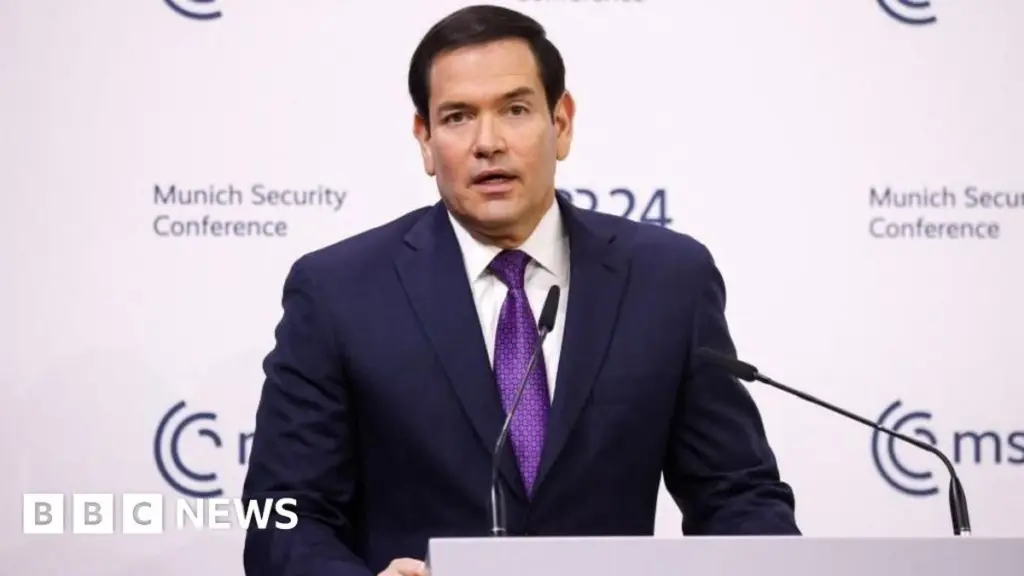
Munich recently hosted Europe’s most significant security and defense conference, drawing world leaders including French President Emmanuel Macron, German Chancellor Friedrich Merz, and UK Prime Minister Sir Keir Starmer. A central question loomed large: could Europe still count on America as an ally?
The highly anticipated keynote address was delivered by Marco Rubio, serving as the US Secretary of State. The prevailing anticipation was whether he would echo the critical remarks made about Europe by US Vice President JD Vance in the previous year, or if his tone would be conciliatory.
A Tense Opening to the Address
The venue was filled to capacity. Generals and admirals, adorned in their medals, along with prime ministers, presidents, diplomats, ambassadors, members of the US Congress, and European politicians and their aides, all convened with a palpable sense of nervousness, awaiting the words from what was considered President Donald Trump’s top diplomat.
The applause did not immediately follow Rubio’s initial remarks. Indeed, for the first few minutes, as he began to articulate his points, the speech strongly resembled a renewed criticism of Europe. Topics such as free trade, mass migration, and environmental policies related to climate change all faced pointed scrutiny.
He even characterized environmental advocacy as “a climate cult” that was detrimentally affecting America’s economy. Furthermore, he sharply criticized the United Nations, stating its inability to effectively resolve ongoing conflicts in Gaza and Ukraine.
The US Secretary of State, appearing impeccably neat and groomed, delivered his prepared remarks from a podium with one hand casually resting in his trouser pocket.
A Pivot Towards Reassurance
Then, Rubio uttered the phrase that resonated with everyone present: “Our destiny will always be intertwined with yours (in Europe).” He continued, emphasizing that “The end of the transatlantic era is neither our goal nor our wish… we will always be a child of Europe.”
Rubio proceeded to discuss “unshackling creativity,” the shared objectives in securing supply chains for essential minerals, and his admiration for European culture. He playfully referenced the continent’s contributions to the world, mentioning Shakespeare, Mozart, and even the Rolling Stones, which elicited a muted laugh from the audience.
However, his speech concluded with a significant caveat. He stated that the bond they shared was unique, and “we in the US have no interest in being polite and orderly caretakers of the West’s managed decline.”
Reactions and Lingering Concerns
The reception to Rubio’s speech was largely positive. Approximately half of the audience rose to applaud him at its conclusion. There was a discernible sense of relief that, following recent disruptions such as trade tariffs and concerns over potential US actions regarding Greenland, the transatlantic alliance remained intact.
“It was a good speech,” Kaja Kallas, the EU’s top diplomat, commented shortly afterward. “I think the Europeans sighed with relief because it conveyed that Europe is important, that Europe and America are very intertwined and good allies, and have been for so long and will be in the future.”
Kallas did acknowledge, however, that significant policy differences persist in certain areas between Washington and Europe. While both sides agree on the necessity for Europe to take on a greater share of its defense responsibilities, a quiet frustration was evident among some attendees in Munich regarding President Trump’s perceived reluctance to exert sufficient pressure on Russia to end the war in Ukraine, a conflict nearing its fifth year.