
Analysis of ancient DNA has shed light on the origins of a little-understood group that appeared in Britain around 2400 BC. Within a few centuries, these newcomers almost entirely replaced the original inhabitants, who were responsible for constructing iconic sites like Stonehenge.
These individuals are linked to the Bell Beaker culture, a phenomenon that emerged in western Europe during the early Bronze Age. The culture is named for the distinctive bell-shaped pots commonly found among their remains. While this culture likely originated in Portugal, a new study indicates that the people who ultimately came to dominate Britain originated from a different region: the river deltas of the Low Countries, situated across the North Sea.
This resilient population managed to preserve aspects of their hunter-gatherer lifestyle and genetic heritage for millennia, even as early farming communities spread across the European continent. David Reich of Harvard University and his colleagues meticulously examined the genomes of 112 individuals who lived in what is now the Netherlands, Belgium, and western Germany between 8500 and 1700 BC.
Reich himself admitted to initial skepticism about the project’s scope. “The Netherlands seemed like the most boring place in the world – every single bit of ground there has been walked on a million times before,” he commented. However, he quickly discovered that this region proved to be exceptionally significant, perhaps more so than any other in Europe.
A Unique Wetland Survival
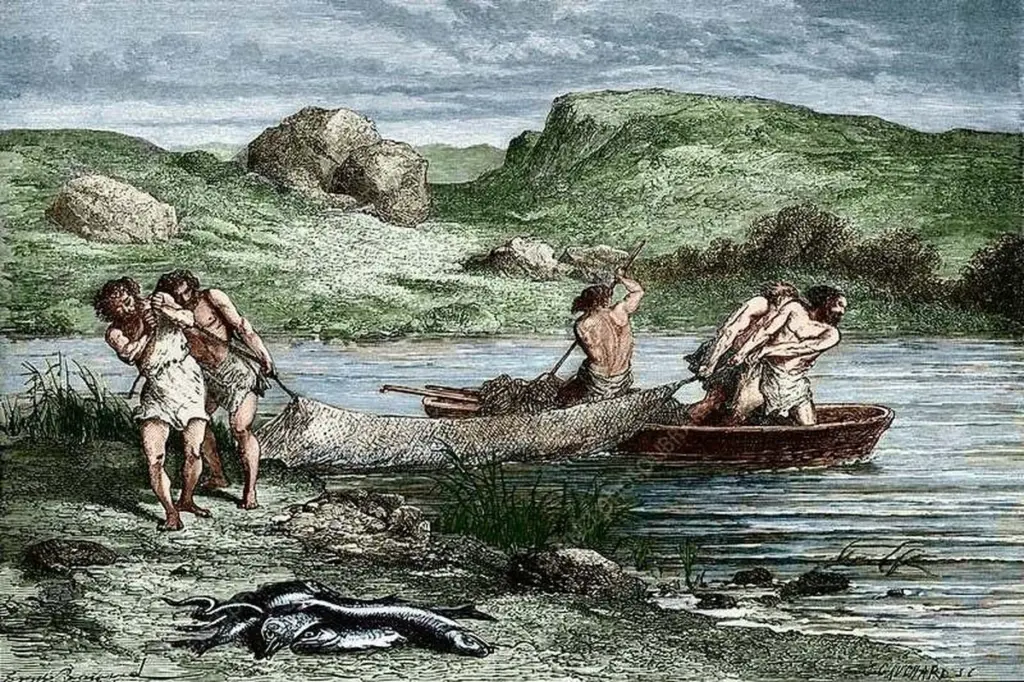
The DNA sequenced by Reich’s team revealed a population that had formed in the Rhine-Meuse delta, an area straddling the Dutch-Belgian border. These people descended from a resourceful group of hunter-gatherers who thrived in the waterlogged environments surrounding these major rivers. Their diet consisted of fish, waterfowl, game, and various plants.
The spread of Neolithic farmers, originating in Anatolia, across Europe commenced around 6500 BC. This expansion was likely driven by their ability to produce their own food, enabling them to support larger families compared to hunter-gatherer groups. Consequently, hunter-gatherer genetic ancestry diminished significantly or became heavily diluted in most areas where farmers settled.
However, the ancient DNA data reveals a different pattern in these wetlands. The encroachment of farmer genes remained relatively sparse. Luc Amkreutz from the National Museum of Antiquities in Leiden, Netherlands, a member of the research team, explained that the dynamic, frequently flooded landscape characterized by rivers, marshes, dunes, and peat bogs posed considerable challenges for early farmers. Conversely, it presented numerous opportunities for those adept at survival in such conditions. “These hunter-gatherers were carving their own path, from a position of strength,” Amkreutz stated.
Genetic evidence suggests these people were far from marginalized. Their Y chromosomes, passed down through the paternal line, maintained a predominantly hunter-gatherer lineage for an additional 1,500 years after the farmers’ arrival in the region. Meanwhile, their mitochondrial DNA and X chromosomes indicate a consistent influx of women from farming communities joining their ranks. “This really was a surprise to us,” remarked team member Eveline Altena of Leiden University Medical Center. “Something you can’t really tell without DNA.”
Archaeological findings suggest that this integration was largely a peaceful interaction between communities, with a tendency for women to relocate while men remained in their established homesteads, according to Reich. Nevertheless, he acknowledged that an element of coercion cannot be entirely ruled out. While exchanges between the groups might have occurred in both directions, DNA preservation in the drier areas inhabited by farmers is poor, leaving this aspect currently unconfirmed.
Over time, archaeological records show that the wetland hunter-gatherers gradually adopted pottery, cultivated some crops, and raised livestock. Crucially, these changes did not involve abandoning their fundamental way of life.
The Arrival of New Cultures
Around 3000 BC, a migratory group of herders known as the Yamna, or Yamnaya, originating from the steppes of present-day Ukraine and Russia, began migrating westward. Their descendants were associated with the Corded Ware culture, identifiable by the cord-like decorations on their pottery. This culture extended across much of Europe, yet it had a negligible impact on the delta region.
The study identified one skeleton from this period possessing a Yamna Y chromosome. Excavations also uncovered pottery, some of which showed evidence of being used for cooking fish—another instance of local inhabitants adapting foreign artifacts for their own purposes. Overall, however, few individuals in this population exhibited significant ancestry from the steppes.
This situation evolved around 2500 BC with the appearance of the Bell Beaker culture. These newcomers introduced steppe ancestry into the genetic makeup of the wetland populations. Despite this, a substantial 13 to 18 percent of their genetic heritage retained the characteristic blend of their hunter-gatherer and early farmer ancestry. It might have seemed at this point that their distinct identity was beginning to fade.
Replacement in Britain
The current study reveals that the individuals who arrived in Britain around 2400 BC possessed an almost identical genetic composition, a blend of Bell Beaker and local wetland community genes. Within a single century, they would nearly—or perhaps completely—replace the Neolithic farmers who had constructed Stonehenge. “Our models indicate that at least 90 percent, but up to 100 percent, of the original ancestry was lost [from Britain],” Reich stated.
It remains unclear whether this displacement began with the arrival of the Bell Beaker culture in Britain or if other groups had migrated there earlier. Prior to the Bell Beakers’ arrival, the inhabitants of Britain practiced cremation rather than burial, which significantly reduced the likelihood of preserving DNA for analysis.
Regardless of the exact timeline, the demographic shift was “very dramatic, unbelievable almost,” Reich commented. The reasons behind this swift replacement have fascinated archaeologists since it was first proposed by a 2018 study. Reich suggests that a disease, such as the plague, to which continental Europeans might have had prior exposure, could have been a factor. Individuals in Britain, conversely, may have been more susceptible.
“What probably didn’t play a role is religious fervour,” noted team member Harry Fokkens from Leiden University. “Existing monuments like Stonehenge and Avebury remained in use and were even expanded after the people who made them were gone.”
Michael Parker Pearson of University College London accepted the new findings without reservation. However, he expressed surprise at the extent to which the incoming population adopted not only the existing monuments but also many prevailing cultural trends in Britain. These included pottery designs and a peculiar reluctance to consume fish, suggesting that the population replacement was archaeologically subtle in many respects.
Nevertheless, the Bell Beaker people did introduce some of their own distinctive items to Britain. “Some gold hair ornaments found in Beaker graves in Britain are nearly identical to ones found in Belgium,” Pearson observed.