
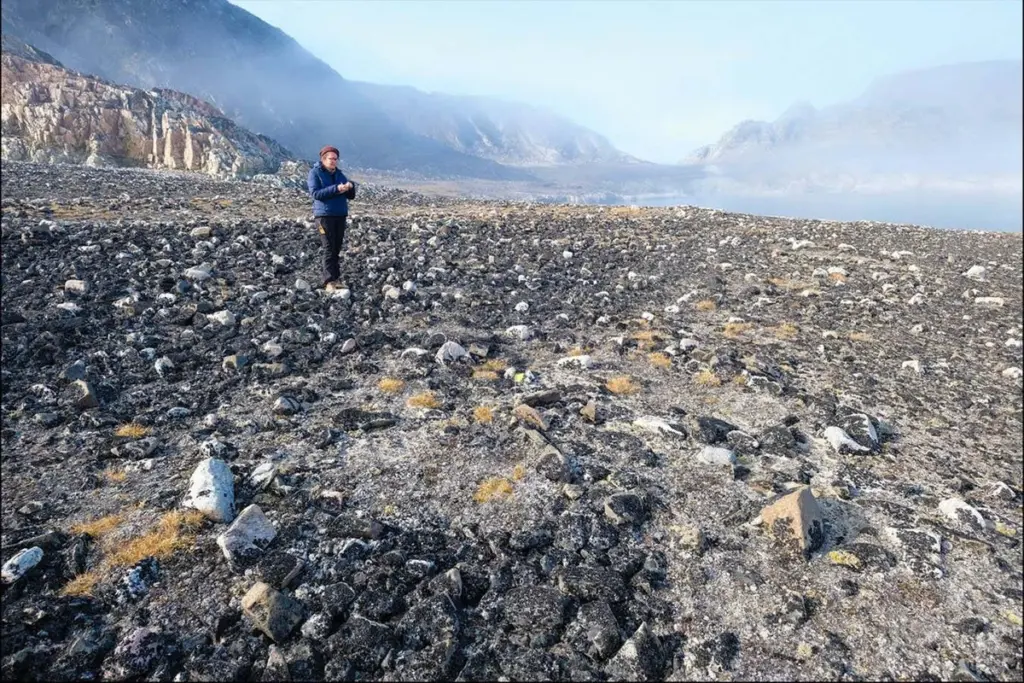
Evidence indicates that humans were traveling to remote islands off Greenland’s northwestern coast as far back as 4,500 years ago. This undertaking involved crossing over 50 kilometers of open water, representing one of the most extensive sea journeys documented for Indigenous peoples within the Arctic region.
Archaeologist John Darwent from the University of California, Davis, who was not involved in the recent study, suggests these early seafarers were the very first humans to ever reach these specific islands.
Discovery on the Kitsissut Islands
In 2019, a team led by Matthew Walls at the University of Calgary in Canada conducted a survey of the Kitsissut Islands, also referred to as the Carey Islands. These islands are situated to the northwest of Greenland, within an area known as the Pikialasuaq polynya. This polynya is characterized by open water completely surrounded by sea ice. Geological studies of marine sediments suggest that this ice-free zone only began to form approximately 4,500 years ago.
The research specifically focused on three of the central islands: Isbjørne, Mellem, and Nordvest. The team identified five distinct archaeological sites containing a total of 297 identified features. The most concentrated findings were located on Isbjørne, along ancient beach terraces. Here, researchers uncovered evidence of 15 circular tent structures. Each tent appeared to be divided into two sections by stones, with a central hearth area.
These distinctive “bilobate” tents are recognized as characteristic of the Paleo-Inuit, the initial human populations to inhabit northern Canada and Greenland.
Dating the Paleo-Inuit Presence
Walls and his collaborators undertook radiocarbon dating on a single wing bone from a seabird known as the thick-billed murre. This bone was discovered within the remnants of one of the tent rings. Their analysis estimates the bone’s age to be between 4,400 and 3,938 years old.
This age estimate strongly suggests that people were present on the Kitsissut Islands by this period, correlating closely with the relatively recent formation of the polynya.
Subsistence and Travel Routes
“There’s a nesting colony of thick-billed murre,” Walls commented. He hypothesizes that the inhabitants would have gathered their eggs and hunted them for sustenance. It is also suspected that seals were a part of their diet.
According to Walls, the Paleo-Inuit were already established in Greenland at this time. He proposes that they likely journeyed westward from the mainland to the Kitsissut Islands. “The shortest distance is about 52.7 kilometers.” However, considering prevalent ocean currents and wind patterns, it is more probable that they originated from a point further north, enabling a longer but safer crossing.
To the west of the Kitsissut Islands lies Ellesmere Island, now part of Canada. This route, however, is more distant, and the marine currents in that particular passage are known to be challenging.
Comparative Arctic Sea Journeys
The only other comparable sea voyage in Arctic prehistory that is documented involves the crossing of the Bering Strait. This 82-kilometer journey, connecting Siberia to Alaska, is believed to have been first undertaken at least 20,000 years ago. Crucially, the Diomede Islands offer a natural stopping point midway across this strait.
Ancient Seafaring Capabilities
Darwent pointed out that these ancient voyagers “did have to have some sophisticated watercraft in order to cross that stretch of water.” Considering the evidence for a community on Kitsissut, it is unlikely that single-person kayaks would have been sufficient for transporting entire families, including children and potentially elderly individuals, on such a voyage.
Instead, it is theorized that the Paleo-Inuit utilized larger vessels capable of carrying approximately nine to ten people. While no boat remnants were recovered on Kitsissut, such items are generally scarce in Arctic archaeological contexts.
Walls identified these watercraft as likely being “skin-on-frame watercraft,” similar to those later used by Inuit communities.
Ecological Impact of Early Settlers
Walls further suggested that these initial Paleo-Inuit settlers played a role in shaping the ecosystem of the Kitsissut Islands. By transporting nutrients from the sea and depositing waste on land, they contributed to the fertilization of the otherwise barren soils, encouraging vegetation growth on the islands.
“You have rich vegetation there, at least at the start, that’s dependent in some ways on humans who are part of the cycling of nutrients between those systems,” he explained.
Journal reference: Antiquity DOI: 10.15184/aqy.2026.10285