
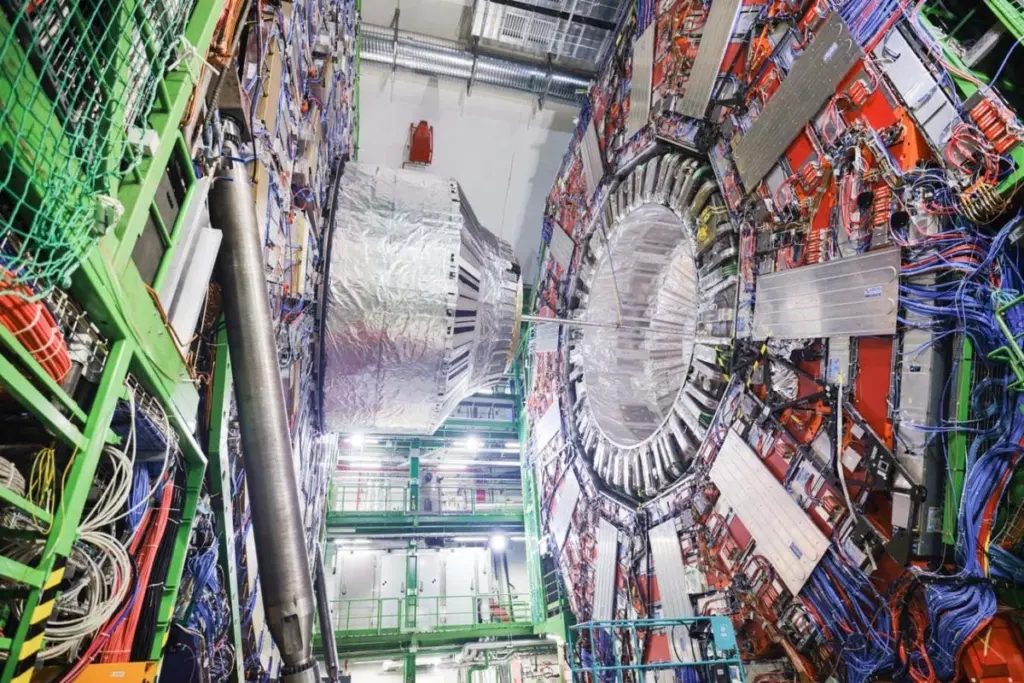
British scientists are voicing grave concerns about the detrimental effects of proposed budget reductions on the nation’s physics research endeavors. Research groups across the UK are anticipating average funding cuts of 30 percent, with some being asked to plan for reductions of up to 60 percent. This fiscal tightening is expected to lead to the complete loss of funding for numerous research groups, a significant decrease in available research positions, and the UK’s potential withdrawal from major international collaborations, such as the CERN particle physics laboratory near Geneva.
UK Research and Innovation (UKRI), a public entity overseeing science and business funding under the Department for Science, Innovation and Technology, has announced a four-year budget totaling £38.6 billion. While UKRI claims this represents a marginal increase, it fails to account for inflation. Nevertheless, the organization has signaled an impending significant reduction in funding specifically allocated to physics research.
UKRI’s mission is twofold: to advance scientific research and to generate economic returns for the United Kingdom. Ian Chapman, the organization’s chief executive, stated on February 5th that a primary focus is shifting towards commercialization. He explained, “We’re a public body, in service of the UK public. The public should expect us to make those hard choices to make sure we make the biggest impact to the country, to grow our economy.”
Funding is distributed through nine councils, with the Science and Technology Facilities Council (STFC) specifically addressing particle physics, nuclear physics, and astronomy. This council manages the UK’s financial contributions to CERN and the European Space Agency. STFC is reportedly facing the brunt of the cuts, with a significant reduction of £162 million anticipated.
Institutions receiving STFC funding have been informed to prepare for an approximate 30 percent overall reduction. However, they have also been required to draft contingency budgets reflecting potential cuts of 20 percent, 40 percent, and 60 percent, according to the Institute of Physics (IOP). The IOP has described these developments as a “devastating blow for the foundations of UK physics.”
Paul Howarth, IOP president-elect, issued a statement asserting that these cuts would impede “human understanding of the universe and human progress.” He highlighted the role of the Large Hadron Collider in advancing fundamental knowledge of the universe and its constituents. Furthermore, he noted that accelerator technologies developed for particle physics find applications in X-ray facilities and novel cancer treatments. “This cut in UK funding will hold up advances in its experimental capability, which will mean less innovation and ultimately less economic growth,” Howarth warned. “We urge the government to step back and consider how its new funding strategy will impact UK science.”
Michele Dougherty, executive chair of STFC, acknowledged in a briefing that the organization had previously set overly ambitious goals. “We’re spread much too thinly, we’re trying to do too many things,” she commented. Dougherty added, “We’ve got a difficult couple of years in front of us. We simply don’t have the money to do everything.” She also conceded that international collaborations in particle physics were nearing their end due to financial constraints affecting all partners.
John Ellis, a researcher at King’s College London, believes these cuts will damage the UK’s international scientific standing. He expressed concern that this could lead to the UK being perceived as an unreliable partner in global scientific endeavors. “That’s not the way forwards for international collaboration, and it risks labelling the UK as an unreliable partner,” Ellis stated. He posed a rhetorical question, asking how international collaborators could be assured of the UK’s commitments.
The ATLAS experiment at the Large Hadron Collider, instrumental in the discovery of the Higgs boson, is among the affected projects. UK funding was slated to support a crucial upgrade during the experiment’s planned shutdown period. Ellis expressed uncertainty about how this will be resolved.
The LHCb experiment, focused on investigating the distinctions between matter and antimatter, is also facing a complete cessation of its budget, according to Ellis. This development jeopardizes plans to enhance its detectors. Reports suggest that the US-led Electron-Ion Collider, currently under construction at the Brookhaven National Laboratory in New York, is another project potentially impacted. UKRI has not confirmed the status of these specific projects when approached by New Scientist.
Ellis further cautioned that the broader reductions in physics research funding could have substantial long-term consequences for the UK, particularly with the projected loss of postdoctoral and junior researcher positions. “What you risk doing is cutting a whole generation of our young researchers off at the knees,” he remarked, emphasizing that the impact would be significant.
Jim Al-Khalili from the University of Surrey warned that the proposed cuts would diminish the pool of knowledge, skills, and experience necessary for operating the UK’s nuclear industry, in addition to broader research implications. “These proposed cuts are going to be devastating for our community,” he stated. “If this goes through, the impact on the core programme will be catastrophic.”
Alicia Greated, representing the Campaign for Science and Engineering, a body advocating for UK research institutions, criticized UKRI’s communication strategy regarding the cuts, which she believes has generated considerable confusion and uncertainty. “Regardless of the rationale behind the decision to make savings in the STFC budget, which we do need further clarity on, the impact is the same,” Greated said. “STFC facilities support all research in the UK, not just that in the physical sciences. Less money for them could undermine a critical part of our research infrastructure.”