
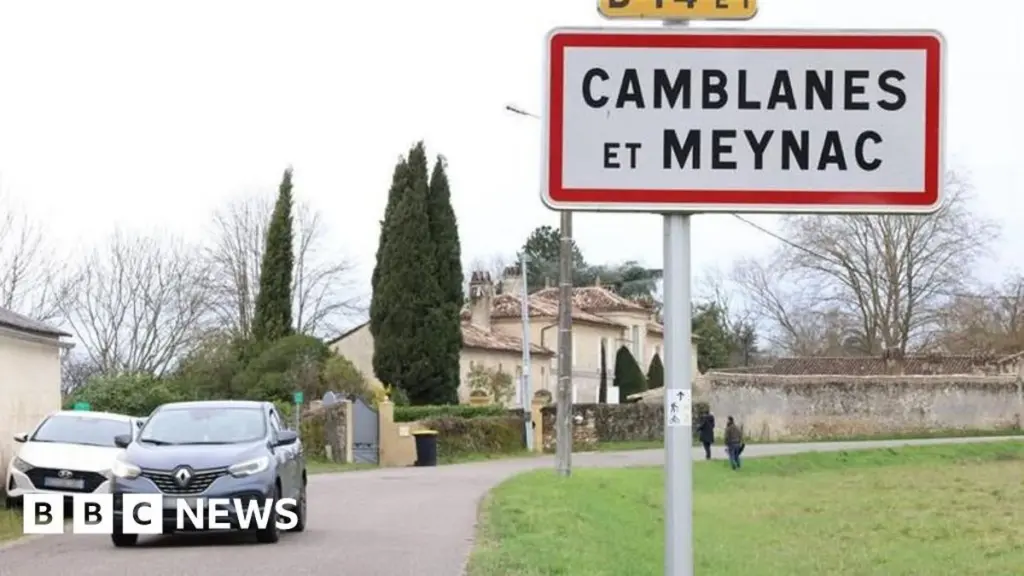
Two individuals, believed to be Chinese spies, have been apprehended in a tranquil village in southwestern France. Authorities accuse them of using their residence to gather intelligence.
The quiet community of Camblanes-et-Meynac, located approximately 15 miles (9 km) from Bordeaux, became alert when a Chinese couple, renting a property through Airbnb, installed a substantial parabolic antenna in their garden. This large dish was pointed towards the sky. Neighbors soon noted that its installation coincided with disruptions to their own internet services.
Intelligence analysts suggest that southwestern France is increasingly becoming a target for Chinese and other espionage efforts due to its strategic proximity to critical defense, aerospace, and telecommunication facilities. This region’s infrastructure makes it a prime area for information gathering.
Intelligence Agency Raid and Charges
Last Saturday, officers from France’s General Directorate for Internal Security (DGSI) executed a raid on the residence. A significant amount of computer equipment was confiscated. The detained individuals, Chinese nationals aged 27 and 29, were subsequently questioned at DGSI headquarters in the Paris suburbs. They have now been formally charged with “delivering information to a foreign power… likely to damage the interests [of France].” Both are currently being held in custody.
The prosecutor’s office revealed that the men had arrived in France the previous month under work visas. Their declared profession was that of engineers specializing in wireless communications. Two additional individuals of Chinese origin, who reside in France, have been charged with providing assistance to the suspected spies.
According to the prosecutor’s office, the alleged spies were reportedly attempting to intercept satellite data from Elon Musk’s Starlink network. Furthermore, they are believed to have targeted data from vital entities, particularly military installations, with the intent of transmitting this information back to China.
Previous Incidents in the Region
This is not the first instance of suspected Chinese espionage activities in southwestern France. During the summer of the previous year, a 51-year-old Chinese engineer was detained in Boulogne-sur-Gesse, a village situated about 40 miles southwest of Toulouse. She too had installed a satellite dish and was suspected of attempting to intercept signals from the Issus-Aussaguel ground station located in the Toulouse suburbs.
More recently, in December, a mathematics researcher affiliated with the University of Bordeaux’s Institute of Mechanics and Engineering was placed under judicial investigation. This action stemmed from accusations of “providing information to a foreign power” after allegedly granting access to a restricted area to members of a Chinese delegation.
Strategic Importance of Southwestern France
“We don’t know the exact activities of the pair in Camblanes-et-Meynac, but the range of potential targets in southwestern France is extensive,” commented Jeremy André, an expert on Asian espionage at Intelligence Online. The region’s significance extends beyond the Issus-Aussaguel station, which facilitates communication with satellites used by French military and intelligence services. Bordeaux-Mérignac hosts a major airbase, and major defense contractors like Airbus, Thales, and Dassault all maintain facilities in the area.
André further explained that southwestern France has been a critical zone for French defense research since World War One. The initial strategic decision was to locate these activities as far as possible from potential frontlines, a practice that has persisted. He noted that China has actively engaged in developing cooperative relationships with towns and other local authorities in the southwest, utilizing legitimate diplomatic and economic channels. While these interactions are not inherently problematic, they can establish a network of connections that might be leveraged at a later time.
Shifting Approach to Espionage Cases
Intelligence experts indicate that French authorities have recently opted to pursue such cases through the courts. Previously, these matters were more commonly handled covertly. This shift suggests a heightened determination to publicize the espionage threat posed by China.
In Camblanes-et-Meynac, the local residents expressed surprise at the events. Mayor Jean-Philippe Guillemeot remarked, “Here, we tend to attract artists, not spies. Perhaps they simply desired a pleasant and quiet location.”