
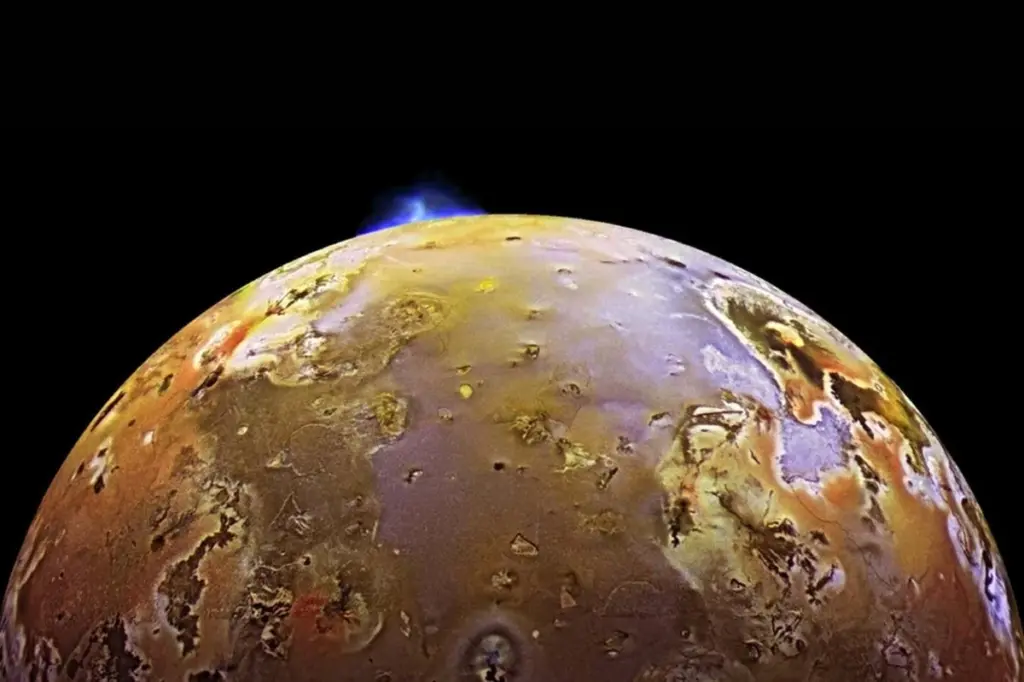
Jupiter’s moon Io experienced a simultaneous eruption from five volcanoes, an event marked by a significant outpouring of lava. This clustered activity indicates a probable connection to a single, extensive magma system beneath the moon’s surface, a finding that could help unravel the mysteries of Io’s internal structure.
In late 2024, scientists observing Io with NASA’s Juno spacecraft detected an exceptionally large lava flow near the moon’s south pole. “What initially caught our attention was a single, immense eruption and lava flow,” stated Jani Radebaugh from Brigham Young University. “However, upon closer inspection, numerous other heat signatures also became apparent. The sheer volume of magma involved is difficult to fully comprehend.”
The area affected by the erupted lava covered approximately 65,000 square kilometers. Furthermore, the eruption released an energy output exceeding any previously recorded event on Io. Radebaugh described the surreal experience: “Imagine standing at the edge of one of these geological features. A valley that was previously cold suddenly becomes inundated with an entire lake of molten rock. As this lava fills the area, you would turn and notice another substantial fissure opening in the ground, simultaneously filling with lava.” She added, “It would be both terrifying and breathtakingly beautiful.”
A central question remains: the origin of this immense volume of magma. Io’s interior composition is not well understood, making this a challenging puzzle to solve. Prior research has contradicted the long-held scientific assumption that Io possesses a global magma ocean beneath its crust. This absence raises questions about how such a vast quantity of magma could erupt simultaneously across the surface.
Radebaugh and her team propose a novel hypothesis: a “magma sponge” might exist beneath extensive regions of Io’s surface. They suggest this could be an interconnected network of porous spaces that fill with magma and subsequently expel it through surface volcanic vents. Further observations are necessary to confirm this theory. However, with Juno having shifted its orbit further from Io, acquiring such data in the near future appears unlikely.
Despite Io’s relatively small size, comparable to Earth’s moon, the extreme nature of these eruptions mirrors volcanic activity on Earth. Radebaugh noted that Io’s volcanic processes are akin to those of early Earth when it was a much hotter and more geologically active planet. Consequently, studying Io offers considerable insights into Earth’s own past. While the precise cause of this powerful series of eruptions may remain elusive for now, its eventual explanation could shed light on a significant aspect of our planet’s history.
Journal Reference: JGR Planets DOI: 10.1029/2025JE009047