
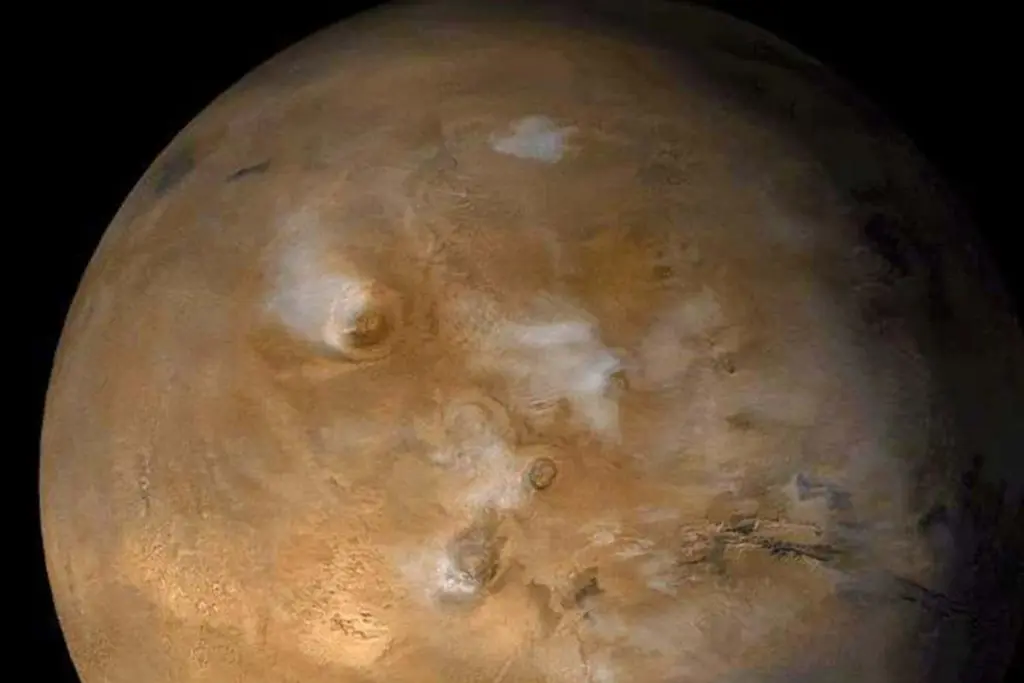
While Earth dwarfs Mars in size, the Red Planet exerts a disproportionately significant influence on our planet’s climate cycles. This observation has led researchers to consider that similar small planets could similarly impact the climates of worlds beyond our solar system, a factor crucial for assessing their habitability potential.
Stephen Kane, based at the University of California, Riverside, along with his research team, investigated this phenomenon through simulations. They modeled Earth’s orbital behavior under various Martian masses, ranging from a hypothetical 100 times its current mass to its complete absence. Kane himself expressed initial skepticism, finding it difficult to believe that a planet one-tenth Earth’s mass could so profoundly affect terrestrial cycles, which prompted this detailed exploration.
Understanding Earth’s Orbital Dynamics
Earth’s climate is shaped by long-term cycles tied to its orbital eccentricity—the degree to which its path around the sun deviates from a perfect circle—and its axial tilt. The gravitational forces of the sun and other planets dictate these orbital parameters, which in turn influence critical climatic events such as ice ages and the intensity of seasonal variations.
One of the most notable of these cycles is the “grand cycle,” which spans approximately 2.4 million years. During this period, Earth’s orbit elongates and then returns to a more circular shape. This fluctuation directly alters the amount of solar radiation reaching Earth’s surface, thereby regulating long-term climatic shifts.
The Impact of Mars’s Mass
The research revealed that removing Mars entirely from the simulations caused the grand cycle to vanish, as did another 100,000-year cycle in Earth’s eccentricity. Kane clarified that this does not imply Earth would cease experiencing ice ages without Mars; rather, it would fundamentally alter the frequency of such occurrences and related climate effects.
Conversely, when the simulated mass of Mars was increased, these cycles became more frequent and intensified. However, a third eccentricity cycle, lasting about 405,000 years and primarily influenced by the gravitational pull of Venus and Jupiter, persisted regardless of Mars’s mass. This indicates that while Mars is not the sole driver, its impact is more considerable than previously understood.
Stabilizing Earth’s Axial Tilt
Beyond orbital shape, Mars also plays a role in Earth’s axial tilt, which typically wobbles over roughly 41,000 years. Kane’s team discovered that Mars appears to offer a stabilizing effect on this wobble. With increased Martian mass, the cycle occurred less frequently, while a smaller Mars led to more frequent tilts.
Implications for Exoplanet Habitability
While it is impossible to precisely define Earth’s state without Mars, significant changes would undoubtedly occur. As the search for Earth-like exoplanets capable of supporting life continues, it is becoming clear that the influence of smaller planetary bodies is more substantial than initial assessments suggested.
Sean Raymond at the University of Bordeaux emphasizes the necessity of thoroughly understanding the orbital configurations of exoplanet systems to accurately predict potential climate fluctuations on those worlds. He notes that this research serves as a critical reminder not to overlook smaller celestial objects, even when they are challenging to detect, due to their unexpectedly large impact.
The findings highlight the intricate gravitational relationships within planetary systems and underscore the importance of considering all orbital components, regardless of individual size, when evaluating the conditions necessary for habitability.
Journal Reference: Publications of the Astronomical Society of the Pacific DOI: 10.1088/1538-3873/ae2800