
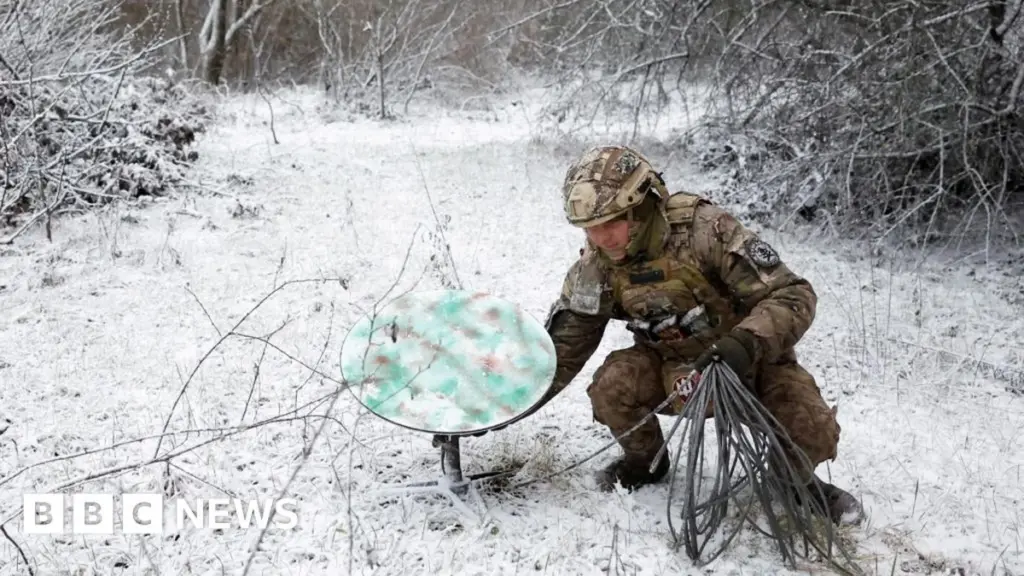
A Ukrainian official has reported that efforts to prevent Russia from utilizing Starlink satellites for drone operations have yielded “real results.” Mykhailo Fedorov, Ukraine’s Minister of Defence, characterized Elon Musk, the founder of SpaceX, as a “true champion of freedom and a true friend of the Ukrainian people.” Fedorov noted that Musk responded promptly when informed that Russian drones equipped with Starlink connectivity were operational within Ukraine.
These drones have been implicated in several recent fatal Russian attacks on Ukraine. One such incident targeted a moving passenger train, resulting in six fatalities. Musk himself commented on X, stating, “Looks like the steps we took to stop the unauthorised use of Starlink by Russia have worked. Let us know if more needs to be done.”
Starlink’s Role and Russian Drone Capabilities
Starlink, a satellite internet service provided by SpaceX, offers high-speed connectivity globally. It has been active in Ukraine since the onset of Russia’s full-scale invasion in 2022. Fedorov described Russian drones as particularly challenging to counter. Their low-altitude flight path, resistance to electronic warfare, and real-time remote control capabilities complicate efforts to intercept them.
The Institute for the Study of War cautioned in mid-January that the battlefield effectiveness of Russia’s inexpensive Molniya-2 kamikaze drones had significantly increased since they began incorporating Starlink technology.
Technical Measures and Future Plans
While neither Fedorov nor Musk provided extensive details on the specific measures taken, Ukraine’s Ministry of Defence official website, ArmiyaInform, reported that SpaceX has implemented a speed restriction of 75 kilometers per hour for Starlink terminals operating over Ukraine. This limitation aims to prevent Russian drone control, as the website explained, “Russian drones move much more quickly, so the enemy operators will not be able to control them in real time.”
On Monday, Fedorov announced that the Ukrainian government is also developing a system to create a white list of approved Starlink satellite terminals permitted for use in Ukraine. Unregistered terminals will be disconnected. He stated that this initiative is being undertaken in cooperation with SpaceX and that further instructions regarding terminal registration will be issued.
Russian war bloggers have expressed concerns that the implications of these restrictions might extend beyond drones, given the Russian military’s reliance on Starlink for providing internet access to its front-line forces.
A Complex Relationship: From Aid to Tensions
Fedorov, who then served as Deputy Prime Minister, initially requested Elon Musk’s assistance shortly after Russia’s full-scale invasion commenced in February 2022. Musk responded swiftly, enabling Starlink in Ukraine and pledging additional satellite dishes.
However, the relationship between Musk and Kyiv has experienced periods of turbulence. In late 2022, Musk reportedly denied Ukrainian military access to Starlink in Crimea, a region Russia had annexed in 2014. At the time, Musk explained this decision by stating that Ukraine intended to use Starlink access to target “most of the Russian fleet,” which would have made SpaceX “complicit in a major act of war.”
Musk has subsequently voiced criticism regarding Western nations’ financial and military aid to Ukraine, at one point questioning the policy: “It is insane to keep sending so much money to Ukraine with no accountability and no end game.” Nevertheless, he also affirmed that “no matter how much I disagree with the Ukraine policy, Starlink will never turn off its terminals.” He further stated in March that “My Starlink system is the backbone of the Ukrainian army. Their entire front line would collapse if I turned it off.”
Continued Importance of Starlink
Despite these past disagreements, Fedorov reiterated his praise last week for Musk’s timely intervention at the start of the full-scale invasion, describing Starlink as “critically important for the stability of our state.”
Fedorov, 35, was appointed Minister of Defence last month by President Volodymyr Zelensky. He advocates for a strategy grounded in data and advanced cyber-warfare. He has also committed to close collaboration with Silicon Valley companies, believing that integrating partners will enhance Ukraine’s defense capabilities.