
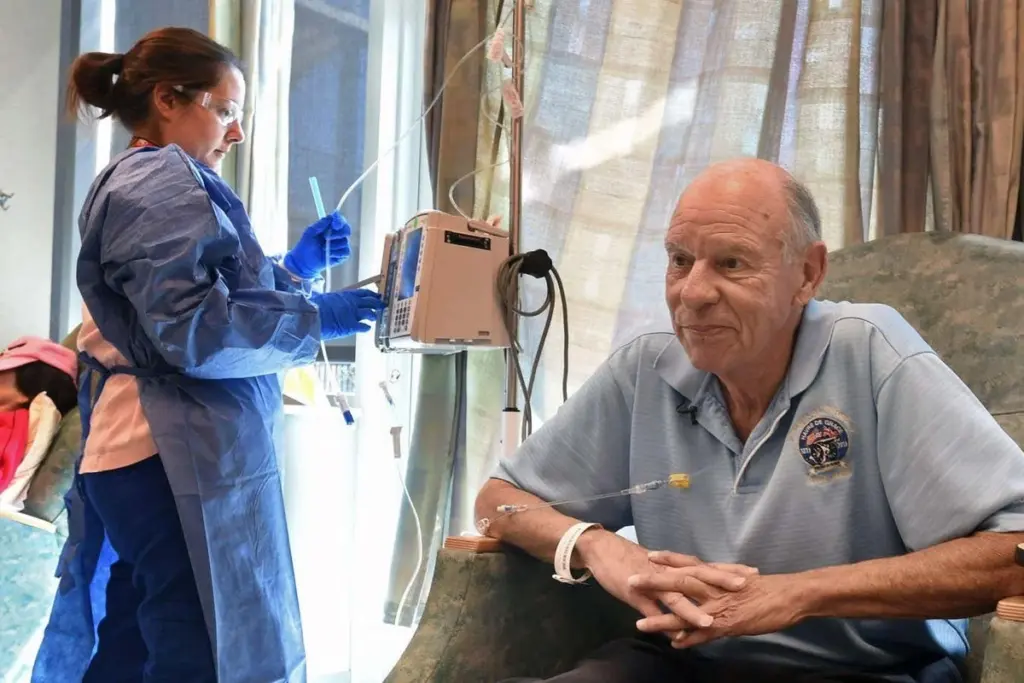
Administering cancer immunotherapy earlier in the day may significantly enhance survival rates for patients, according to the findings of the first randomized controlled trial to investigate the impact of treatment timing on patient outcomes.
Our bodies operate on 24-hour internal clocks, known as circadian rhythms, which govern a wide range of physiological processes, from mood regulation to metabolism and immune system function. These biological cycles influence how our cells and tissues behave throughout the day.
Previous observational studies, numbering over a dozen, have indicated a correlation between receiving cancer immunotherapy drugs—specifically checkpoint inhibitors that empower immune cells to combat cancer—earlier in the day and a lower risk of disease progression or mortality. These findings suggested a potential benefit to timed treatments.
Now, researchers led by Francis Lévi at Paris-Saclay University in France have conducted the inaugural randomized controlled trial focused on chronotherapy, which involves aligning medical treatments with an individual’s circadian rhythms. This study utilized a combination of chemotherapy and immunotherapy drugs for cancer treatment.
Trial Design and Patient Recruitment
The research team enrolled 210 individuals diagnosed with non-small cell lung cancer. All participants were administered four doses of either pembrolizumab or sintilimab, both of which are checkpoint inhibitors functioning similarly.
Participants were divided into two groups. Every three weeks, one half of the group received their immunotherapy dose before 3 PM, while the other half received it later in the day. Chemotherapy, which targets rapidly dividing cells and is believed to be less affected by chronotherapy than immunotherapy, was administered shortly after each immunotherapy infusion. This regiment was followed for the initial four cycles of what is termed immunochemotherapy.
Following these initial four cycles, all participants continued to receive the same medications. However, these subsequent treatments were not administered at specific times. Their continuation depended on tumor progression or a lack of response to the therapy. According to Yongchang Zhang, a team member from Central South University in China, prior research suggests that focusing on the first four cycles is sufficient to substantially improve long-term survival outcomes.
Survival Outcomes and Potential Mechanisms
The researchers meticulously monitored the participants for an average of 29 months from their first treatment dose. The results revealed a notable difference in survival times. Those who received their initial treatments before 3 PM lived for an average of 28 months. In contrast, individuals treated later in the day had an average survival of 17 months.
“The effects are absolutely huge,” stated Lévi, highlighting that this represents a nearly doubling of survival time. Pasquale Innominato from the University of Warwick in the UK commented, “If you compare the results to landmark trials where new drugs have been licensed to use, those drugs rarely have this large an effect.” This suggests, he added, that altering the timing of cancer therapy genuinely improves survival outcomes, providing what he described as “the strongest evidence for causality.”
The observed benefits may be attributed to the behavior of T cells, the specific immune cells targeted by these checkpoint inhibitors. Lévi explained that T cells tend to cluster around tumors in the morning before gradually moving into the bloodstream later in the day. Administering immunotherapy earlier ensures that T cells are in closer proximity to the tumor, thus enhancing their ability to destroy cancer cells.
Future Research Directions and Considerations
Lévi suggested that future studies should investigate whether more precise timing for cancer therapies, such as administering them at 11 AM rather than within a broader time window, could yield even greater benefits. Innominato noted that a wider treatment window might offer practical advantages for busy hospital settings.
Further research is also needed to determine if optimizing the timing of chemoimmunotherapy cycles beyond the initial four could lead to more significant improvements, as Lévi pointed out. Additionally, understanding whether optimal timings vary among individuals, considering factors like chronotypes (“morning larks” or “night owls”) whose immune systems may fluctuate differently throughout the day, is another area for exploration.
The applicability of these findings to different types of cancer remains an open question. Innominato anticipates similar results for other cancers commonly treated with immunotherapy, such as those affecting the skin and bladder. However, he expressed skepticism about timing adjustments significantly impacting the effectiveness of immunotherapy for tumors that typically do not respond to such treatments, like those affecting the prostate and pancreas.