
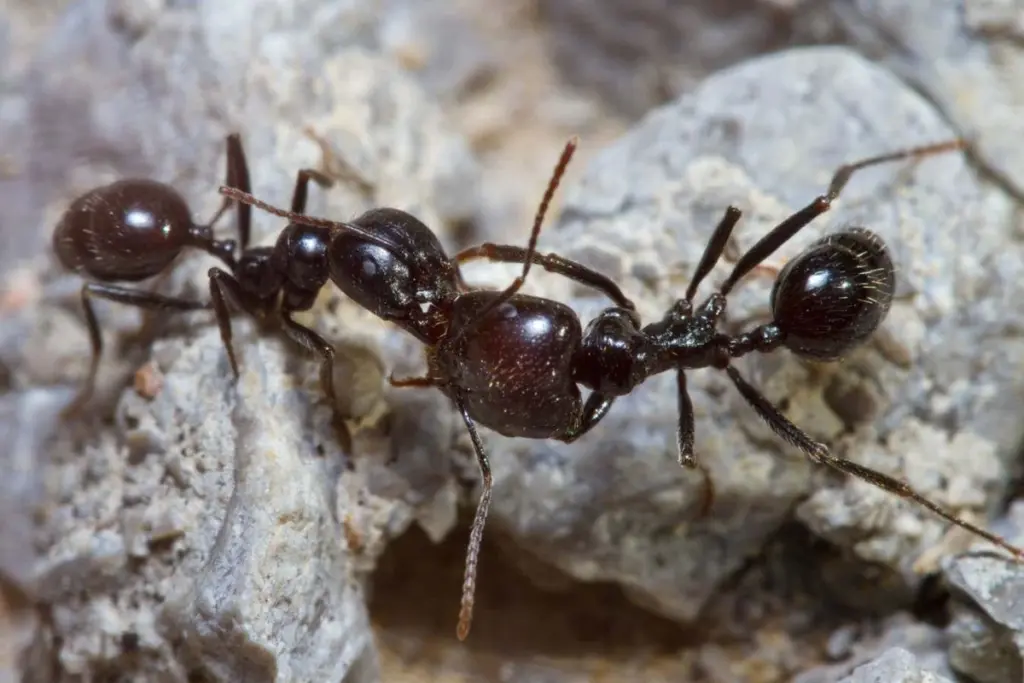
Common air pollutants affecting ants can significantly alter their ability to recognize nest-mates. Exposure to substances like ozone and nitric oxide can lead to friendly ants mistaking their own colony members for intruders, subsequently attacking them.
Ants rely on scent for identifying comrades. Upon encountering an ant with an unfamiliar scent, they typically react aggressively, often biting and sometimes killing the perceived interloper. Ozone, a greenhouse gas generated by automotive and industrial emissions, has the capacity to break down the molecular structure of alkenes. These alkenes are key chemical compounds that contribute to the unique colony-specific scents.
Researchers, including Markus Knaden from the Max Planck Institute for Chemical Ecology in Jena, Germany, had previously established that ozone-induced changes to alkenes can disrupt insect communication. Their prior observations included instances of fruit flies mating with incorrect species and pollinators like tobacco hawkmoths ignoring flowers whose scents had been altered by ozone exposure.
To investigate the specific impact on ants, Knaden and his team established artificial colonies comprising six different ant species. They isolated one ant from each colony and placed it in a glass chamber containing varying concentrations of ozone. Some of these concentrations mimicked levels recorded in Jena during the summer months. Upon returning the treated ants to their colonies, the other ants displayed aggressive behavior towards them.
Knaden expressed surprise at the outcome. “I did not expect it,” he admitted, noting that alkenes represent a relatively small component of an ant’s overall scent profile. The expectation was that ozone exposure would alter only a minor percentage, perhaps two to five percent, of the scent blend.
In natural environments, such disruptions in recognition could reduce the efficiency of a colony, even if the ants are not killed. However, designing experiments to accurately capture these behavioral effects presents considerable complexity.
Daniel Kronauer, a researcher at The Rockefeller University in New York who was not involved in the study, commented that the aggressive reactions were not entirely unexpected. He highlighted the significant role alkenes play in nest-mate recognition among ants.
Beyond recognition, alkenes are also integral to other ant behaviors, such as trail following and communication between larval and adult ants. The study revealed that when exposed to ozone, adult clonal raider ants (Ooceraea biroi) may neglect their larvae. This suggests that ozone-induced changes have the potential to disrupt multiple facets of ant life, with wider implications for the ecosystem.
Kronauer emphasized the critical ecological importance of ants. He stated, “If you took the ants out of most terrestrial ecosystems, they would probably collapse,” due to their essential roles in seed dispersal, soil movement, and symbiotic relationships with numerous organisms.
The ongoing worldwide decline in insect populations is a widespread concern. This recent study contributes to a growing body of research indicating that air pollutants are a contributing factor to this decrease. Knaden pointed out that while current ozone pollution levels may not pose an immediate threat to human health, “we just should know that what we are doing has additional costs that we have maybe not thought about before.”