
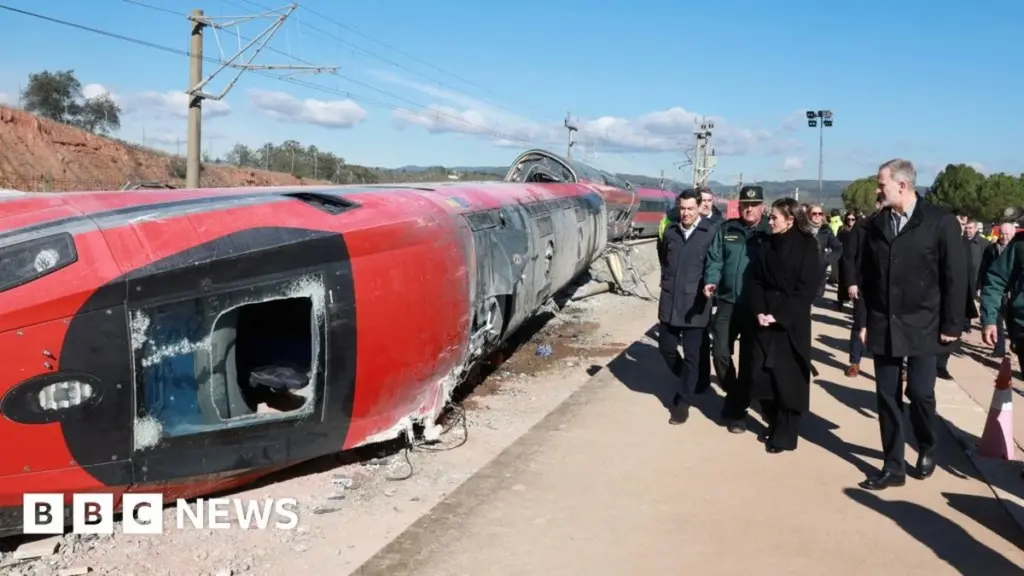
A devastating high-speed train crash in southern Spain on Sunday, claiming at least 42 lives, has plunged the nation into grief and confusion. This incident marks the most severe rail disaster in over a decade, prompting urgent questions about the causes of such a catastrophic failure within one of Europe’s most highly regarded rail systems.
The CIAF rail investigatory commission has commenced its analysis into the reasons why a northbound train from Málaga veered off course on a straight stretch of track. This derailment led to a collision with an oncoming train, which also went off its rails. The Spanish government has characterized the event as “extremely strange.”
By Tuesday afternoon, recovery efforts had yielded three bodies from the wreckage. A 42nd victim was subsequently discovered at the crash site near Adamuz. The local community, accustomed to a quiet existence, finds itself bewildered by how a rail route that had operated smoothly for an extended period could suddenly fail so dramatically.
The Historical Context of Spain’s High-Speed Rail
Launched in 1992, Spain’s high-speed rail, or AVE, network was initially heralded as a significant symbol of the country’s modernization efforts. Constructed with financial support from the European Union, it established a cutting-edge transport system renowned for its speed, efficiency, and safety.
It is noteworthy that a 2013 derailment near Santiago de Compostela, which resulted in 80 fatalities, did not occur on the AVE network. However, that train was also traveling at a high velocity. Sunday’s collision, in contrast, took place on the oldest AVE route, connecting Madrid directly with Andalusia.
Initial Investigations and Potential Causes
Several officials, including Álvaro Fernández Heredia, the president of Renfe, the national rail operator, have indicated that human error is unlikely to be the direct cause. This assessment is based on the fact that neither train was reportedly exceeding speed limits. Fernando Grande-Marlaska, the Interior Minister, has also stated that sabotage has been ruled out as a possibility.
Investigators are understandably focusing significant attention on the train that initially derailed. Owned by the Italian firm Iryo and manufactured in 2022, carriage number six has been singled out by Transport Minister Óscar Puente as a key area of examination. Puente described this carriage as “many pieces of the puzzle,” suggesting its failure initiated the sequence of events.
Beyond the rolling stock, investigations are also scrutinizing the section of track where the derailment occurred. Plans are in place to transport parts of this track to a laboratory for detailed analysis.
Emerging Concerns and Infrastructure Issues
The discovery that a portion of the track at the crash site was found to be broken has fueled speculation about infrastructure failure being the primary cause. However, the government has been cautious in drawing definitive conclusions, suggesting that the track damage may have been a consequence of the collision’s immense force.
Some observers have pointed to potential underlying issues within the broader rail network. It has come to light that Adif, the rail infrastructure administrator, had previously highlighted eight technical concerns on the line segment near the accident site via social media over the past year. Many of these issues were related to signaling systems, with one particularly noted in the Senate last summer.
Concerns about the condition of the line have led Adif to implement a reduced speed limit of 160 km/h (approximately 99 mph) on a 150 km (93 mile) stretch of the AVE route between Madrid and Barcelona. This new limit represents nearly half of the previously permitted speed.
Since the collision, numerous social media users have shared past complaints regarding uncomfortable travel experiences on AVE trains. One video from December clearly shows the interior of a train vibrating intensely, with the user expressing fears for their safety and that of their child.
In August 2025, Semaf, the train drivers’ union, issued a statement warning that the condition of several AVE lines was compromising the “comfort and reliability” for passengers. The union advocated for reduced speed limits to mitigate further infrastructure degradation and to “guarantee the safety of workers and travellers.”
Government Response and Future Implications
The recent crash, coupled with a separate derailment of a Rodalies train near Barcelona on Tuesday, which tragically resulted in the driver’s death, has prompted Semaf to call for a strike. These ongoing issues might suggest a pressing need for comprehensive renovations to Spain’s high-speed rail network.
Conversely, the government asserts that the specific section of track where Sunday’s accident occurred underwent renovation last year. This project, costing €49 million (£42 million), was part of a larger €700 million investment aimed at modernizing the Madrid-Andalusia network in recent years.
Prime Minister Pedro Sánchez, speaking during his visit to Adamuz where he declared three days of mourning, emphasized a commitment to transparency. “When we find the answer, with absolute transparency we will make it known to Spaniards,” he stated, referring to the ongoing investigation. The findings of this inquiry are poised to carry significant implications for the future of Spain’s esteemed rail system.