
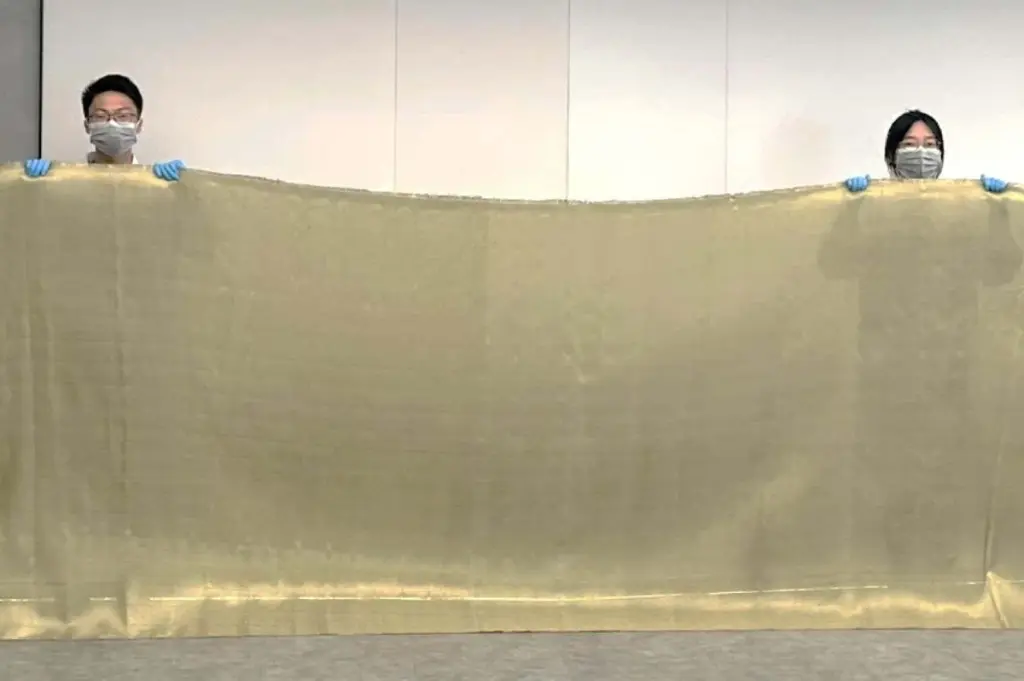
A novel material has been developed that exhibits exceptional strength, with a mere 1.8-millimeter thick sheet capable of stopping a bullet. This development positions it as significantly more robust than Kevlar and potentially the strongest fabric ever engineered.
Bulletproof vests function by distributing the kinetic energy of a projectile across an interconnected fiber network. Kevlar, for instance, relies on aramid fibers, a class of polymers known for their remarkable tensile strength. However, under immense force, these polymer chains can shift, thereby limiting the protective capacity they provide.
For the past six years, Jin Zhang, leading a team at Peking University in China, has dedicated efforts toward creating materials that surpass current benchmarks like Kevlar and Dyneema. Dyneema, a distinct type of polyethylene fiber, is frequently recognized as the world’s strongest fabric.
Zhang highlights the critical role of “ultra-high dynamic strength and toughness” in fibrous materials intended for impact protection. Applications range broadly, encompassing bulletproofing for personal armor, vehicles, and aircraft.
A Hybrid Approach to Enhanced Strength
Zhang’s research group has successfully devised a method that precisely aligns carbon nanotubes with aramid polymer chains. This strategic arrangement effectively prevents molecular slippage, a key limitation in existing materials. “Our new fiber significantly surpasses all reported macroscopic high-performance polymer fibers,” Zhang stated. “Our fabric outperforms Kevlar entirely.”
The new composite material is characterized as a “fabricated carbon nanotube/heterocyclic aramid composite.” While Zhang anticipates developing a more memorable commercial name, potentially in the vein of “Kevlar,” at a future juncture, the material’s performance is already noteworthy.
Superior Protection with Reduced Thickness
The material’s superior strength compared to Kevlar means that equivalent ballistic protection can be achieved with substantially less material. A single layer of this fabric, measuring approximately 0.6 millimeters in thickness, can decelerate a bullet traveling at 300 meters per second down to 220 m/s. Calculation of energy absorption suggests that just three layers, totaling 1.8 millimeters, are sufficient to stop such a projectile. In contrast, Kevlar requires a minimum thickness of 4 millimeters to achieve comparable bullet-stopping power.
Industrial Compatibility and Future Potential
Julie Cairney, from the University of Sydney, Australia, recognized the innovative nature of combining aramid fibers with oriented carbon nanotubes. She suggests that this approach holds promise for the development of “other new composite materials.” Furthermore, Cairney noted that the manufacturing strategy is compatible with existing industrial processes. This adaptability is crucial for facilitating scalable production and widespread real-world adoption.
For applications in personal and military protection, the use of these advanced materials could lead to lighter, yet more effective, bulletproof vests and armor. Such advancements would enhance safety for individuals without compromising their mobility, offering a significant upgrade in protective gear.