
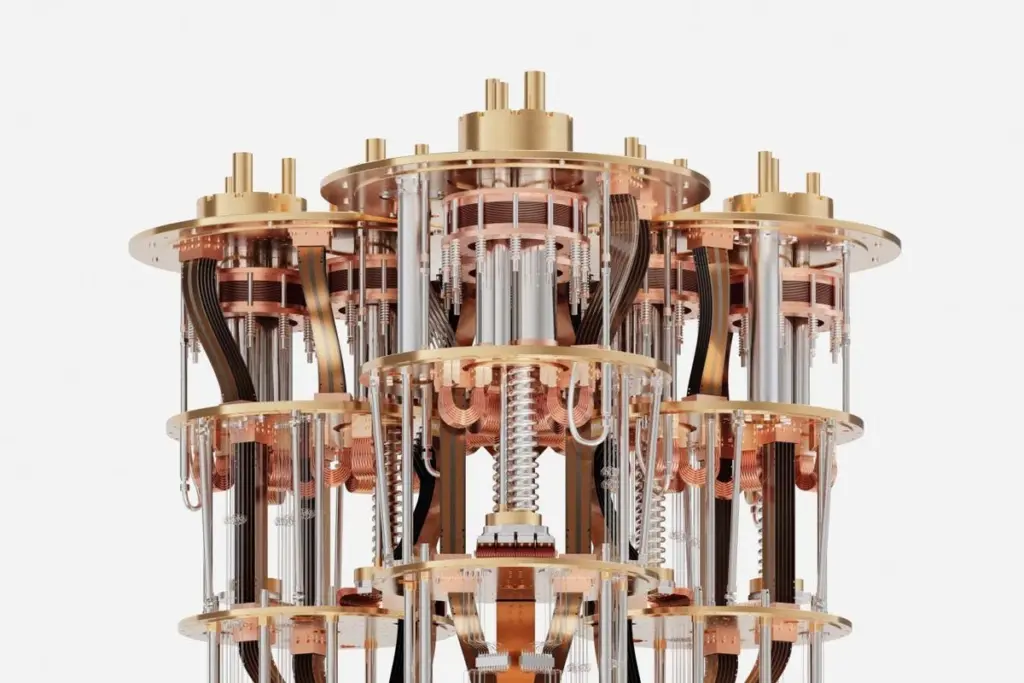
Scientists have successfully engineered a time crystal exhibiting unprecedented complexity within a quantum computer. This accomplishment not only represents a significant advancement in the study of exotic quantum phenomena but also reinforces the potential of quantum computing as a powerful tool for scientific exploration.
Unlike conventional crystals, which exhibit a repeating pattern of atoms in physical space, time crystals are characterized by a repeating temporal pattern. They are known to cycle through a series of configurations, theoretically persisting indefinitely if shielded from environmental disturbances.
Initially, the seemingly perpetual motion of time crystals raised questions about potential conflicts with fundamental physics. However, over the past decade, laboratory experiments have confirmed their existence. Most recently, a team led by Nicolás Lorente at the Donostia International Physics Center in Spain utilized an IBM superconducting quantum computer to construct a time crystal of remarkable complexity, surpassing previous creations.
While earlier research largely focused on one-dimensional time crystals, analogous to a single line of atoms, Lorente’s group aimed to build a two-dimensional analogue. They accomplished this by arranging 144 superconducting qubits in an interconnected, honeycomb-like structure. Each qubit functioned akin to a quantum mechanical spin, with the researchers capable of precisely controlling the interactions between neighboring qubits.
The dynamic alteration of these interactions over time was instrumental in generating the time crystal. Furthermore, the researchers were able to program these interactions with a more intricate pattern of strengths than had been achieved in prior quantum computing experiments involving time crystals.
Achieving this enhanced level of complexity enabled the team to not only produce a time crystal more elaborate than any previously constructed in a quantum computer but also to begin mapping the characteristics of the entire qubit system. This process allowed them to derive its “phase diagram.” The completion of a phase diagram is a crucial step in understanding a material’s properties, much like a phase diagram for water illustrates whether it is in a liquid, solid, or gaseous state under specific temperature and pressure conditions.
Jamie Garcia at IBM suggests that this experiment may herald a series of advancements where quantum computers could eventually contribute to the design of novel materials. This would be achieved by offering a comprehensive understanding of all potential properties a quantum system can exhibit, including the peculiar nature of time crystals.
The specific model the researchers sought to replicate, which incorporates a time crystal within its phase diagram, is already sufficiently complex that simulating it on conventional computers necessitates approximations. Concurrently, current quantum computers are prone to errors. Consequently, the research team had to leverage these conventional approximate methods to assess the reliability of their quantum results. This iterative process, alternating between approximate classical simulations and exact yet error-prone quantum computations, is expected to refine our comprehension of many intricate quantum models relevant to materials science moving forward, according to Garcia.
“Two-dimensional systems pose significant numerical simulation challenges, thus large-scale quantum simulations involving over 100 qubits should serve as a foundational point for future investigations,” stated Biao Huang at the University of Chinese Academy of Sciences. He further noted that this new study represents significant experimental progress across multiple fields of quantum matter research. Specifically, it has the potential to bridge the gap between time crystals, which are amenable to quantum computer simulation, and analogous states reproducible in certain types of quantum sensors, Huang explained.
Journal Reference
Nature Communications DOI: 10.1038/s41467-025-67787-1