
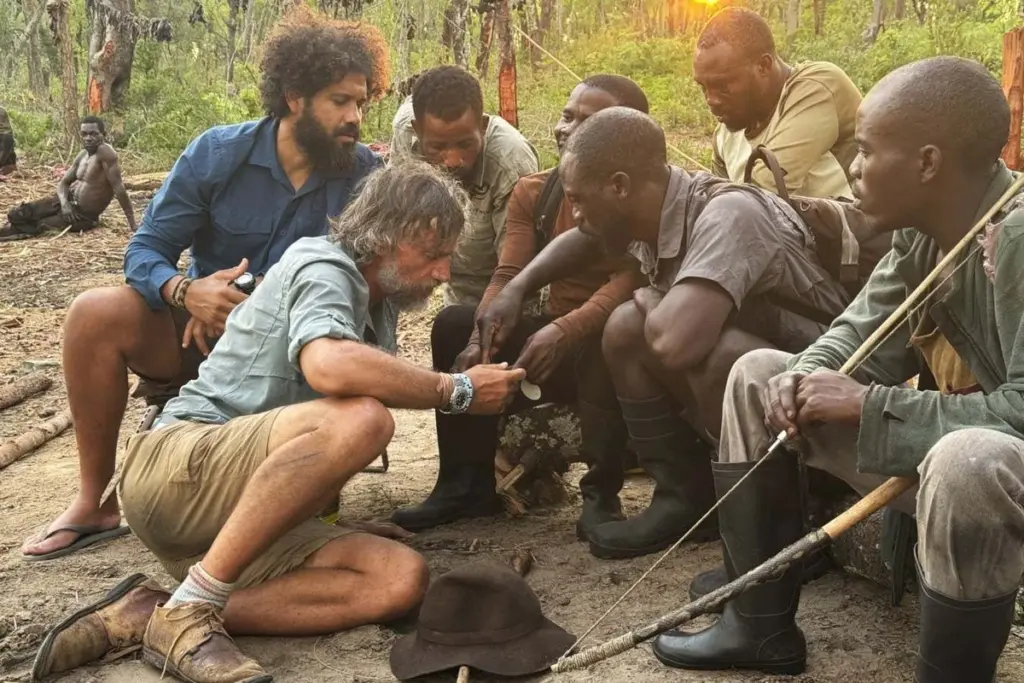
Filmmaker Werner Herzog has consistently been drawn to the frontiers of human understanding, to the nexus where scientific inquiry brushes against myth and where the pursuit of knowledge can verge on obsession. In “Ghost Elephants,” a documentary that premiered at the previous year’s Venice Film Festival, Herzog accompanies conservationist Steve Boyes on an expedition in Angola. Their mission: to seek a herd of elephants that may or may not exist.
The film unfolds as both a scientific endeavor and a philosophical exploration. It poses fundamental questions about the nature of pursuing a dream that might forever remain elusive. At its core, the premise is remarkably straightforward. Boyes operates on the belief that a group of unusually large elephants has been sighted.
He theorizes these might be related to the legendary Fnykvi specimen. This particular elephant, preserved at the Smithsonian National Museum of Natural History in Washington D.C., was named after Josef Fnykvi, an engineer and big-game hunter who acquired it. The Fnykvi specimen is notable; it stands nearly a meter taller than the average African elephant, making it one of the largest land mammals ever documented.
The potential habitat for these elusive creatures is the remote Bi plateau. This is a sparsely populated, wooded region covering an area roughly equivalent to England’s size. For the past decade, Boyes has diligently cultivated this hypothesis. He has painstakingly assembled anecdotal evidence, drawing upon the wisdom of San master trackers. Their profound ability to interpret signs in the natural landscape represents one of the most sophisticated forms of knowledge among surviving hunter-gatherer societies.
The discovery of these “ghost elephants,” should it occur, could significantly advance biological understanding. It might offer new insights into elephant genetics, the phenomenon of gigantism, and migration patterns within a seldom-studied region of Africa. However, Herzog avoids a simple natural history narrative. His distinctive narration—a blend of academic reflection, skepticism, and understated humor—casts Boyes’s project within a broader context. What commences as a mission to collect DNA samples evolves into a contemplation of the intricate relationship between science and imagination.
Herzog draws a parallel between Boyes’s quest and Captain Ahab’s pursuit of the White Whale. Yet, he distinguishes this obsession by characterizing it not as destructive, but as generative. This sustained drive stems from a deep-seated conviction that something immense and concealed still lies just beyond human perception. The film meticulously integrates scientific elements into its overarching narrative. Viewers witness Boyes and his team preparing their expedition gear, engaging in discussions with local leaders to secure access, and conducting fieldwork in challenging terrain that tests both their resolve and their equipment.
While “Ghost Elephants” does not present definitive data—it is not a peer-reviewed scientific paper, after all—it effectively captures the real-time methodology of field science. This includes the cycle of hypothesis formation, observation, inference, and the cautious formulation of conclusions. The ultimate revelation, acknowledged as provisional and incomplete, relies less on dramatic spectacle. Instead, it emerges from the gradual accumulation of evidence, a rhythm that the film embodies through its deliberate pacing.
Herzog also employs the camera to broaden the scope of the inquiry. The cinematography shares the refined aesthetic of National Geographic documentaries but consistently bears Herzog’s characteristic curiosity. Expansive aerial shots of the plateau emphasize the sheer scale of the landscape. Simultaneously, close-up examinations of trackers’ hands as they interpret footprints on the ground highlight a parallel form of knowledge, one rooted in embodied experience and honed through generations.
The San people, representing one of the Earth’s oldest continuous cultures, possess genetic lineages that diverged from other human populations as far back as 200,000 years ago. Their exceptional tracking expertise is not presented as mere folklore. Rather, it is recognized as a form of empirical knowledge, refined over millennia—a scientific practice that predates formal laboratories. The search for elephants inevitably becomes a lens through which larger thematic concerns are examined. Climate change, the legacies of colonialism, and the lingering effects of industrial exploitation surface in Herzog’s commentary. His observations, while never overbearing, are consistently present.
The Angolan landscape, once marked by conflict, now serves as a location where the domains of conservation, Indigenous sovereignty, and ecological accountability converge. Boyes’s pursuit subtly underscores a central paradox within conservation science: the act of study inherently involves intervention. The very attempt to preserve a subject can, paradoxically, alter its nature. In Herzog’s directorial vision, the ghost elephants retain their dual identity as both a tangible possibility and a potent metaphor. They represent fascinating creatures that embody humanity’s enduring fascination with mysteries yet to be fully understood by science.
The film conveys a clear message: exploration is not solely defined by what is discovered. It is equally shaped by the profound humility of acknowledging what remains unknown and the persistent human drive to ask questions at the very edge of our knowledge. Davide Abbatescianni is a film critic based in Rome.