
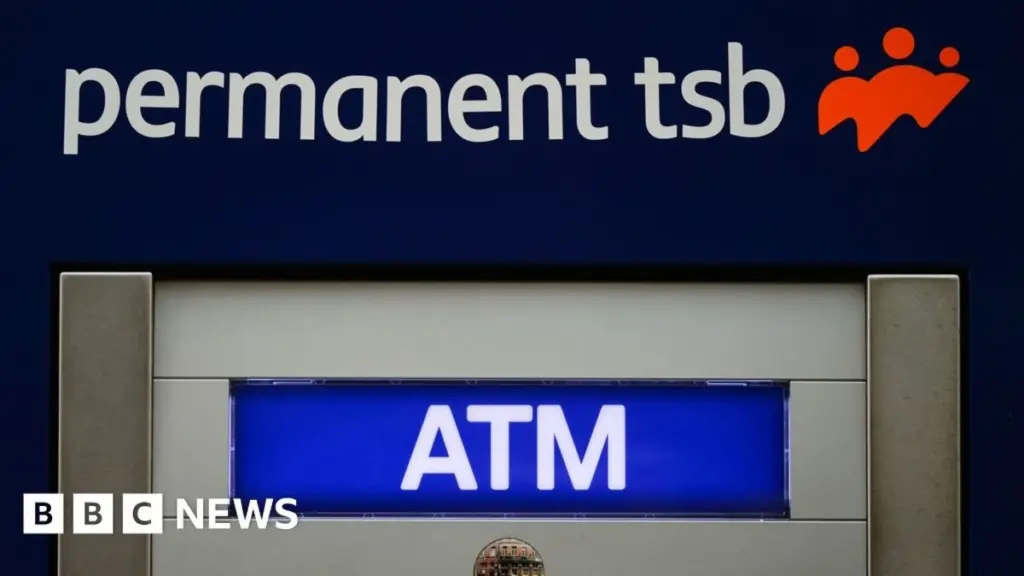
In April 2011, the Irish public unexpectedly became the majority stakeholders of a modest financial institution known as Permanent TSB (PTSB). This development was far from a cause for celebration.
A government-commissioned inquiry had revealed the depth of the systemic issues within the nation’s banking sector, which proved to be more pervasive than initially anticipated. PTSB required a substantial €4 billion (£3.49 billion) capital injection simply to remain solvent. Given the circumstances, no commercial investor was inclined to undertake such a transaction, leaving public funds as the only recourse for a bailout.
This €4 billion represented a mere fraction of the total public investment directed towards the country’s banks. These funds were deployed to offset considerable losses incurred from exposure to a high volume of non-performing property loans.
Now, fifteen years following that critical juncture, the period of state involvement in banking is drawing to a close. This week, the Austrian bank BAWAG announced its agreement to acquire the government’s substantial stake in PTSB for €931 million (£812 million).
A Key Development in Retail Banking
Tánaiste (Ireland’s Deputy Prime Minister) and Minister for Finance, Simon Harris, characterized the transaction as “the most significant development in the Irish retail banking market in over a decade.” His stated objective for this move is to foster greater competition within a market currently dominated by Bank of Ireland and AIB, the two primary entities that survived the extensive bailout programs.
Harris also highlighted the state’s success in recouping the majority of its outlay from PTSB. Beyond the proceeds from the BAWAG acquisition, earlier divestments of assets and various accumulated fees mean the total recovery from PTSB is projected to exceed €3.7 billion (£3.23 billion).
However, as the state relinquishes its final substantial shareholding, the question of whether the bailouts were ultimately “successful” remains a subject of complex debate. While Harris indicated that taxpayers have achieved a surplus of approximately €1.3 billion (£1.13 billion) on their combined investments in PTSB, AIB, and Bank of Ireland, this seemingly positive outcome is shadowed by the profound failures of certain more imprudent institutions.
Navigating Immense Pressure and Unforeseen Consequences
Dan O’Brien, Chief Economist at the IIEA and an expert who witnessed the crisis unfold firsthand, draws a parallel between Ireland’s recovery trajectory and the Swedish banking crisis of the 1980s, noting a comparable cycle of roughly twenty years to achieve stability.
Nevertheless, the sheer magnitude of the losses associated with the infamous Anglo Irish Bank, which cost taxpayers an estimated €30 billion (£26 billion), complicates any narrative of unqualified success. O’Brien suggests that “if you take Anglo out of it… it would have been like the Swedish case from the 80s, and you could definitely say it was a success.”
The conclusion of this era also reignites discussions regarding whether international creditors of Ireland’s distressed banks should have absorbed a portion of the losses — a concept commonly referred to as “burning the bondholders.” O’Brien points out that the decision to shield these lenders was heavily influenced by “immense pressure” originating from the Eurozone.
“There was absolute certainty in Frankfurt that if… bank bonds were burnt, then that would affect the borrowing cost of all banks across the Eurozone,” O’Brien elaborated. This sentiment culminated in a stark warning from Jean-Claude Trichet, then-head of the European Central Bank, who reportedly stated that “a bomb would go off in Dublin” if bondholders were not protected.
O’Brien finds it remarkable that this experience did not foster a significant growth in Euroscepticism within Ireland. “If you look at opinion polling today about the European Union, Irish people are among the most pro-EU on all the metrics—in terms of pro-euro, pro-trust in the European Commission, trust in the European institutions, Ireland is right up at the top there.”