
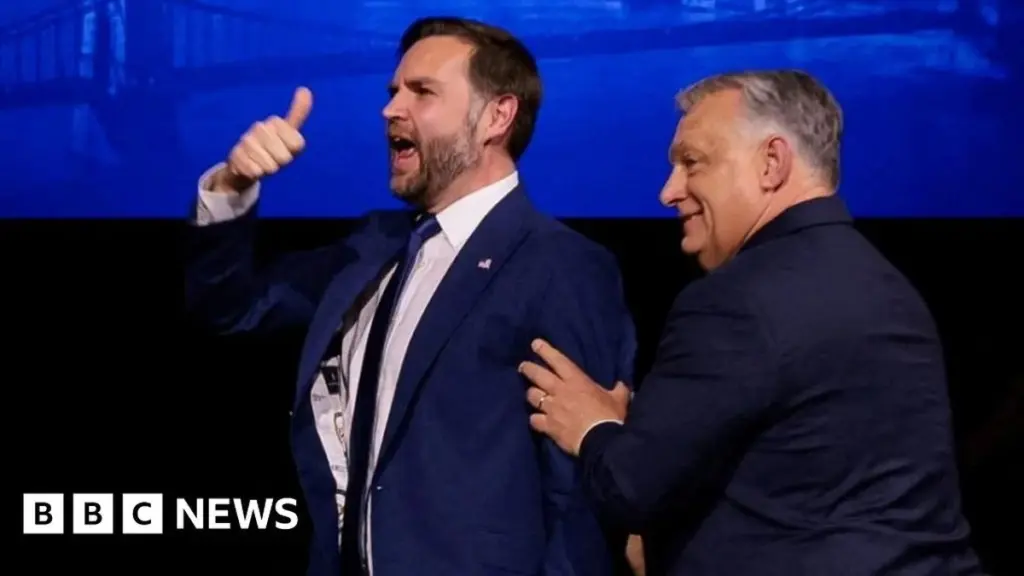
Vance’s Endorsement and Orbán’s Defeat
US Vice-President JD Vance has maintained his stance on endorsing Hungarian Prime Minister Viktor Orbán, despite Orbán’s recent landslide defeat. Vance undertook a two-day campaign visit to support Orbán just five days before the opposition party Tisza secured a significant victory under the leadership of Péter Magyar.
Vance’s Assessment of Orbán
Speaking to Fox News, Vance described Orbán as a “great guy” who performed a “very good job.” He highlighted Orbán as one of the few European leaders willing to challenge the bureaucracy in Brussels. While Vance expressed regret over Orbán’s loss, he conveyed confidence in the prospect of the United States working effectively with the incoming Hungarian government.
Magyar’s Reaction to Foreign Intervention
Péter Magyar, the leader of Tisza, had previously criticized Vance’s involvement in the Hungarian elections, emphasizing that foreign interference in electoral processes is unacceptable. However, Magyar indicated on Monday that the United States is a “strong and important” ally within NATO. He stated his willingness to engage in discussions with President Donald Trump or any other US representative.
Transition of Power in Hungary
Viktor Orbán is set to continue leading Hungary in a caretaker capacity until Magyar is officially sworn into office. President Tamás Sulyok has invited the three party leaders with parliamentary seats to a meeting on Wednesday. Sulyok’s specific duties include convening the new Hungarian parliament and recommending a new prime minister by May 12th. Magyar has urged Sulyok to expedite this process and subsequently resign, referring to him as a “puppet” of Orbán’s administration.
Projected Timeline for New Government
Magyar has suggested that he could assume the role of prime minister as early as May 5th, or potentially sooner. Sulyok’s office communicated to Hungarian media that he has no intention of resigning. Nevertheless, it is anticipated that he will confer with the three party leaders regarding the timing of the National Assembly’s convening and the nomination of a new prime minister.
Magyar’s Media Appearances and Stance
In a notable development, the designated new prime minister announced his intention to appear on public radio and television on Wednesday, prior to his meeting with the president. Magyar recounted that during his tenure leading Hungary’s primary opposition party, he had consistently been denied access to public television. This changed on Monday morning, shortly after his party’s decisive win against Fidesz. He revealed that he initially declined the invitation, pledging to temporarily halt all news broadcasts on public television and radio until they could guarantee impartial reporting. Magyar proposed the establishment of a board to ensure the independence of state media, drawing inspiration from the models of the BBC and other public broadcasters.
Tisza’s Parliamentary Mandate and Governing Abilities
Magyar has outlined a series of objectives to be implemented promptly upon his party’s assumption of power. Tisza secured a “super majority,” with preliminary results indicating 137 seats out of 199 in parliament. While these results are not yet final, the incoming Hungarian leader anticipates an even larger victory margin. Achieving a two-thirds majority in parliament grants the government the authority to amend the constitution and reverse policies enacted during the Orbán era.
Addressing Corruption and EU Relations
Magyar characterized Hungary as the European Union’s poorest and most corrupt member. His government plans to establish an Anti-Corruption Office and a National Asset Recovery and Protection Office. Furthermore, Hungary will initiate the process of joining the EU’s European Public Prosecutor’s Office. Orbán’s government was notably criticized for a system of cronyism that favored certain individuals in public contracts, while judicial independence was undermined, impacting the rule of law.
Combating Corruption and Reclaiming EU Funds
Magyar has spoken extensively about Hungary being systematically exploited, with substantial sums disappearing from state contracts and pervasive corruption operating on a significant scale. A primary focus for his government will be to unblock billions of euros in EU funding and loans that were frozen due to concerns over the rule of law and democratic backsliding under Orbán’s leadership. An estimated €17 billion (£14.8 billion) has been suspended, with Hungary also awaiting the approval of an additional €16 billion in defense loans.
European Commission’s Stance and Ukraine Aid
European Commission President Ursula von der Leyen conveyed that she had spoken with Magyar, emphasizing the need for “swift work to be done to… restore the rule of law [and] realign with our shared European values.” Concurrently, EU leaders are actively urging Hungary to revoke a veto imposed by Orbán on €90 billion in aid to Ukraine, which was enacted shortly before the elections. Magyar has clarified that he does not view the veto as relevant, as Hungary was among three countries that opted out of the Ukraine loan agreement in December.
German-Hungarian Relations and Future Engagements
German Chancellor Friedrich Merz has stressed the importance of releasing aid to Kyiv “very quickly” following the change in government in Hungary. Merz had met with Magyar earlier this year in Munich. Budapest is expected to be one of Magyar’s initial foreign destinations. This engagement with German leadership signals a potential shift in Hungary’s relationship with key European partners.