
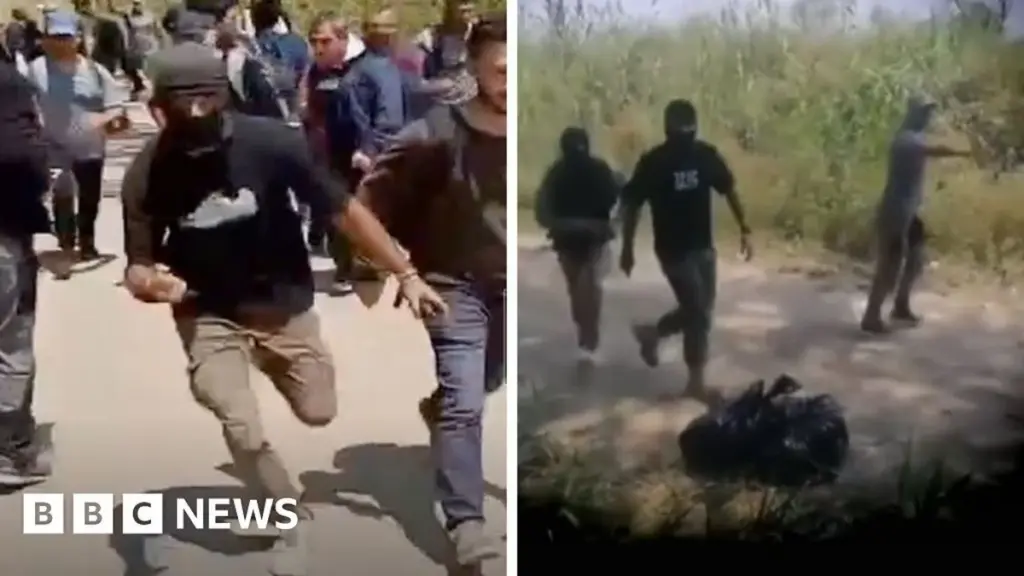
Evidence has emerged indicating that Greek border police have been employing migrants to forcibly repel other migrants attempting to cross the country’s land border with Turkey. This practice, revealed through extensive BBC investigations, involves the recruitment of individuals who then engage in violent pushbacks.
Internal police documents obtained by the BBC describe how the recruitment and deployment of these so-called “mercenaries” were authorized and overseen by senior officers. The investigation has uncovered allegations of extreme brutality, with witnesses recounting incidents where migrants were stripped, robbed, subjected to physical assaults, and even sexually assaulted. Reports suggest that these individuals have been unofficially active on the border since at least 2020.
The Greek Prime Minister has stated his complete unawareness of any allegations concerning the use of migrants for pushback operations. Greek authorities have not yet provided a formal response to detailed written inquiries seeking comment on these matters.
The Practice of Pushbacks
Pushbacks, which involve the expulsion of migrants and asylum seekers across borders without adherence to due process, are widely considered a violation of international law. Initial claims of such actions being carried out in Greece by masked foreign nationals surfaced in 2022, reported by the Netherlands-based news organization Lighthouse Reports.
The current BBC investigation, conducted in collaboration with the Consolidated Rescue Group (CRG), commenced last autumn following the reception of disturbing video footage. This footage, allegedly depicting migrants being mistreated by mercenaries, was shared by an individual identifying as a smuggler who expressed dissatisfaction with former associates. While the BBC has been unable to independently verify the video’s authenticity, its content aligns with accounts gathered from various independent sources.
Information has been systematically compiled from migrants, former mercenaries, police sources, official documents, and leaked transcripts. These sources point to serious misconduct:
- A border guard reportedly informed a disciplinary hearing about information, shared with superiors, indicating that mercenaries had been involved in the rape of female migrants.
- Two migrants and one former mercenary have described witnessing severe violence perpetrated by both mercenaries and Greek police. These accounts include instances where individuals were beaten to the point of losing consciousness.
- A migrant has recounted an incident where a masked individual removed her daughter’s nappy in search of valuables.
The Evros Border Zone
Greece has experienced a substantial influx of migrants since 2015, with over a million arrivals primarily via sea routes, but also along its land border with Turkey. This frontier spans approximately 200 kilometers (124 miles) along the Evros River, marking the European Union’s external edge and separating Greece’s Evros region from Turkey’s East Thrace territory.
Migrants or illegal immigrants who cross the river into Greece enter a heavily militarized restricted zone, characterized by numerous watchtowers. A police source operating in the region indicated that mercenaries are utilized to facilitate pushbacks of hundreds of individuals weekly. “There is no soldier, police officer, or Frontex (EU border agency) officer serving here in Evros who does not know that pushbacks are taking place,” the source stated.
Recruitment and Rewards
Investigations reveal that the mercenaries themselves are often migrants, recruited from countries such as Pakistan, Syria, and Afghanistan. Their compensation can include cash, looted mobile phones, and documents that effectively permit passage through Greece.
Footage dated June 22, 2023, shows a group of migrants, newly arrived in Evros and seeking asylum, being ambushed by masked individuals. A subsequent report by the Fundamental Rights Office, an independent investigator within Frontex, concluded, based on available evidence, that between 10 and 20 “third-country nationals” acted under the direction of Greek officers. The report details physical and verbal abuse, including death and rape threats, intrusive body searches, beatings, stabbings, restraints, and theft of personal property. These migrants were then forcibly returned to Turkey, contravening EU human rights law.
Greek authorities have denied that migrants from this specific group were present in the area on that date. This incident is one of several investigated by the Fundamental Rights Office concerning pushbacks involving masked foreign men.
Human Rights Concerns
Maria Gavouneli, President of Greece’s Human Rights Commission (GNCHR), has described these findings as potentially representing an “extremely significant” human rights abuse. The GNCHR itself has documented over 100 alleged forced return incidents in Evros since 2020. While the number of cases has reportedly decreased, dozens of these alleged incidents have involved non-Greek nationals, with the most recent occurring in October 2025.
In a brief interaction with the BBC in March, Greek Prime Minister Kyriakos Mitsotakis stated he was unaware of allegations regarding mercenary use. He emphasized Greece’s commitment to border protection and noted that European leaders were united in preventing a repeat of past “mistakes” by allowing a “massive influx” of migrants and refugees. Frontex has refuted any implications of overlooking rights violations, asserting its role in lawful border management and support for strained countries.
Personal Testimonies of Abuse
‘We couldn’t breathe’
Two Syrian migrants shared their experiences of allegedly being forced back to Turkey across the Evros River. Amal (name changed for protection) provided videos and documentation of her family’s asylum application process in Greece. She recounted her family’s unexpected detention by police in 2025 while traveling in Orestiada, northern Evros. They were reportedly handed over to two masked men who demanded their identification and phones before transporting them to the border in a windowless white van.
The subsequent search at the river was described as far more distressing. “My daughter was wearing a diaper, they took it off,” Amal stated. “She was screaming in fear.” She described how approximately seven masked men then herded them, along with about 20 other individuals, down a track, using sticks to maintain order. “As we were walking, there was a young man… they beat him so much that he fainted,” she reported. Her daughters, witnesses to this event, were reportedly in a state of shock and terror. Upon meeting them in Turkey, Amal’s youngest daughter displayed visible signs of trauma.
Another Syrian migrant, Ahmad, claims he was beaten by Greek police to the point of unconsciousness after being apprehended in Evros. The following day, he was among dozens of migrants loaded into a truck. “Because of the crowding and the smell, people were suffocating. We couldn’t breathe,” he stated.
Ahmad recounted being brought to the Evros River by police and lined up in groups, then handed over to five or six mercenaries. These individuals allegedly stripped the men and conducted searches, using sticks to beat anyone found to be concealing money. The migrants were then placed in rubber dinghies and rowed halfway across the river. The mercenaries reportedly hesitated to proceed further due to concerns about being fired upon by Turkish border guards. If migrants did not jump from the boat, Ahmad claimed they were thrown out, with consequences for their safety and the risk of being swept away by the current.
Both Amal and Ahmad undertook perilous, unlawful journeys to reach Greece. However, Ahmad argued that he, like many others, felt compelled by circumstances. “I was dying slowly in Syria,” he said. “People didn’t leave their homes for no reason – they lived through the worst torture, oppression, and injustice.”
‘Illegal boatmen’
Allegations of Greek police using mercenaries surfaced during a 2024 disciplinary hearing, with excerpts obtained by the BBC. Five border guards, who deny charges of corruption against them, reportedly acknowledged the use of mercenaries, or as they termed them, “boatmen.”
One guard testified in 2020 that he was instructed to find boatmen for pushback operations, as COVID-19 restrictions and tensions with Turkish authorities made it riskier for police to perform these duties themselves. This guard, from northern Evros, stated that his superior indicated a similar system was already in place in the southern part of the region. Communication regarding pushback plans reportedly occurred via the Viber messaging app, using a coded phrase: “X persons to the operation by Special Team.”
Testimonies also suggested that these “illegal migrant boatmen” were involved in abducting migrants to wooded areas, raping women, and stealing their money. These concerns, according to the testimonies, were raised with higher-ranking officers.
Separately, a lawyer informed the BBC that she has filed a case with the European Court of Human Rights on behalf of an Afghan woman alleging rape by a masked man who spoke Farsi shortly before a pushback incident in 2023.
‘Forced’
Conflicting accounts exist regarding the voluntariness of recruitment for mercenaries in the Evros region. Marwan (name changed for protection), a Moroccan interviewed in Paris, claimed he had no genuine choice but to accept the role in 2020, describing himself as feeling like a captive. Having been apprehended entering Evros and held in a jail cell with other migrants, he recalls a Greek officer asking him: “You seem like a good guy and you speak some English. Do you want to work with me?”
Marwan stated he felt “forced to say yes” due to fear of repercussions. He described living in an old prison cell with other mercenaries, led by an Afghan individual who reportedly harbored resentment towards Syrians and engaged in physical violence. Marwan estimates he worked at the border for approximately 10 weeks, his duties including transporting individuals back to Turkey, inspecting boats for damage, and burning migrant belongings to “destroy” evidence. He claims his recruiting officer would collect phones or euros, while mercenaries were permitted to keep Arabic or Turkish currency. Marwan also alleged that the officer offered to take mercenaries to prostitutes.
He believes his base was in Soufli, a municipality in central Evros, having overheard Afghans mentioning the town frequently. Marwan expressed that the treatment of migrants left him “completely destroyed,” noting that many suffered from thirst, starvation, or severe foot conditions due to their journeys. While adamant that he never personally beat anyone, Marwan reported witnessing frequent violence from both Greek officers and mercenaries, particularly near the Evros River. When confronted about his complicity, Marwan stated, “I am deeply sorry… I was under threat.”
Further evidence of migrant mercenaries operating in the Evros region comes from a photograph provided to the BBC. The image shows a group of masked men in plain clothes inside a van, shared by the smuggler who initially sent the video of migrant mistreatment. While it is not definitively confirmed that all individuals are mercenaries, their attire is noteworthy. Facial recognition technology reportedly indicates a 90% match between the man on the right and four images of a Syrian identified as “Mike.” Multiple sources confirmed Mike’s identity, and he is referenced in internal police documents. Upon contact via social media, Mike did not respond directly, but his lawyer issued a statement cautioning against publishing his image and making “unproven” allegations.