
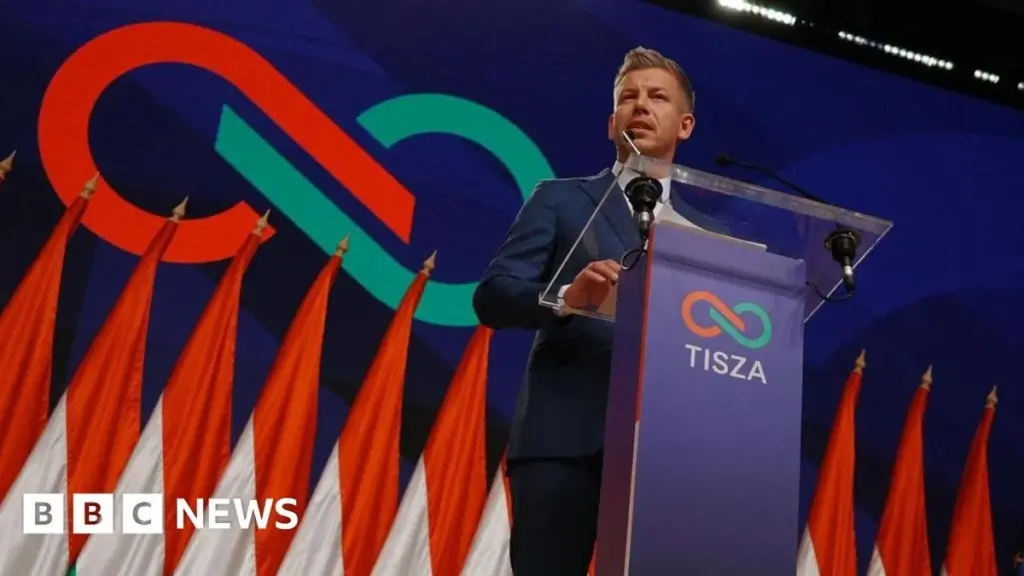
Péter Magyar has indicated that Hungary’s next prime minister would engage with Russian President Vladimir Putin if contacted, suggesting a departure from the current administration’s approach to the war in Ukraine. This statement follows Magyar’s party’s significant electoral victory, which marks the end of Viktor Orbán’s 16-year tenure as prime minister.
International Engagement and Stance on Ukraine War
Magyar stated that he had already communicated with ten European leaders shortly after his party secured a substantial win. Addressing the possibility of a call from Vladimir Putin, he conveyed that he would answer. “If Vladimir Putin calls I’ll pick up the phone,” he told reporters during an extensive press conference following his party’s success on Sunday. He expressed skepticism about such a call occurring, but added, “but if we did talk I’d tell him to please, after four years, put an end to the killing and end this war.” The Hungarian prime minister-elect’s comments suggest a willingness to directly address the conflict, a contrast to Orbán’s sustained alignment with Russia.
Moscow has publicly acknowledged Magyar’s victory and indicated an expectation to maintain “pragmatic” relations with Budapest. Viktor Orbán had previously maintained close ties with Russian leadership and had been a notable supporter of former US President Donald Trump. Trump had endorsed Orbán’s electoral bid, a sentiment echoed by Vice President JD Vance during a recent campaign visit to Hungary. However, Magyar has indicated that he would not initiate contact with Trump but would respond if contacted, expressing his gladness as they are “strong allies in Nato” and extending an invitation to attend the 70th anniversary of the Hungarian uprising against Soviet occupation next October.
Domestic Mandate and Government Overhaul
Magyar, a former insider within Orbán’s Fidesz party, established a grassroots movement focused on addressing corruption and cronyism within the government. Preliminary election results indicate that his Tisza party has secured 136 seats in parliament. While this is a slight decrease from an earlier projection of 138 seats, it still represents a substantial “super majority” of two-thirds, providing the party with the capacity to amend the constitution. Magyar expressed optimism that his party would capture additional seats as approximately 400,000 votes remain uncounted. He characterized the election outcome not merely as a change of government, but as a mandate for “complete regime change.”
European Relations and Economic Considerations
On Monday, Péter Magyar was a prominent figure in discussions among European leaders, reflecting the significant impact of his party’s dramatic electoral performance. Ursula von der Leyen, President of the European Commission, remarked, “Hungary has chosen Europe.” Magyar confirmed he had spoken with leaders such as von der Leyen, reinforcing Hungary’s commitment to the European Union. He emphasized that Hungary’s place is within the EU, regardless of the outgoing government’s intentions, and highlighted the national interest in joining the eurozone. His initial diplomatic itinerary includes visits to Poland, Austria, and Germany, countries with which he stressed Hungary shares a close affinity.
The 45-year-old leader’s rhetoric diverges sharply from that of the defeated incumbent, Viktor Orbán, who had consistently blamed the EU and Ukrainian President Volodymyr Zelensky for the protracted conflict. Orbán’s campaign had accused them of prolonging Russia’s war, and he had previously blocked a significant EU loan to Kyiv, drawing criticism for disloyalty from European allies. Magyar asserted that the widespread understanding in Hungary is that Ukraine is the wronged party in the conflict with Russia, and he also pointed out the substantial human cost to Russia, noting the loss of “tens of thousands of Russians” and the destruction of countless families, including Russian-speaking populations within Ukraine.
“It would probably be a short phone call [with Putin], and I don’t think he’d end the war on my advice,” Magyar commented on the potential interaction with the Russian president.
Scrutiny of Foreign Ministry Conduct
While Orbán had cultivated allies within the EU, his government faced increased scrutiny over its relations with Russia. Foreign Minister Péter Szijjártó’s admission of sharing information with Russian officials before and after EU meetings pertaining to sanctions had raised particular concern. Reports suggested Szijjártó had communicated to his Russian counterpart, Sergey Lavrov, “I am at your service,” a statement that reportedly triggered an investigation into wiretapping ordered by Orbán. During Monday’s press conference, Magyar received a note which led him to allege that the outgoing foreign minister had been observed shredding classified documents related to sanctions with Russia within the ministry premises that day. The ministry has not yet issued a comment on these allegations.