
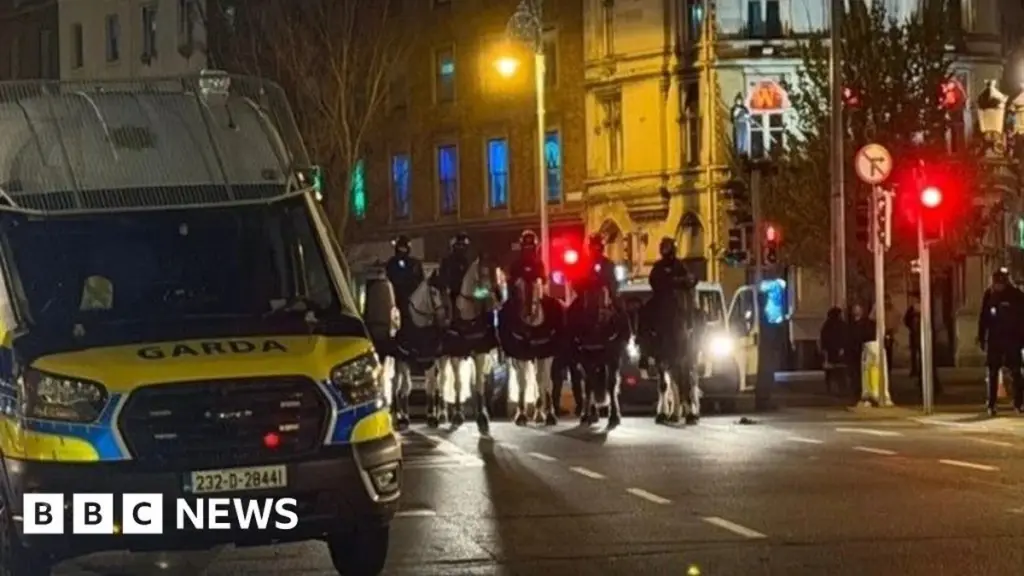
Irish police, known as gardaí, conducted an operation in the early hours of Sunday morning to clear demonstrators from O’Connell Street in Dublin. The protests, now in their sixth day, have centered on blocking fuel distribution sites and major roads across the country, sparked by rising fuel costs following the conflict between the US and Iran.
Uniformed gardaí, supported by the public order unit and mounted officers, cordoned off O’Connell Street. The water unit patrolled the nearby River Liffey, while a Garda helicopter monitored the situation from above. Shortly before 4:00 AM, officers requested individuals inside tractors and trailers to vacate the area, a request that was met.
In addition to clearing O’Connell Street, gardaí also dismantled a blockade on the M50 motorway’s northbound route into Dublin. However, a separate protest at Galway Port in the western part of Ireland remained active, with demonstrators forming a barricade on the bridge leading to the port terminal on Sunday.
Widespread Impact of Protests
The ongoing blockades, characterized by slow-moving convoys of vehicles including tractors, have led to widespread fuel shortages. Hundreds of petrol stations throughout the Republic of Ireland have depleted their supplies. Key fuel distribution sites in counties Cork, Galway, and Limerick have also been blockaded, significantly disrupting supply chains.
A cabinet meeting was scheduled for Sunday to receive an update on the fuel crisis talks. Government ministers have been engaged in discussions with representatives of farmers and hauliers since Friday, aiming to finalize a new government funding package to address the escalating situation.
Previous Enforcement Actions
On Saturday, fuel trucks were able to regain access to an oil refinery in County Cork. This followed a multi-day blockade where protesters had obstructed vehicles leaving the Whitegate Refinery. Gardaí used pepper spray to dislodge the protesters, an operation which received support from the Irish Defence Forces.
The Garda Commissioner stated that several arrests were made during the operation. He characterized the blockades as illegal and not a legitimate form of protest. Commissioner Justin Kelly asserted that protesters were given clear warnings about an impending enforcement phase but chose to disregard them, effectively holding the country “to ransom.”
Furthermore, gardaí acknowledged awareness of intimidation directed at fuel tanker drivers. The Commissioner issued a stern warning, noting that offenses such as threats to kill or cause serious harm carry potential sentences of up to 10 years. He urged blockaders to cease their actions at critical infrastructure and road networks immediately to avoid the full force of the law.
Emergency Services Under Pressure
The National Emergency Coordination Group, an inter-departmental and state agency body responsible for coordinating emergency responses, reported that fuel supplies for critical services, including ambulances and fire brigades, are facing “increasing pressure.”
Taoiseach Micheál Martin commented on the severity of the situation, stating that the blockades were pushing the country “to the precipice of turning oil away from the country” during a period of global oil supply crisis. On Saturday in Dublin, Mary Lou McDonald, leader of Sinn Féin, the main opposition party, criticized the Irish government for allowing the “difficult situation” to worsen. She urged the government to engage in negotiations with protesters to resolve the blockades.
Root Causes of the Protests
The protests are directly linked to rapid price increases in both petrol and diesel, exacerbated by recent events in the Middle East. Approximately 20% of the global oil trade, the fundamental component for producing these fuels, has been affected by the closure of the Strait of Hormuz.
In recent weeks, diesel prices in the Republic of Ireland have climbed from approximately €1.70 per litre to €2.17 on many forecourts. Petrol prices have also seen an increase, with some pumps charging up to 25 cents more per litre.