
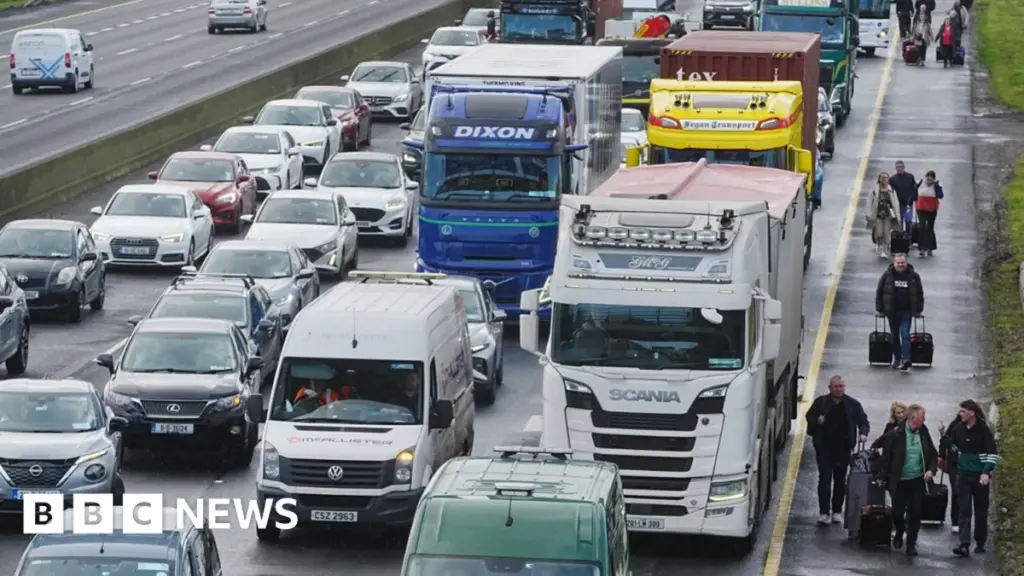
Travel across various parts of the Republic of Ireland has faced significant disruption for a consecutive fourth day. This interruption stems from ongoing fuel protests where vehicles are actively blocking roadways.
Authorities on Thursday requested military assistance to clear road blockades. The Irish police force has classified the demonstrations at fuel depots as outright “blockades.”
Protesters are employing slow-moving convoys. Their actions are a response to elevated fuel prices, which they attribute to the conflict involving the US and Iran in the Middle East.
As of Friday, the Gardaí, Ireland’s national police service, stated they are “continuing to engage extensively with those taking part in fuel protests across the country.”
Irish Minister for Agriculture, Martin Heydon, and Minister of State, Timmy Dooley, are scheduled to meet with representative bodies on Friday. Minister Dooley indicated to RTÉ, an Irish broadcaster, that invitations had been extended to these groups. He noted that who attends is their prerogative.
The Irish Minister for Justice, Jim O’Callaghan, warned of potential “legal consequences” for individuals involved in certain protest activities. He elaborated that while immediate repercussions might not occur, driving licenses could be affected.
In a statement issued on Thursday, a gardaí spokesperson announced the force was transitioning to an “enforcement phase.” This action would be taken unless individuals obstructing access to critical infrastructure decided to “desist and disperse.”
The spokesperson further highlighted that these blockades were jeopardizing supplies of essential goods, including food, fuel, clean water, and animal feed.
Fuels for Ireland reported that approximately 100 garage forecourts have experienced complete fuel stockouts. The majority of these were located in the Munster and western regions of Ireland.
Kevin McPartlin, the chief executive of Fuels for Ireland, informed RTÉ that this number could potentially quintuple by Friday evening. He also stated that fifty percent of the nation’s incoming fuel supply was being held back by the barricades.
Travel Delays Intensify
On Thursday, images emerged of people navigating Dublin’s M50 motorway on foot, carrying their luggage towards the airport, as traffic came to a complete halt. Passengers traveling to and from Dublin Airport were advised on Friday morning via a social media post to factor in additional travel time due to the ongoing protest activity.
The Irish Health Service Executive issued a plea for all access routes to medical facilities to remain unobstructed, ensuring unimpeded access for patients seeking treatment.
Speaking on Thursday, Taoiseach (Irish Prime Minister) Micheál Martin told RTÉ that the obstruction of roads and vital infrastructure constituted “not a fair form of protest.”
Irish Defence Minister Helen McEntee asserted that the actions of some protesters had “now crossing into criminal behaviour.”
Sinn Féin leader Mary Lou McDonald urged the taoiseach and tánaiste (deputy prime minister) to directly engage with the protesters by initiating contact.
Protesters’ Perspectives
Mark Maguire, a farmer from the Monaghan-Fermanagh border region and a participant in the protests, shared his concerns with BBC Radio Ulster’s Good Morning Ulster program. He explained that current fuel costs are simply not sustainable for his agricultural sector. Maguire emphasized, “There’s not one farmer in Ireland or Northern Ireland that wants to be out protesting. They have enough to do.” He specifically called for the Irish government to cease imposing fuel taxes.
Eugene Drennan, Deputy Vice President of the Irish Road Haulage Association, characterized recent “green” policies implemented by the Irish government as excessively ambitious and rapid in their introduction. Drennan confirmed that his association would not be joined by protesters during their scheduled meeting with the government on Friday. While his organization has not formally demanded an end to the protests, he expressed a desire for the blockades to cease, as they are currently “hurting people.”
Underlying Causes of the Protests
The conflict unfolding in the Middle East has directly triggered sharp price increases for both petrol and diesel fuel. Approximately twenty percent of global oil trade, the fundamental commodity for producing both petrol and diesel, has been impacted by the closure of the Strait of Hormuz.
Recent reports indicate significant price hikes for diesel in the Republic of Ireland, escalating from roughly €1.70 (£1.48) per liter to €2.17 (£1.89) on many forecourts. Furthermore, petrol prices have seen an increase of up to twenty-five cents per liter at numerous fueling stations, according to RTÉ.