
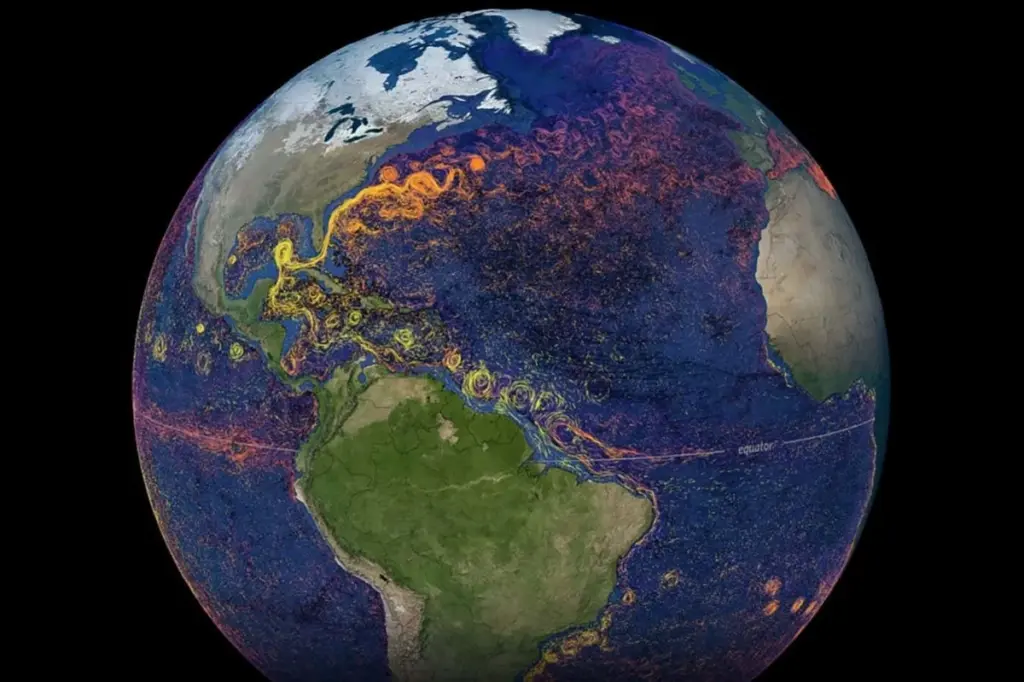
Measurements from buoys in the Atlantic Ocean indicate that the Atlantic Meridional Overturning Circulation (AMOC), a vital system responsible for moderating Europe’s climate, is progressively weakening across four distinct latitudes. This evidence represents the most substantial indication to date that this intricate network of ocean currents is decelerating and potentially approaching a critical threshold.
The AMOC functions as a crucial component of the global ocean conveyor belt. It transports warm, saline water originating from the Gulf of Mexico northward into the North Atlantic. This process significantly contributes to maintaining milder temperatures in Western Europe when contrasted with regions like Canada or Russia. Subsequently, this water cools, increases in density, and descends, initiating its southward journey along the seafloor on the western side of the Atlantic basin.
Historical analysis of ocean temperature data suggests that the AMOC has experienced a reduction in strength of approximately 15 percent since the mid-20th century. Furthermore, some computational models have projected a potential shutdown of this circulation system within the coming decades. However, direct scientific measurements of the AMOC have a relatively short history, spanning only about twenty years, which has historically limited the ability to draw definitive conclusions.
A recent investigation conducted in the western Atlantic has now provided more compelling evidence of the AMOC’s slowdown.
Qianjiang Xing, a lead author of the study from the University of Miami, Florida, stated, “The Atlantic circulation is weakening at the western boundary, and we utilize data from multiple latitudes within the basin array to confirm that such a signal originating from the western boundary is consistent throughout the wider North Atlantic.”
Methodology and Findings
In 2004, the University of Miami, in collaboration with other institutions, established a series of anchored moorings that extended from the Bahamas to the Canary Islands. This project, known as RAPID-MOCHA, has been instrumental in gathering critical data. Shane Elipot, a team member also affiliated with the University of Miami, explained that the array’s measurements of temperature, salinity, and water velocity enable scientists to estimate pressure, which he described as “how much water is effectively stacked up” on either side of the Atlantic.
Ocean water naturally flows from areas of higher pressure to areas of lower pressure. This movement is then influenced by the Earth’s counterclockwise rotation, which deflects the water flow to the right and drives the overturning circulation. Consequently, alterations in pressure serve as an indicator of changes in the AMOC’s strength.
The study’s examination of the most recent RAPID-MOCHA data reveals a decline in the AMOC’s flow rate, estimated at approximately 90,000 cubic meters of water per second annually. This observed rate of decrease is faster than previously documented. Therefore, the AMOC experienced a weakening of about 10 percent between 2004 and 2023.
However, the margin of error associated with this observed change in flow is nearly as significant as the change itself. To address this, Dr. Xing’s team also analyzed pressure variations at three mooring arrays deployed since 2004 in the western Atlantic. These arrays are located off the coasts of the West Indies, the U.S. East Coast, and Nova Scotia, Canada. This supplementary analysis revealed a more pronounced weakening of the AMOC with considerably less uncertainty.
Confirmation and Implications
Stefan Rahmstorf from the University of Potsdam, Germany, who was not involved in the research, commented, “It is the strongest direct observational evidence so far” confirming the AMOC’s weakening, a phenomenon that models have long predicted.
Current scientific hypotheses suggest that the influx of freshwater from the melting Greenland ice sheet is diluting the dense, saline water characteristic of the AMOC. This dilution potentially slows the sinking process, thereby weakening the southward flow of water along the western Atlantic seabed. The declining trend observed by the study across the four distinct latitudes in the western Atlantic strongly supports this hypothesis.
David Smeed of the UK’s National Oceanography Centre, a member of the research team, noted, “We expect to see that in the deep western boundary. It’s giving us confidence that that interpretation is correct.”
René van Westen from Utrecht University in the Netherlands, who was not part of the study, remarked, “They show for the first time I’m aware of that there is this very coherent picture of deep western overturning weakening for all different kinds of latitudes.”
According to Elipot, these findings emphasize the necessity for expanded observational efforts to better comprehend whether the AMOC is moving towards a potential collapse. Such a collapse could lead to drastically colder winters across Europe and significantly disrupt monsoon patterns in Asia and Africa. He added, “The trend would be consistent with going towards the tipping point.”