
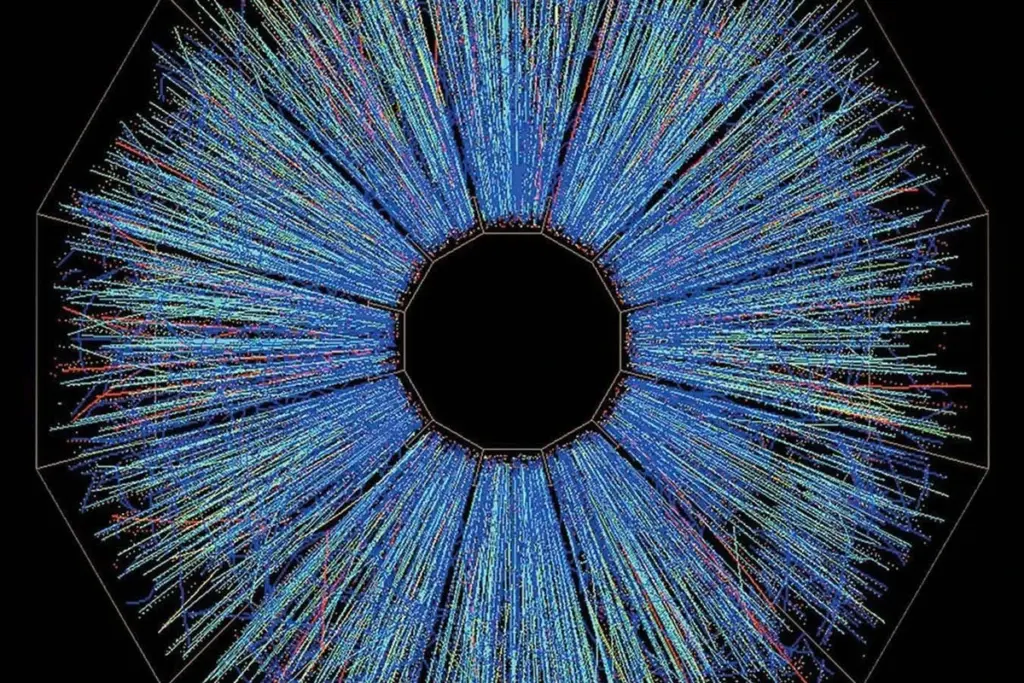
A pair of rare particles, observed in high-energy proton collisions, could provide the most compelling evidence to date that mass can originate from seemingly empty space. This discovery holds the potential to illuminate one of physics’ most enduring questions: how particles acquire their mass.
Quantum chromodynamics (QCD), widely regarded as our foremost theory of the strong nuclear force that binds quarks within protons and neutrons, posits that even a perfect vacuum is not truly devoid of activity. Instead, it is characterized by ephemeral disturbances in the fundamental energy of space. These disturbances, known as virtual particles, constantly flicker in and out of existence. Among these are pairs of quarks and antiquarks.
Under typical conditions, these transient pairs cease to exist almost immediately after their formation. However, if a significant amount of energy is introduced into a vacuum, QCD predicts that these virtual particles can transform into real, observable particles possessing measurable mass.
The STAR collaboration, an international group of physicists operating at the Relativistic Heavy Ion Collider located at Brookhaven National Laboratory in New York, has now documented this phenomenon for the first time.
The experiment involved colliding high-energy protons within a vacuum, which generated a cascade of particles. Some of these particles were expected to be quark-antiquark pairs, directly originating from the vacuum. Quarks, however, cannot exist in isolation and swiftly combine to form composite particles.
A key characteristic of these particles provided researchers with insights into their origins. Quarks and antiquarks are created with correlated spins, a shared quantum alignment inherited from their vacuum source. This link is significant.
The researchers detected that this spin correlation persists even after the quarks and antiquarks become integrated into larger particles, specifically hyperons. These hyperons decay in less than one-tenth of a nanosecond. By identifying these spin-aligned hyperons in the debris of the proton collisions, the researchers were able to confirm that the quarks contained within them originated from the vacuum.
“This marks the initial observation of the entire process,” stated Zhoudunming Tu, a participant in the STAR collaboration.
Daniel Boer from the University of Groningen in the Netherlands, who was not involved in this specific research, expressed satisfaction with the findings. He noted that numerous questions about quarks remain unanswered, such as why they cannot exist independently. “This is what makes this experiment particularly noteworthy,” he commented.
Tu suggests that this research offers a new avenue for direct investigation into the properties of the vacuum. The hope is that it will enable scientists to study the mechanisms by which particles acquire mass. The theory of QCD proposes that quarks gain a substantial portion of their mass through interactions with the vacuum itself, though the precise nature of this interaction remains obscure.
Alessandro Bacchetta of the University of Pavia in Italy cautioned that the results may not yet be entirely conclusive. He explained that reconstructing events from particle collisions can be a complex undertaking. Researchers must rigorously rule out all alternative explanations that could account for the observed signals, he added.