
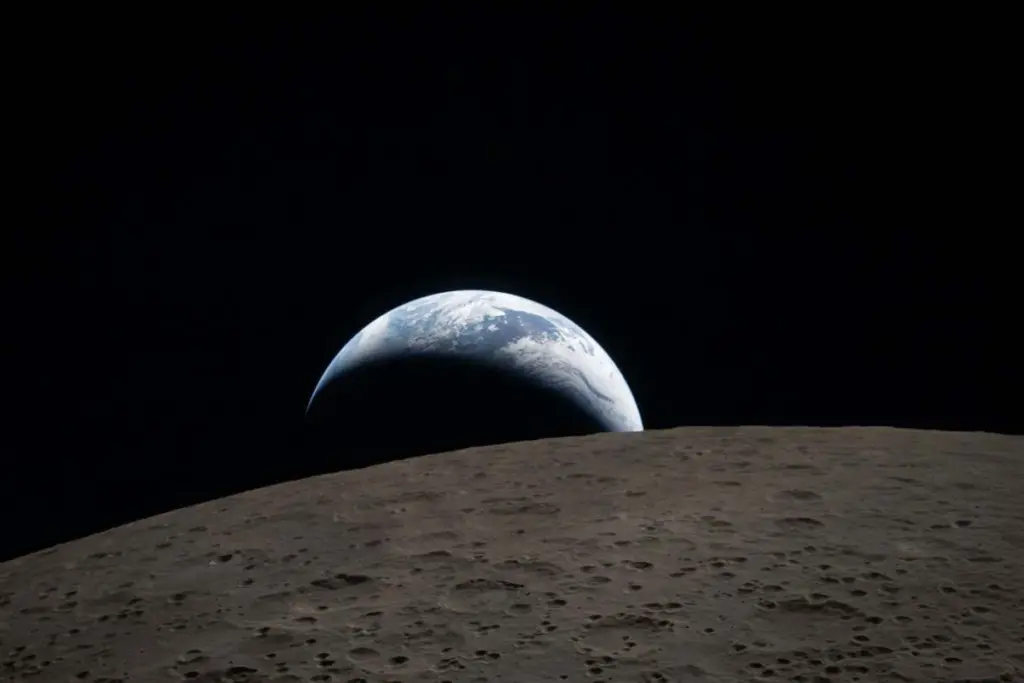
On April 6th, the astronauts of NASA’s Artemis II mission embarked on a journey that took them around the far side of the Moon. During this excursion, they traveled over 406,700 kilometers from Earth, a distance that surpasses any previous human reach into space.
The four-person crew—Reid Wiseman, Christina Koch, Victor Glover, and Jeremy Hansen—took turns observing Earth and the Moon through the Orion capsule’s windows. Sunlight reflecting off Earth’s surface, a phenomenon known as earthshine, proved so intense that one window was temporarily covered with a spare shirt.
Passing behind the Moon offered the astronauts an unprecedented view of regions previously unseen by human eyes. Among these was the Orientale basin, a vast crater. The dark central area within the crater is evidence of ancient lava flows from eruptions billions of years ago. The crew proposed new names for two smaller craters adjacent to Orientale: “Integrity,” in honor of their spacecraft, and “Carroll,” dedicated to Wiseman’s late wife.
Throughout the mission, the apparent phases of both Earth and the Moon shifted dramatically from the spacecraft’s vantage point. At one juncture, Hansen noted, “The moon is a gibbous and the Earth is a crescent.” As the Orion capsule began its orbit around the Moon’s far side, the crescent-shaped Earth descended below the lunar horizon.
Glover specifically expressed fascination with the Moon’s terminator, the boundary between lunar day and night. Along this line, sunlight strikes the surface at a shallow angle, casting elongated shadows. These shadows exaggerate the terrain’s features, revealing details that would not be apparent under direct illumination.
While traversing the far side of the Moon, direct communication with mission control on Earth was impossible. Nevertheless, the astronauts continued to document their observations through photography and voice recordings. On one occasion, they witnessed a solar eclipse that lasted nearly an hour. During this event, the Sun was completely obscured by the Moon, while the lunar hemisphere facing Earth remained illuminated by earthshine.
With their successful flyby completed, the astronauts are now en route back to Earth. Their return is anticipated on April 10th, at which point the Orion capsule is scheduled to splash down off the coast of California.