
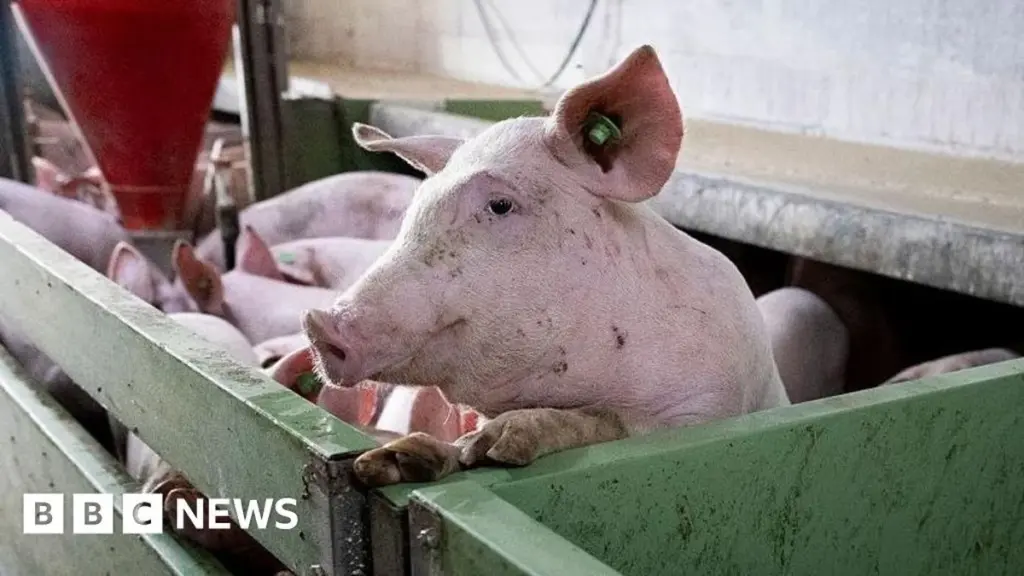
Jordi Saltiveri, tending to 8,000 pigs on his family’s farmland in Lleida, Catalonia, recalls the unsettling news of African Swine Fever (ASF) detection in Spain late last year. The farmer expressed feelings of sadness, anger, and impotence, recognizing that an ASF diagnosis in a country typically leads to import bans from other nations.
Saltiveri’s farm, a generational legacy, is situated in an isolated area. Despite the virus remaining largely contained and not yet reaching his specific location, the impact is palpable. As president of the federation of farming cooperatives in Catalonia, Saltiveri notes a significant decrease in the value of each pig sent for slaughter, estimating losses between €30 and €40 compared to pre-outbreak figures. He voiced concern over these substantial financial losses.
African Swine Fever is highly contagious and fatal for pigs and wild boars, though it poses no threat to humans. The initial outbreak was traced to Collserola Park, a natural area bordering Barcelona, approximately two hours from Saltiveri’s farm. There, the carcass of an infected wild boar was discovered in late November.
Authorities responded by promptly closing the park and restricting access, initiating efforts to locate further infected carcasses. The precise origin of the outbreak is still under investigation, with initial findings ruling out a potential leak from a nearby animal research facility. However, the large population of wild boars, some documented venturing into Barcelona’s outskirts, has been identified as a critical factor in the virus’s spread.
“Being too permissive with wild animals has led to an overpopulation of rabbits, deer, and wild boar,” stated Òscar Ordeig, Catalonia’s minister for agriculture, fisheries, and food. He highlighted wild boar as a particular concern, contributing to a significant rise in traffic accidents and disease transmission.
Ordeig estimates the wild boar population in Catalonia to range between 120,000 and 180,000. The regional government aims to halve this population, with 24,000 animals already culled this year. Rural police are prioritizing a 6km radius around the initial infection sites, considered high-risk, and have also established a 20km lower-risk zone.
The culling process employs net traps, metal box traps, and silenced firearms. Drones and cameras are utilized for monitoring the traps and animal movements. All culled boar carcasses are tested for ASF; by the end of March, 232 had tested positive. Authorities are also implementing fences to restrict wild boar movement and ensuring personnel disinfect their equipment after patrolling high-risk areas.
Ordeig emphasized the robust biosecurity measures long in place in Spain and the concerted efforts to manage the current outbreak. He stated, “We have to use all the resources available to defend our industry, our economy, our farming sector, and farmers. There is a lot at stake here.”
Following its last ASF outbreak three decades ago, Spain’s pork industry experienced substantial growth, becoming Europe’s largest with a market value of €25 billion. However, the detection of ASF has led to immediate closures of export markets. Countries including Brazil, Japan, Mexico, South Africa, and the United States have halted imports of Spanish pork. Other nations, such as China, the UK, and EU members, have adopted a more localized approach, banning only pork originating from the affected northeastern region of Spain.
The decline in international demand has not only reduced the volume of Spanish pork exports but also impacted prices, directly affecting farmers like Saltiveri. Exports from Catalonia alone dropped by 17% in January compared to the previous year. According to Unión de Uniones, a farmers’ organization, export restrictions and price decreases have resulted in over €600 million in losses for the Spanish pork industry since the crisis began.
Reinstating full export status requires a 12-month period of being disease-free after the disease has been completely eradicated. In contrast, countries like Germany have already experienced severe repercussions from ASF, with a reported 25% reduction in pork production and thousands of farm closures.
Spanish authorities are looking to Belgium’s successful eradication of ASF 14 months after its first recorded case as a model to follow. Saltiveri, who adheres to strict biosecurity protocols, remains confident in his farm’s and others’ ability to stay infection-free.
However, some within the pork industry have expressed reservations about Spain’s containment efforts. In February, after wild boar tested positive outside the initial high-risk zone, Mercolleida, a key agricultural market in Catalonia, criticized the response. They warned that the culling of boar in the Barcelona area was progressing too slowly, and stated, “Farmers across Spain are now paying the cost of ASF. Spain must not be allowed to turn into Germany.”
Despite these concerns, domestic consumption remains stable. At Sants market in central Barcelona, near the initial outbreak site, shoppers appeared reassured by the authorities’ actions. Lupe López, a pork buyer, stated, “I fully trust the safety measures that have been taken with this; they have controlled it very well. I feel quite calm about it.” Another shopper, Nati Martínez, shared similar sentiments, feeling calmer due to increased controls on pork, contrasting it with the 1990s BSE outbreak which affected humans.
José Rodríguez, a butcher at the market, reported that retail prices have remained consistent since the crisis began. He attributed any lull in sales not to swine fever but to broader economic factors like the high cost of living. He concluded that Spaniards’ appreciation for pork remains strong, noting the cultural practice of consuming the entire animal.