
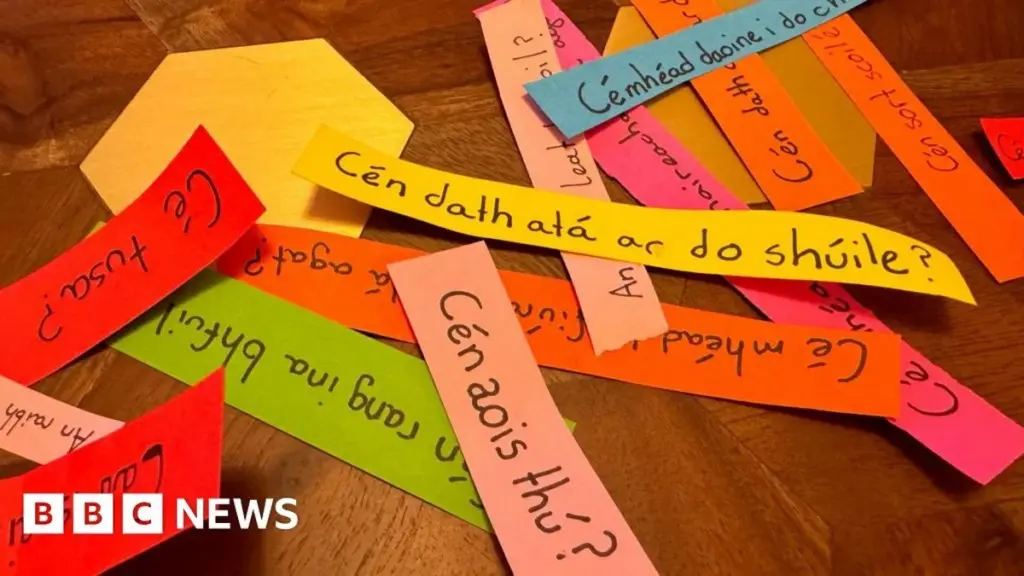
Despite a notable resurgence in the cultural sphere, with Irish language elements appearing in music, film, and even international awards ceremonies, a practical challenge persists within the Republic of Ireland. This challenge centers on the fada, the crucial accent mark over vowels that fundamentally alters pronunciation and meaning, and the growing inability of major corporations and state agencies to accommodate it.
The omission of fadas on official forms and digital platforms has become a point of significant contention. This is not merely a matter of aesthetic preference; it directly impacts the correct representation of names and, consequently, individual identity. The consequences of this oversight are far-reaching, affecting everything from official documentation to air travel, leading to widespread frustration among Irish speakers.
What is a Fada and Why Does it Matter?
A fada, an upward-pointing accent placed on vowels (á, é, í, ó, ú), is more than a stylistic flourish. It profoundly influences a word’s pronunciation and, crucially, its meaning. The distinction between “caca” (excrement) and “cáca” (cake), for example, highlights the semantic significance of this diacritical mark. This is not an abstract linguistic detail; it is a practical necessity for accurate communication.
The reluctance to embrace the fada in official contexts has prompted a deeper discussion about Ireland’s complex relationship with its native language. For Aodhán Ó Ríordáin, a Labour MEP, this issue is acutely personal. He notes that while his name is consistently spelled correctly when he provides it for international use, relying on copy-paste mechanisms, back home in Ireland, the fadas are often omitted. A recent nameplate incident, displaying “Aodhan O’Riordain” instead of the correct “Aodhán Ó Ríordáin,” exemplifies this persistent problem.
“The one country that I have a difficulty with the spelling of my name, including the fadas, is Ireland. And I find that deeply, deeply infuriating.”
Ó Ríordáin argues that the corporate sector and state agencies should be more receptive to individuals using the proper form of their names. He suggests that the island has historically maintained a “difficult relationship with the Irish language,” a sentiment echoed by historian and author Caoimhín de Barra.
A Historical Perspective on Language Revival
De Barra traces this historical disconnect back to Ireland’s establishment as an independent state in 1922. At that time, the nation’s identity was strongly tied to a perceived difference, encapsulated by a distinct language, culture, and political entity. While Irish was once spoken across the entire island, its prevalence declined significantly by the 19th century, largely supplanted by English following centuries of English influence, including the Anglo-Norman invasion, plantations, economic instability, and the Great Famine.
However, de Barra contends that the newly formed state failed to adequately support language revival efforts. “They set it up in schools and didn’t do much more than that,” he states, emphasizing that language shift is a far more intricate process. The assumption by both the government and the public that the other would spearhead the revival proved to be an ineffective strategy.
This historical “indifference,” as de Barra describes it, directly translates to contemporary issues like the fada omission. He observes that the government’s stance has often been one of passive neglect. In an increasingly interconnected, English-speaking world, this indifference, coupled with occasional hostility toward foreign languages, leads to the casual removal of accents like the fada. “If there’s an accent, it just gets left off,” he notes.
Aer Lingus and the Technology Gap
The manifestation of this “indifference” is perhaps most evident in the IT systems of prominent Irish companies, including Bank of Ireland and the national airline, Aer Lingus. Both have encountered limitations where their systems cannot process fadas in customer names. When attempting to book an Aer Lingus flight with a fada in one’s name, the response from the booking system is a stark error message: “Name may only contain letters, spaces, apostrophes, and hyphens.”
Aer Lingus has issued an apology, citing that its booking technology was developed in the 1960s. The airline stated it is “considering implementing reasonable steps to address this issue… as part of future systems development.” A comparative check of other major airlines’ booking websites, such as British Airways and KLM, revealed that these platforms do successfully accommodate names with fadas.
Legislative Efforts and the Path Forward
As interest in the Irish language grows, more individuals are opting to reclaim their ancestral names, further highlighting the need for digital and administrative systems to support them. Aengus Ó Snodaigh, Sinn Féin’s spokesperson for the Irish language, points out that names are often unique identifiers, and the state should recognize this, particularly with the ease of implementation in today’s technological landscape.
Recent legislative changes now mandate that Irish public bodies record names and addresses in full, including fadas. Ó Snodaigh advocates for extending this requirement to private companies. He has introduced a bill in the Dáil Éireann (Irish Parliament) aimed at ensuring accuracy in the use of Irish names and addresses. This proposed legislation, slated to take effect from January 1, 2030, would grant companies sufficient time to update their computer systems.
The bill would also empower individuals to file complaints with an ombudsman if public bodies fail to properly facilitate the use of fadas in their names. Ó Snodaigh acknowledges a historical “reluctance” among some state bodies to actively champion the Irish language, a sentiment that persists in certain quarters.
Ó Ríordáin encourages individuals to voice their concerns. “I think people with Irish names or a fada over a letter in their name shouldn’t be ashamed to say that ‘actually you’ve misspelt my name there.’ It’s something I’m getting a little bit better at,” he shares.
A Resurgent Interest in Learning Irish
Beyond official contexts, the Irish language is experiencing a surge in popularity. Even in Northern Ireland, where Irish has only recently been recognized as an official language, pupils of all ages are showing increased interest in learning. Data from the Department of Education in Northern Ireland indicates an almost 400% rise in pupils engaged in Irish-language education over the past 25 years.
While the majority of learners are native English speakers, teacher Alexandra Galbraith stresses that the fada should not deter newcomers. She describes the fada as an “incredibly important part of the language syntax as a whole” but asserts that Irish remains “a completely approachable language.”
“The biggest mistake I’ve seen people make is assuming they’ll pick it up as easily as they would another Latin-based language, and becoming frustrated with themselves when they aren’t as far along as they’d like to be,” Galbraith notes. She contrasts this sentiment with past perceptions of Irish as a “dying language,” stating that the current perception has clearly shifted. “It seems trendy at the minute to learn or speak Irish,” she observes.
Galbraith views teaching the language as both a “joy and a privilege,” particularly for those who may not have had prior opportunities to learn it.